Facts
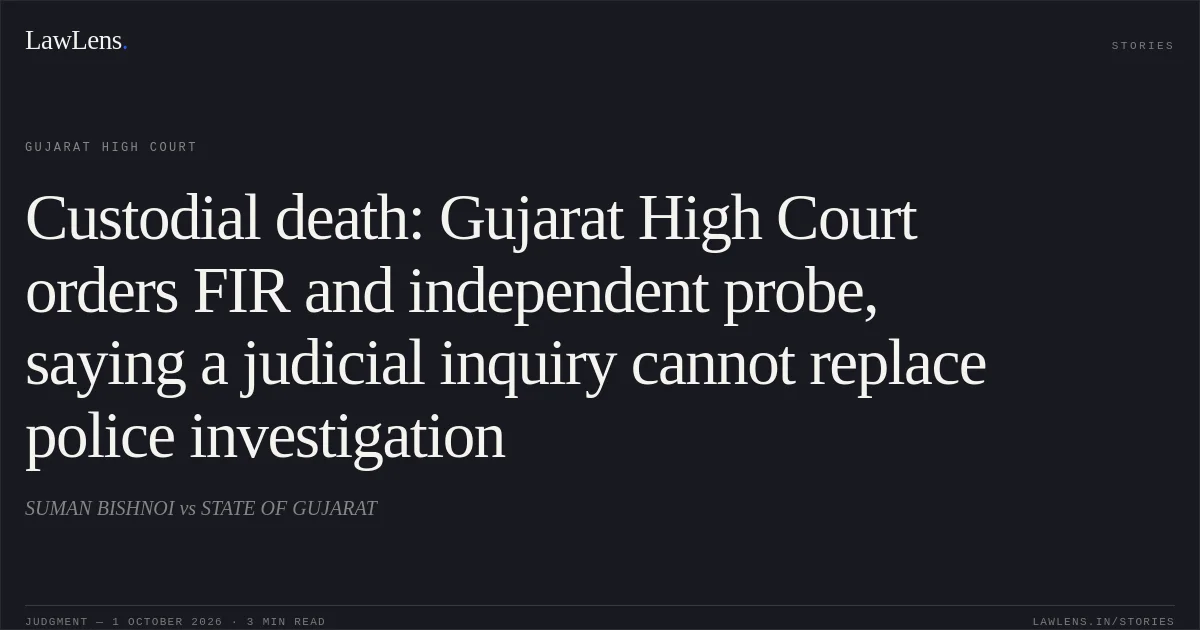
Jawri Mal Bishnoi, a Joint Director General of Foreign Trade, was arrested by the CBI on 24 March 2023 in a bribery trap and died the following morning while in CBI custody.
Source reference: para. 2.1–2.6The CBI’s account was that he jumped from a fourth-floor window; the petitioner alleged custodial mistreatment and circumstances requiring investigation.
Source reference: para. 2.1–2.6Police registered an accidental-death case and conducted an inquiry, while a judicial inquiry under Section 176 CrPC and an SIT investigation did not find CBI officers responsible for the death.
Source reference: para. 2.1–2.6The deceased’s son complained to the police and the Magistrate, seeking action against the officers, but no FIR was registered.
Source reference: para. 2.4, 2.6The petitioner therefore sought relief under Articles 226 and 482 of the Constitution and the CrPC.
Source reference: para. 4.4–4.5Issues
Whether the information and circumstances concerning the death in custody disclosed a cognizable offence requiring registration of an FIR, notwithstanding the inquiries conducted under Sections 174 and 176 CrPC.
Source reference: para. 1, 8–9, 14Whether the Court should direct FIR registration and independent investigation despite the alternative remedies ordinarily available for non-registration of an FIR and the prior inquiries.
Source reference: para. 12–14, 17Law Applied
Section 154 CrPC requires registration of an FIR where information discloses a cognizable offence, followed by investigation and a report under Section 173; an adverse or closure conclusion is for the Magistrate to consider on the investigation record.
Source reference: para. 9An inquiry under Section 174 CrPC is directed to ascertaining the apparent cause of death, while a judicial inquiry under Section 176(1-A) is additional to, and not a substitute for, a police investigation into a disclosed cognizable offence.
Source reference: para. 7–9.1Article 22(2) of the Constitution and Section 167 CrPC require an arrested person to be produced before a Magistrate within the prescribed period; the Court observed that the 24-hour limit does not entitle an agency to retain an arrested person for that entire period without production.
Source reference: para. 14Lalita Kumari v. State of Uttar Pradesh, (2014) 2 SCC 1, supports mandatory FIR registration when a cognizable offence is disclosed.
Source reference: para. 15Nilabati Behera v. State of Orissa, (1993) 2 SCC 746, recognises the State’s duty to protect the life of a person in custody.
Source reference: para. 16The Court also relied on the distinction between an inquiry and an investigation, including the definition discussed in Satender Kumar Antil v. Central Bureau of Investigation, and on the custodial-death approach in Vijayabai Vyankat Suryawanshi v. State of Maharashtra.
Source reference: para. 10–11, 13–14Reasoning
The Court considered that the post-mortem recorded multiple injuries and that the local inquiry appeared to have treated them as injuries from the fall; it also noted that the forensic report concerning a mobile-phone recording had not yet been received.
Source reference: para. 14The Court further considered the allegation that the deceased remained at the CBI office after arrest and was not produced before a Magistrate.
Source reference: para. 14These matters, viewed with the complaints concerning the custodial death, warranted investigation rather than being resolved through the limited inquiries under Sections 174 and 176 CrPC.
Source reference: para. 14The Court did not determine whether any officer committed an offence; it held that the issues should be examined through an FIR-based investigation.
Source reference: para. 14, 17To address concerns about fairness and independence, it directed that the FIR be registered against an unknown person.
Source reference: para. 14, 17Holding
The Court held that the prior police and judicial inquiries did not bar an investigation into a cognizable offence disclosed by the custodial-death circumstances.
It directed registration of an FIR against an unknown person and ordered that the investigation be conducted under the supervision of the DIG, CID Crime.
Source reference: para. 17The investigation was to be concluded and an appropriate report forwarded to the Registry within three months; the petition was disposed of accordingly.
Source reference: para. 17Acts & Sections Cited
16 provisions across 4 statutes referred to in this judgment. Each provision opens on LawLens.
Prevention of Corruption Act, 19881
Code of Criminal Procedure, 1973
Indian Penal Code, 18603
Bharatiya Nagarik Suraksha Sanhita, 20232
Original Court PDF
SUMAN BISHNOIvsSTATE OF GUJARAT
Click to open original judgment
Original judgment, available to read, download and summarize on LawLens.in