Facts
The applicant, a police official, filed a third bail application under Section 483 of the Bharatiya Nagarik Suraksha Sanhita, 2023, regarding the custodial death of 53-year-old Rajkali Kewat.
Source reference: p. 1The deceased was brought to Civil Lines Police Station, Rewa, on October 30, 2023, on suspicion of theft.
Source reference: p. 1The prosecution alleges that the applicant and other officers subjected the deceased to brutal physical assault, including electric shocks and blows with plastic pipes, to extract a confession.
Source reference: p. 1-2The post-mortem report recorded 27 injuries, attributing death to shock and hemorrhage from homicidal violence.
Source reference: p. 2A judicial inquiry and CCTV footage corroborated that the deceased was physically fit upon arrival but was tortured in custody.
Source reference: p. 2The applicant has been in custody since January 23, 2025, following the dismissal of two prior bail applications.
Source reference: p. 1Issues
1. Whether the applicant is entitled to regular bail considering the period of incarceration and the fact that co-accused persons were granted bail.
Source reference: p. 2 / para. 32. Whether the nature and heinousness of a custodial death outweigh the personal liberty of the accused in a bail plea.
Source reference: p. 3 / para. 5-6Law Applied
The Court applied Sections 302, 330, and 331 read with Section 34 of the IPC regarding murder and voluntarily causing hurt to extort a confession.
Source reference: p. 1It relied on the constitutional mandate of Article 21 (Right to Life) and Article 22(1) as interpreted in D.K. Basu v. State of W.B. (1997), which identifies custodial death as a "worst crime" in a civilized society.
Source reference: p. 4It further applied principles from Shakila Abdul Gafar Khan v. Vasant Raghunath Dhoble (2003) and Munshi Singh Gautam v. State M.P. (2005), which emphasize that courts must treat custodial torture with extreme sensitivity to prevent the "protector becoming the predator" and to maintain public faith in the judiciary.
Source reference: p. 4-5Reasoning
The Court rejected the applicant’s contention that the deceased died due to prior injuries inflicted by her employers, noting that witnesses and medical evidence indicated she was fit when entering police custody.
Source reference: p. 2The Court observed that while the applicant sought parity with co-accused who were granted bail, those individuals had distinct grounds such as ailment or femininity.
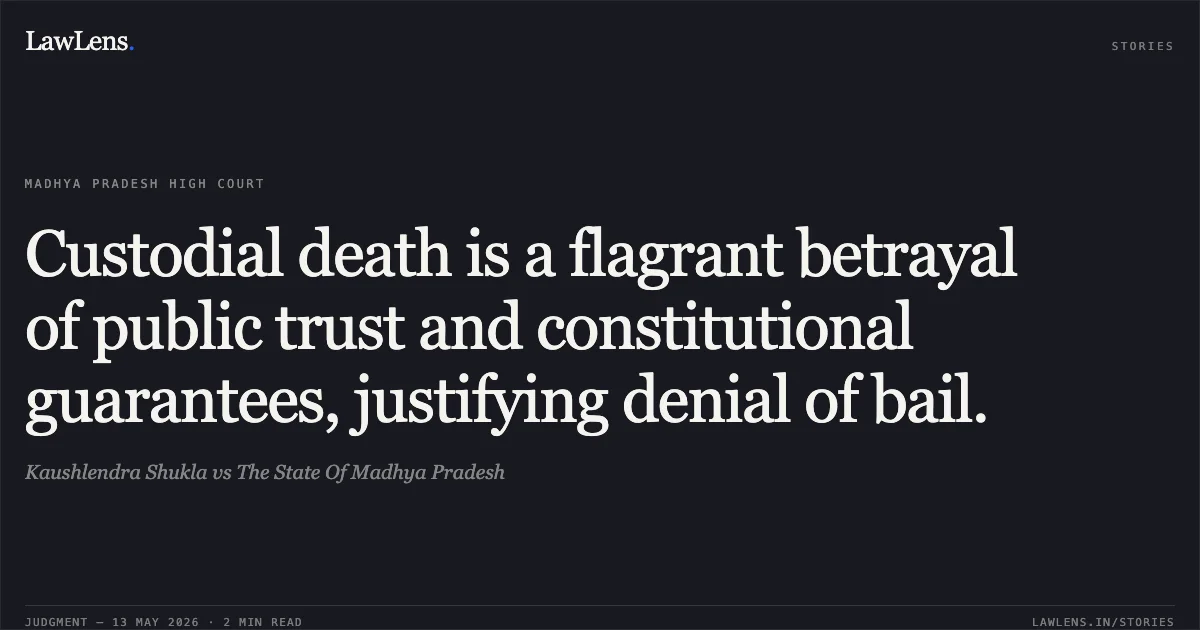
Source reference: p. 3The Court reasoned that custodial death is a betrayal of public trust and a breakdown of constitutional machinery.
Source reference: p. 3-4Applying the D.K. Basu precedent, the Court held that the "precious right guaranteed by Article 21" cannot be suspended upon arrest, and police excesses tarnish the image of the nation.
Source reference: p. 4-5Given the "barbarity of torture" (27 injuries) and the findings of the Judicial Magistrate, the Court determined that the seriousness of the offence superseded the duration of the applicant’s detention.
Source reference: p. 3, 6Holding
The Court answered the issues in the negative, holding that the heinous nature of custodial death and the specific evidence against the applicant precluded the grant of bail.
The application was dismissed.
Source reference: p. 6Acts & Sections Cited
5 provisions across 2 statutes referred to in this judgment. Each provision opens on LawLens.
Bharatiya Nagarik Suraksha Sanhita, 20231
Indian Penal Code, 18604
Original Court PDF
Kaushlendra ShuklavsThe State Of Madhya Pradesh
Click to open original judgment
Original judgment, available to read, download and summarize on LawLens.in