Facts
The applicants (original accused) were convicted by the 4th Additional Senior Civil Judge and JMFC, Palanpur, in Criminal Case No. 59 of 1990 for offences under Sections 7 and 16 of the Prevention of Food Adulteration Act ("PFA Act").
Source reference: p. 1-2The trial court sentenced them to one year of simple imprisonment and a fine of Rs. 1,000 each.
Source reference: p. 2This conviction arose from a sample of 375 ml of palmolein oil purchased by the Food Inspector (Respondent No. 2), which was found to be sub-standard.
Source reference: p. 2-3The applicants challenged the conviction on the grounds of procedural irregularities in sampling and sealing.
Source reference: p. 2The 3rd Additional Sessions Judge, Banaskantha, dismissed their appeal (Criminal Appeal No. 5 of 2006) on 03.12.2010, confirming the trial court's order.
Source reference: p. 2Issues
1. Whether the conviction and sentence under the Prevention of Food Adulteration Act should be maintained given the alleged procedural lapses in the collection and sealing of samples.
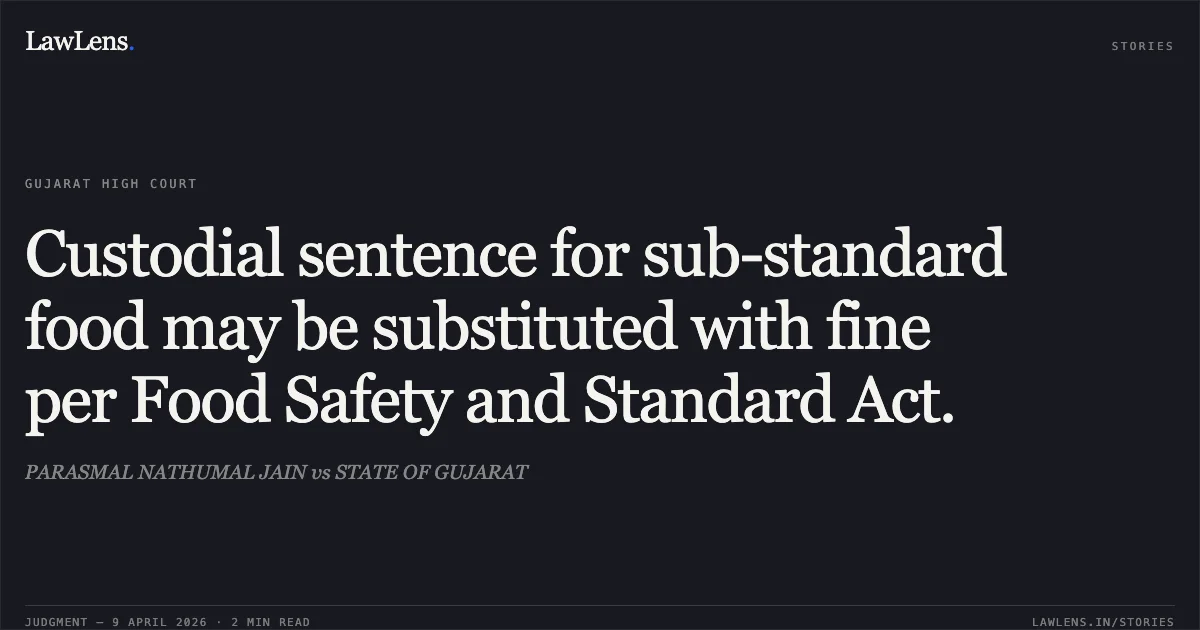
Source reference: p. 22. Whether the sentence of imprisonment can be modified to a fine only, in light of the subsequent enactment of the Food Safety and Standard Act, 2006, regarding sub-standard food items.
Source reference: p. 3Law Applied
The court considered Sections 7 and 16 of the Prevention of Food Adulteration Act, 1954, which governed the original conviction.
Source reference: p. 3The court primarily applied the principles underlying Sections 51 and 52 of the Food Safety and Standard Act, 2006, which provide for penalties in the form of fines rather than imprisonment for "sub-standard" food.
Source reference: p. 3The court relied on the precedents of Nemi Chand v. State of Rajasthan (2018) 17 SCC 448 and Triloki Chand v. State of Himachal Pradesh (2020) 10 SCC 763, which established that in cases involving sub-standard articles, the sentence may be restricted to a fine.
Source reference: p. 3-4Reasoning
The Court observed that the primary allegation against the applicants pertained to the "sub-standardization" of the palmolein oil rather than its being unsafe for consumption.
Source reference: p. 3While the applicants raised several merits-based arguments regarding the sampling procedure at Exhibit 41, the Court focused on the legislative shift between the PFA Act and the Food Safety and Standard Act, 2006.
Source reference: p. 2-3The Court reasoned that since the modern regulatory framework (Sections 51 and 52 of the 2006 Act) contemplates only monetary penalties for sub-standard goods, a lenient view was warranted.
Source reference: p. 3By applying the ratios of Nemi Chand and Triloki Chand, the Court determined that the ends of justice would be met by substituting the substantive sentence of one-year imprisonment with an enhanced fine, thereby maintaining the conviction but modifying the quantum of punishment.
Source reference: p. 4Holding
The High Court partly allowed the revision application and upheld the judgment of conviction passed by the trial court and confirmed by the Sessions Court.
The Court modified the order of sentence, replacing the one-year simple imprisonment with a fine of Rs. 5,000 for each accused.
Source reference: p. 4The Court directed that any fine previously deposited be adjusted against this amount and ordered the discharge of the applicants' surety bonds.
Source reference: p. 4-5Acts & Sections Cited
4 provisions across 2 statutes referred to in this judgment. Each provision opens on LawLens.
Code of Criminal Procedure, 19732
Food Safety and Standards Act, 20062
Original Court PDF
PARASMAL NATHUMAL JAINvsSTATE OF GUJARAT
Click to open original judgment
Original judgment, available to read, download and summarize on LawLens.in