Facts
The applicant, Shaza Hamid, is the divorced daughter of Late Abdul Hamid, a former employee of the Field Gun Factory who died on August 13, 2021
Source reference: p. 1-2The applicant's marriage, solemnized in 2012, was dissolved on September 8, 2016, through Khulanama (divorce by mutual consent/at the instance of the wife) under Muslim Personal Law
Source reference: p. 2This divorce was supported by a Fatwa from Darul Qaza, a Divorce Certificate from the Qazi-e-Shahr, and was further recognized by the Hon’ble High Court in an order dated October 4, 2016, which quashed related criminal proceedings
Source reference: p. 2Following her father’s death, the applicant applied for a family pension.
Source reference: p. 2The respondents refused the claim, issuing a letter dated January 15, 2024, insisting that the applicant produce a divorce decree from a competent civil court, citing CCS (Pension) Rules, 1972, and an Office Memorandum (OM) dated July 19, 2017
Source reference: p. 2, 4-5Issues
1. Whether a divorced daughter is eligible for family pension under Rule 54(6) of the CCS (Pension) Rules, 1972, based on a valid customary divorce (Khula) recognized under Muslim Personal Law
Source reference: p. 72. Whether the respondents are justified in insisting upon a divorce decree from a competent court as a mandatory prerequisite for granting family pension
Source reference: p. 7-8Law Applied
The court primarily applied Rule 54(6)(iii) of the Central Civil Services (Pension) Rules, 1972, which extends family pension eligibility to "divorced daughters" without prescribing a specific mode of divorce
Source reference: p. 5-7It relied on Paras 319 and 320 of Mulla's Principles of Mahomedan Law, which recognize Khula as an irrevocable form of divorce
Source reference: p. 3The Tribunal further applied the principle from Union of India v. Mayuriben Jani (Gujarat High Court) and Najmaben Umarbhai Kureshi v. Union of India (CAT Ahmedabad), which established that when customary divorce is legally recognized under personal law, administrative guidelines cannot impose additional requirements—such as a court decree—that are not found in the statutory rules
Source reference: p. 7-9Reasoning
The Tribunal observed that Rule 54(6) does not qualify the term "divorced daughter" with any requirement for a judicial decree
Source reference: p. 7Since Khula is an established and valid mode of dissolution of marriage under Muslim Personal Law (Shariat) Application Act, 1937, it must be treated as a valid divorce for pensionary benefits
Source reference: p. 2-3The Tribunal noted that the applicant's divorce occurred during her father's lifetime, fulfilling the dependency criteria
Source reference: p. 2Relying on the Mayuriben Jani precedent, the Tribunal reasoned that OMs are merely "facilitating tools" to assess eligibility and cannot override the benevolent nature of the Pension Rules or the validity of customary law recognized by the state
Source reference: p. 8As the factum of divorce was undisputed and previously recognized by the High Court, the respondents’ insistence on a court decree was deemed a non-application of mind and an unnecessary hurdle to a beneficial provision
Source reference: p. 3, 9Holding
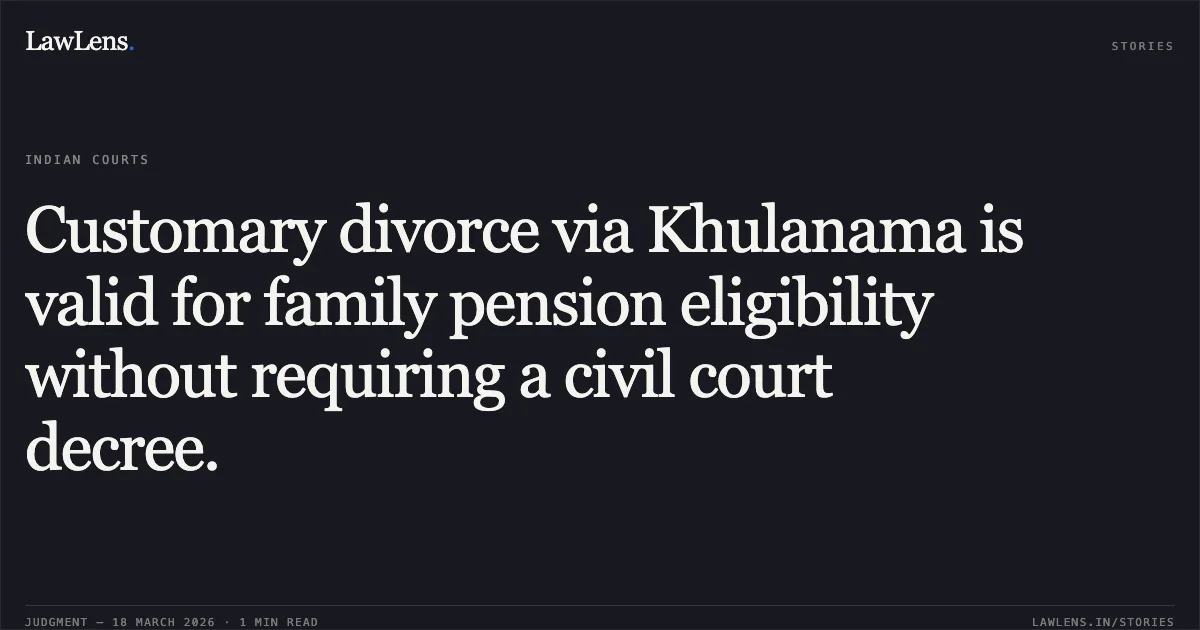
The Tribunal allowed the Original Application, holding that a valid customary divorce (Khula) is sufficient to establish eligibility for a family pension under Rule 54 of the CCS (Pension) Rules
The respondents were directed to process the applicant’s claim based on the submitted Khulanama and Divorce Certificate. The Tribunal ordered the grant of family pension from the due date along with interest on arrears at the prevailing bank rate, to be complied with within three months
Source reference: p. 9Acts & Sections Cited
4 provisions across 4 statutes referred to in this judgment. Each provision opens on LawLens.
Hindu Marriage Act, 19551
Administrative Tribunals Act, 19851
Dissolution of Muslim Marriages Act, 19391
Muslim Personal Law (Shariat) Application Act, 19371
Original Court PDF
SHAZA HAMIDvsField Gun Factory
Click to open original judgment
Original judgment, available to read, download and summarize on LawLens.in


