Facts
The plaintiff, Bhindro, sought a declaration that defendant No. 1, Kaunto, was not the legally entitled heir of deceased Shiridhar because Shiridhar had divorced her through a Talaknama dated 21 May 1976, after which she allegedly married Shiv Ram and defendant No. 2 was born from that marriage.
Source reference: para. 2The plaintiff further claimed ownership and possession of the suit land under Shiridhar’s registered Will dated 11 September 1997 and sought cancellation of revenue mutations attested in favour of the defendants, along with permanent injunction.
Source reference: para. 2The defendants denied the alleged divorce, contending that the parties were governed by the Hindu Marriage Act, 1955, that no customary divorce had been pleaded or proved, and that the Will was not genuine.
Source reference: para. 3The trial Court held that the alleged divorce deed was invalid, the plaintiff had failed to prove the alleged subsequent marriage and parentage of defendant No. 2, and the Will was surrounded by suspicious circumstances; it consequently dismissed both the suit and the counterclaim.
Source reference: para. 7On appeal, the District Judge held that defendant No. 1 was not proved to be Shiridhar’s legally wedded wife, accepted the execution of the Will, and decreed the plaintiff’s suit.
Source reference: para. 8The defendants thereafter filed the present second appeal, which was admitted on three substantial questions of law concerning the customary divorce deed, the relief granted on the basis of the pleadings and admissions, and the validity of the Will.
Source reference: para. 9Issues
1. Whether the Talaknama dated 21 May 1976 constituted a valid divorce when the parties were Hindus governed by the Hindu Marriage Act, 1955, in the absence of a pleaded and proved custom permitting such divorce?
Source reference: para. 9; paras. 14–172. Whether the First Appellate Court could grant relief on the basis of the defendant’s pleadings and admissions, notwithstanding the absence of an expressly pleaded alternative case by the plaintiff?
Source reference: para. 9; paras. 18–203. Whether the registered Will dated 11 September 1997 was duly executed and proved in accordance with law, despite the alleged suspicious circumstances and the objections under Section 63 of the Indian Succession Act, 1925?
Source reference: para. 9; paras. 21–42Law Applied
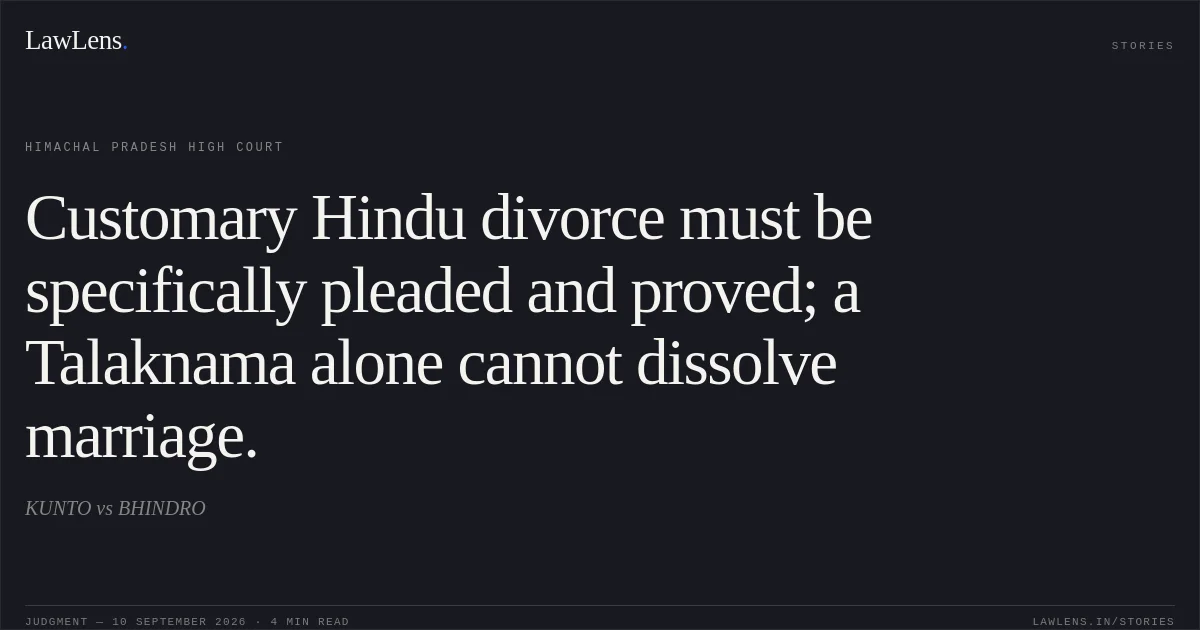
The Court applied Sections 11, 13 and 29(2) of the Hindu Marriage Act, 1955, holding that a Hindu marriage may be dissolved only in accordance with the statutory scheme or a custom specifically recognised and preserved by law; any customary divorce must be specifically pleaded and proved.
Source reference: paras. 14–17Relying on Yamanaji H. Jadhav v. Nirmala, Subramani v. M. Chandralekha and Sanjana Kumari v. Vijay Kumar, the Court held that a divorce deed by itself cannot terminate a Hindu marriage unless the underlying custom is established.
Source reference: paras. 14–16Under Srinivas Ram Kumar v. Mahabir Prasad, a Court may grant relief on an alternative case expressly admitted and relied upon by the defendant where no prejudice is caused.
Source reference: paras. 18–19The validity of the Will was governed by Section 63 of the Indian Succession Act, 1925 and Section 68 of the Evidence Act, 1872: the testator must execute the Will and it must be attested by at least two witnesses, with at least one attesting witness proving due execution.
Source reference: paras. 23–26The principles in H. Venkatachala Iyengar v. B.N. Thimmajamma, Meena Pradhan v. Kamla Pradhan and Gurdial Singh v. Jagir Kaur require the propounder to dispel legitimate, real and inherent suspicious circumstances.
Source reference: paras. 23–26Finally, under Section 100 CPC, the High Court in second appeal cannot reappreciate findings of fact unless they are perverse, based on no evidence, or legally unsustainable.
Source reference: paras. 37–42Reasoning
The Court held that the plaintiff had neither pleaded nor proved any community custom permitting divorce through a Talaknama. Consequently, the document dated 21 May 1976 did not sever the marital relationship between Shiridhar and defendant No. 1 under Hindu law.
Source reference: paras. 14–17Nevertheless, the First Appellate Court was entitled to consider defendant No. 1’s own admission that another woman, Begmu, was Shiridhar’s wife; the status of the defendants as Shiridhar’s legal heirs had also been directly put in issue, so the appellate finding did not travel beyond the pleadings or issues.
Source reference: paras. 18–20As to the Will, the evidence of the scribe and attesting witness established that the Will was read over and explained to Shiridhar, that he signed it, and that the witnesses thereafter signed in his presence.
Source reference: paras. 27–36The alleged omission of Shiridhar’s wife’s name and the plaintiff’s presence at the time of execution did not constitute inherent or legitimate suspicious circumstances.
Source reference: paras. 27–36The Court also noted that the defendants had not specifically pleaded the alleged suspicious circumstances and that the First Appellate Court’s finding regarding due execution was a finding of fact supported by evidence.
Source reference: paras. 27–36, 41–42In the absence of perversity, the High Court could not interfere with that finding in second appeal.
Source reference: paras. 41–42The unraised plea regarding the legitimacy of defendant No. 2 under Section 16 of the Hindu Marriage Act could not be adjudicated because the High Court’s jurisdiction was confined to the substantial questions of law framed under Section 100 CPC.
Source reference: paras. 43–45Holding
The High Court answered the first substantial question by holding that the Talaknama was ineffective because no customary divorce had been pleaded or proved.
It upheld the First Appellate Court’s authority to rely on the defendant’s admissions and to find that defendant No. 1 was not proved to be Shiridhar’s legally wedded wife.
Source reference: paras. 18–20It further upheld the finding that Shiridhar’s registered Will was duly executed and proved and that no legally sufficient suspicious circumstance justified its rejection.
Source reference: paras. 32–42The defendants’ second appeal was dismissed, the appellate decree in favour of the plaintiff was maintained, and the pending applications, if any, were also dismissed.
Source reference: paras. 46–48Acts & Sections Cited
9 provisions across 5 statutes referred to in this judgment. Each provision opens on LawLens.
Hindu Marriage Act, 19554
Indian Succession Act, 19251
Indian Contract Act, 18721
Transfer of Property Act, 18821
Code of Civil Procedure, 19082
Original Court PDF
KUNTOvsBHINDRO
Click to open original judgment
Original judgment, available to read, download and summarize on LawLens.in