Facts
The petitioner initiated contempt proceedings under Section 12 of the Contempt of Courts Act, 1971, alleging wilful disobedience of the Delhi High Court’s order dated 17 March 2021 in W.P.(C) 3829/2020.
Source reference: p.1The parties had entered into a Settlement Agreement dated 11 February 2021. Under Clause 4, the respondent was required to provide certain apostilled or attested documents and, upon receipt of the first instalment of ₹3,36,000/-, dispatch the original documents to the petitioner through courier and share proof of dispatch within two days.
Source reference: pp.2–3The writ petition was disposed of in terms of the Settlement Agreement after the respondent undertook to abide by its terms, and that undertaking was accepted and recorded by the Court.
Source reference: pp.1–2The petitioner submitted that, after inspecting the documents, he paid the first instalment after deduction of applicable TDS, but the respondent failed to dispatch the original documents.
Source reference: pp.3–4Despite having appeared earlier in the contempt proceedings, the respondent failed to appear on the subsequent dates and the matter was heard ex parte.
Source reference: p.4Issues
Whether the respondent wilfully disobeyed the order dated 17 March 2021 by failing to perform his obligations under the Settlement Agreement after receiving the first instalment.
Source reference: pp.3–5Whether the respondent’s failure to participate in the contempt proceedings, coupled with the absence of any dispute regarding the Settlement Agreement or his obligations, established contempt of court.
Source reference: pp.4–5Law Applied
The Court applied Section 12 of the Contempt of Courts Act, 1971, which empowers the Court to punish contempt, read with Section 2(b), which defines civil contempt as wilful disobedience of a judgment, decree, direction, order, writ or other process of a court, or wilful breach of an undertaking given to a court.
Source reference: p.1; p.4The Court also applied the principle that terms of a settlement incorporated into a judicial order, together with an undertaking expressly accepted and recorded by the Court, are enforceable in contempt jurisdiction where non-compliance is deliberate and relates to a specific obligation.
Source reference: pp.1–2, p.4No judicial precedent was cited in the judgment.
Source reference: no citationReasoning
The Court found the Settlement Agreement to be clear and unambiguous, with specific obligations requiring the respondent to dispatch the original documents after receiving the first instalment.
Source reference: p.4The petitioner’s payment of the agreed instalment demonstrated performance of the condition precedent and the respondent’s acceptance of the settlement terms.
Source reference: p.5The respondent nevertheless failed to dispatch the documents or provide proof of courier, thereby breaching an obligation that had formed the basis of the order dated 17 March 2021 and his undertaking to the Court.
Source reference: pp.4–5The respondent’s prolonged non-appearance and the absence of any material disputing the settlement or the obligation further supported the inference that the disobedience was wilful and deliberate.
Source reference: p.5Holding
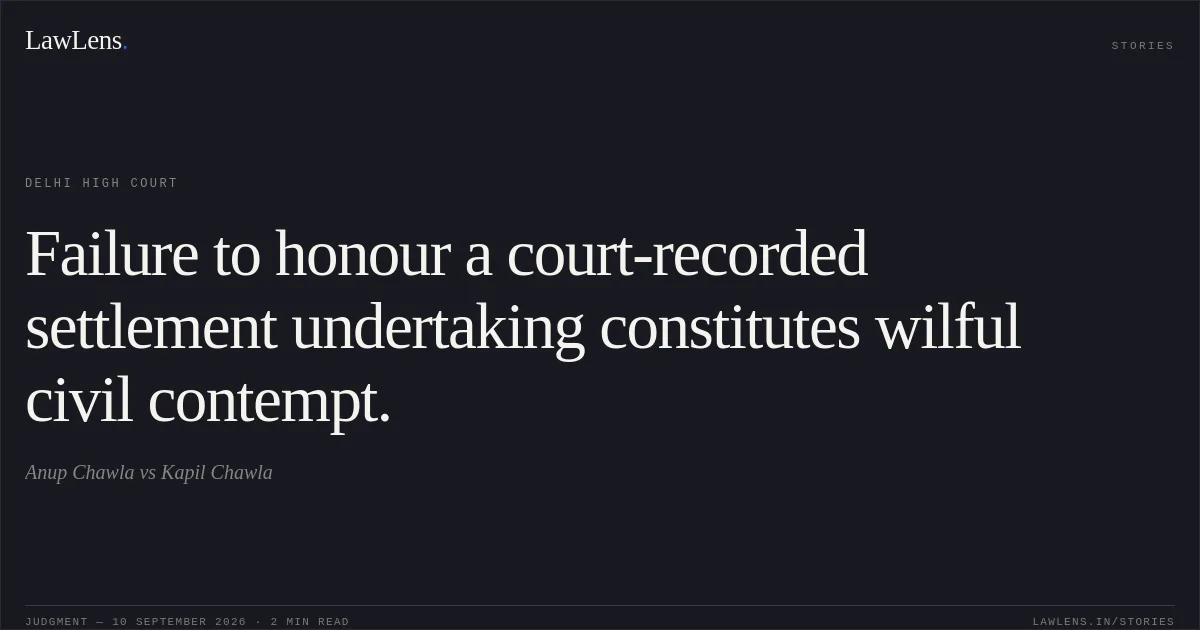
The Court held that the respondent had wilfully and deliberately disobeyed the order dated 17 March 2021 and was guilty of contempt of court under the Contempt of Courts Act, 1971.
The contempt petition was allowed.
Source reference: p.5The matter was listed for sentencing on 30 October 2026, and the respondent, Kapil Chawla, was directed to remain physically present before the Court on that date.
Source reference: p.5Acts & Sections Cited
2 provisions across 1 statute referred to in this judgment. Each provision opens on LawLens.
Contempt of Courts Act, 19712
Original Court PDF
Anup ChawlavsKapil Chawla
Click to open original judgment
Original judgment, available to read, download and summarize on LawLens.in