Facts
M/s Prakruthi Traders imported a consignment declared as roasted areca-nut splits under Bill of Entry dated 21.01.2026 and classified under CTH 2008 19 91.
Source reference: p.2, para. 1Although the goods were subjected to examination and testing, they were neither assessed nor released, and no seizure memo was issued.
Source reference: p.2, para. 1The importer therefore filed a writ petition seeking assessment and clearance.
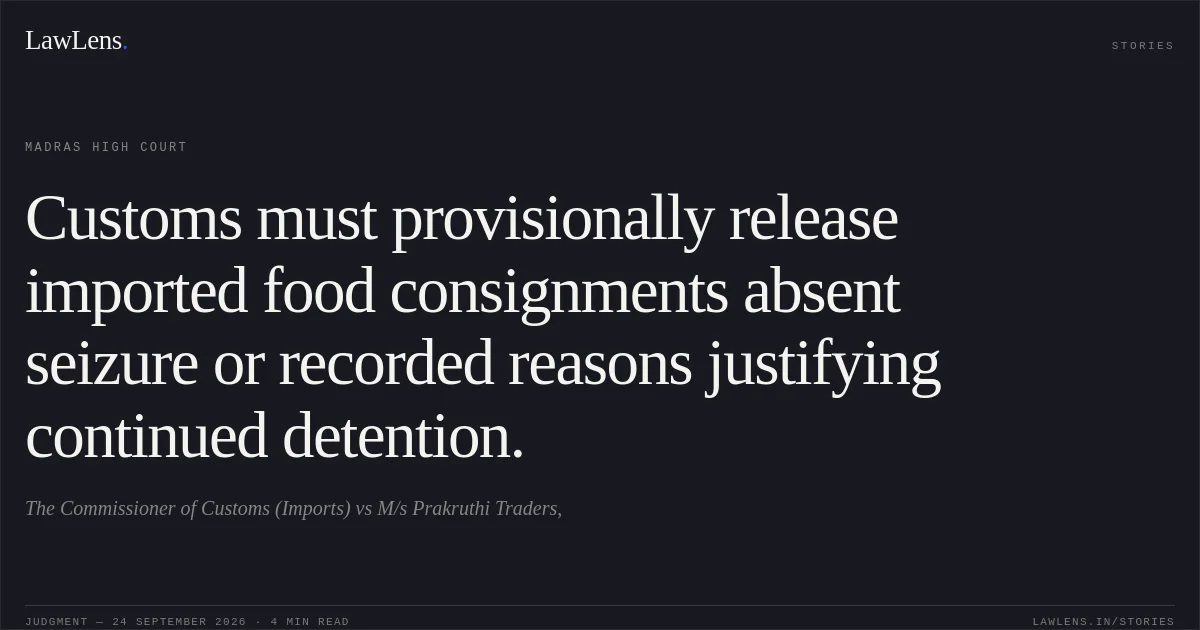
Source reference: p.2, para. 2The Writ Court directed provisional release of the goods and directed the authorities to proceed with assessment under Section 28 of the Customs Act, 1962.
Source reference: p.2, para. 2The Customs Department challenged that order, contending that release should not have been ordered before adjudication because the first test report allegedly found the goods unfit for human consumption.
Source reference: p.2, para. 3It also argued that the indemnity bond should cover more than the full value of the goods.
Source reference: p.2, para. 4The importer relied on a subsequent test report, obtained after sampling by an authorised officer under the Food Safety and Standards Act, 2006, which confirmed conformity with applicable standards.
Source reference: pp. 2–3, para. 5Both reports recorded moisture content below 10%, and the importer relied on AAR rulings concerning the classification of areca nuts.
Source reference: pp. 2–3, para. 6Issues
Whether the Customs authorities could continue to retain the imported consignment and resist provisional release in the absence of a seizure memo or recorded reasons showing that the goods were liable to confiscation under Section 110 of the Customs Act, 1962?
Source reference: p.4, paras. 8–10Whether the first test report, based on samples drawn by a Customs officer, could justify continued retention of an edible consignment when the Food Safety and Standards (Import) Regulations, 2017 contemplated sampling by an authorised officer under the Food Safety and Standards Act, 2006?
Source reference: pp. 4–5, paras. 11–14Whether the Writ Court was justified in directing provisional release before completion of assessment and adjudication, subject to appropriate security for differential duty or penalty?
Source reference: pp. 5–7, paras. 15–21Whether the moisture content and applicable AAR rulings prima facie supported the importer’s declared classification and undermined the Customs Department’s objection to release?
Source reference: p.6, paras. 18–19Law Applied
The Court applied Section 110 of the Customs Act, 1962, which requires justification for seizure and proceeds on the basis that reasons must exist to show that goods are liable to confiscation before their continued detention can be justified.
Source reference: p.4, para. 9Section 144 of the Act empowers the proper Customs officer to draw samples for examination, testing or valuation; however, in the case of food or edible consignments, that power must be read with the Food Safety and Standards Act, 2006 and Regulations 5 and 10 of the Food Safety and Standards (Import) Regulations, 2017, under which samples are to be drawn by an authorised Food Safety officer, in the presence of Customs and the importer.
Source reference: pp. 4–5, paras. 11–13The Court also relied on the Division Bench decision in W.A. Nos. 3647 and 3648 of 2024, affirmed by the Supreme Court in SLP (C) Nos. 17655–17656 of 2025, which supported provisional release of roasted areca-nut consignments in comparable circumstances.
Source reference: p.5, para. 15The AAR rulings in Neena Enterprises and Universal Impex established that areca nuts with moisture content between 10% and 15% could be treated as raw areca nuts, whereas consignments with moisture content below that range would not prima facie fall within that category.
Source reference: p.6, paras. 18–19Reasoning
The Court found that the goods had remained uncleared from January 2026 without seizure and that the Customs Department had not disclosed, either in a seizure memo or in its counter-affidavit, any specific reason justifying their continued retention.
Source reference: pp. 3–4, paras. 8–10, 17The first test report was disregarded because the samples had been drawn by a Customs officer rather than by an authorised officer under the FSS Act and the 2017 Regulations.
Source reference: pp. 4–5, para. 13The subsequent report, based on proper sampling and issued by an accredited agency, confirmed conformity with applicable standards and therefore superseded the earlier report for the purposes of the appeal.
Source reference: pp. 4–5, para. 14Further, both reports recorded moisture content below 6%, which was materially below the 10%–15% range identified in the AAR rulings for classification as raw areca nut.
Source reference: p.6, para. 18This created a prima facie basis for the importer’s declared classification and weakened the justification for continued detention.
Source reference: p.6, para. 19Applying the earlier Division Bench precedent, the Court held that provisional release could be ordered even though assessment and adjudication remained pending, while preserving the Customs authority’s power to seek a personal bond for differential duty or penalty and to determine classification in accordance with law.
Source reference: pp. 6–7, paras. 20–21Holding
The Division Bench dismissed the Customs Department’s writ appeal and the connected miscellaneous petition, with no order as to costs.
It upheld the direction for provisional release of the consignment, leaving the Customs authorities at liberty to require a personal bond for any differential duty or penalty.
Source reference: p.7, paras. 20–22The Court further directed that assessment and adjudication commence immediately, while clarifying that the observations on classification and testing were prima facie and would not bind the adjudicating authority in the final assessment proceedings.
Source reference: p.7, paras. 20–22Acts & Sections Cited
3 provisions across 1 statute referred to in this judgment. Each provision opens on LawLens.
Customs Act,19623
Original Court PDF
The Commissioner of Customs (Imports)vsM/s Prakruthi Traders,
Click to open original judgment
Original judgment, available to read, download and summarize on LawLens.in