Facts
The Petitioner, an importer of components used in manufacturing mobile phones, faced two Show Cause Notices dated 21 September 2023 concerning alleged wrongful availment of customs exemptions, incorrect classification, and non-payment of differential customs duty.
Source reference: paras. 4–5After its initial settlement applications were not admitted, the Petitioner filed fresh applications under Section 127B of the Customs Act, 1962, which were admitted and subsequently transferred to the Interim Board for Settlement-I following the statutory amendments effective from 29 March 2025.
Source reference: paras. 6–7The applications were heard jointly on 22 August 2025, after which the matters were reserved for orders; the Petitioner also filed the additional written submissions sought by the Board.
Source reference: para. 8One Member of the Interim Board retired on 30 September 2025, causing the Board to lose its quorum and become incapable of proceeding from 1 October 2025.
Source reference: para. 9The Board later acknowledged that the applications remained pending “for want of quorum since 01.10.2025”.
Source reference: para. 10Nevertheless, by communications dated 17 April 2026, the Board treated the settlement proceedings as abated with effect from 8 April 2026 under Section 127C(8A), read with Section 127C(12), and permitted the adjudicating authorities to proceed with the Show Cause Notices.
Source reference: para. 11The Petitioner challenged those communications and sought exclusion of the period during which the Board lacked quorum.
Source reference: paras. 1–2, 12Issues
1. Whether settlement proceedings under Chapter XIVA of the Customs Act automatically abate under Section 127C(8A), read with Section 127C(12), when the Interim Board is legally incapable of passing an order because it lacks the requisite quorum?
Source reference: paras. 15, 202. Whether the period during which the Interim Board remained non-functional for want of quorum must be excluded while computing the statutory period for disposal of the settlement applications?
Source reference: paras. 20, 28, 323. Whether the communications dated 17 April 2026 treating the Petitioner’s settlement proceedings as abated were legally sustainable?
Source reference: paras. 11, 33, 37Law Applied
The Court applied Sections 127C(5), 127C(8A), and 127C(12) of the Customs Act, 1962.
Source reference: paras. 18–19Section 127C(5) empowers the Settlement Commission, and for pending matters the Interim Board, to pass orders on settlement applications after considering the statutory reports, evidence, and submissions; Section 127C(8A) prescribes the period for passing such an order and provides for abatement if no order is passed within that period; and Section 127C(12) permits extension of the prescribed period in the circumstances specified therein.
Source reference: paras. 18–19The Court applied the principles of harmonious and purposive statutory interpretation, under which a provision must be read in the context of the statutory scheme and in a manner that advances its object, avoids manifestly arbitrary consequences, and remains practically workable.
Source reference: paras. 21, 29–30It further applied the principle that statutory time cannot operate against a litigant during a period when the adjudicatory authority is legally disabled from exercising jurisdiction, particularly where the applicant has not caused the delay.
Source reference: paras. 25, 31The Court also recognised the principle underlying actus curiae neminem gravabit, namely, that a party should not suffer prejudice because of an incapacity or failure attributable to the adjudicatory forum.
Source reference: para. 13.5Reasoning
The Court held that the statutory timeline under Section 127C presupposes the continued existence of a duly constituted Interim Board capable of exercising jurisdiction and passing an order under Section 127C(5).
Source reference: paras. 22–23The Petitioner had completed all procedural obligations: the applications had been admitted, the parties had been heard, additional submissions had been filed, and the matters were reserved for orders.
Source reference: paras. 8, 24The failure to pass orders was therefore not due to any default by the Petitioner but solely because the Board lost its quorum after the Member’s retirement and expressly remained non-functional for that reason.
Source reference: paras. 9–10, 24–25A literal interpretation under which time continued to run despite the Board’s legal incapacity would cause the Petitioner’s statutory remedy to lapse for an institutional failure beyond its control and would produce an arbitrary and unworkable result.
Source reference: paras. 26–29Accordingly, the expression “no order is passed within the prescribed period” could not be applied to a period during which the Interim Board was legally incapable of passing any order.
Source reference: paras. 28, 30–32The period of such incapacity was therefore required to be excluded while computing the statutory period.
Source reference: paras. 28, 30–32Holding
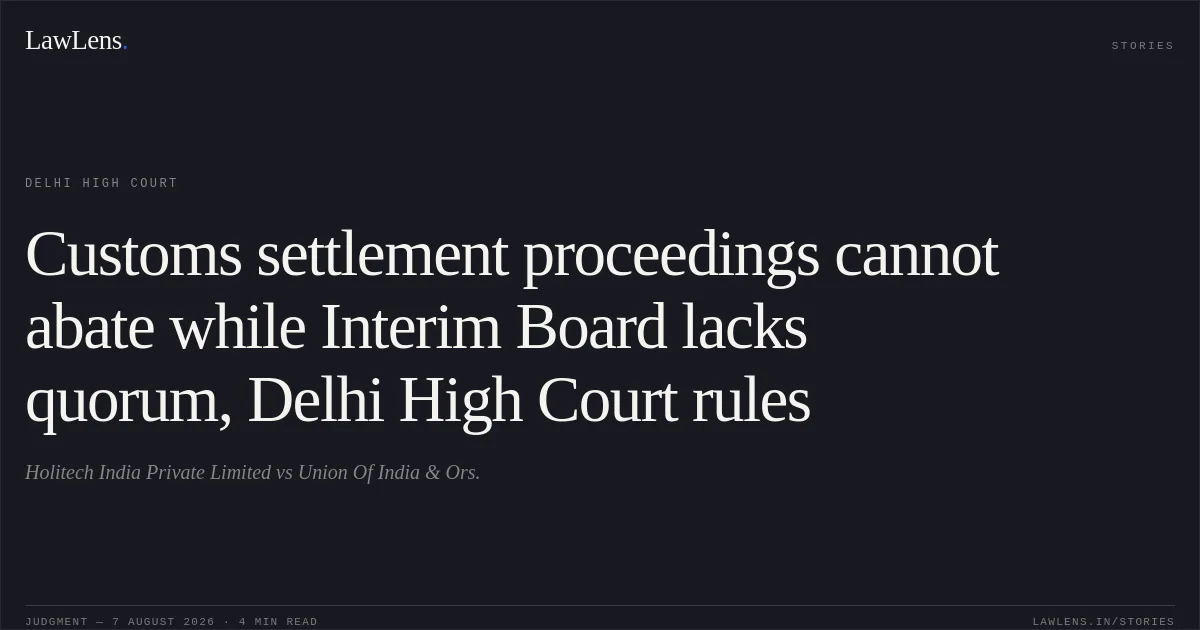
The Court held that the Petitioner’s settlement proceedings did not abate on 8 April 2026 because the period from 1 October 2025, when the Interim Board lost quorum, could not be counted for purposes of Section 127C(8A), as extended under Section 127C(12).
The communications dated 17 April 2026 were set aside.
Source reference: para. 37The entire period from 1 October 2025 until 4 August 2026 was directed to be excluded in computing the statutory period, and the Interim Board—having since been duly reconstituted—was directed to resume and decide the pending settlement applications expeditiously from the stage at which they stood before the impugned communications.
Source reference: paras. 38–39The Court clarified that it expressed no opinion on the merits of the settlement applications or the underlying Show Cause Notices.
Source reference: para. 40The writ petition was accordingly allowed, and the pending applications were closed.
Source reference: para. 41Acts & Sections Cited
5 provisions across 2 statutes referred to in this judgment. Linked provisions open on LawLens.
Customs Act, 19622
Central Excise Act, 19443
Original Court PDF
Holitech India Private LimitedvsUnion Of India & Ors.
Click to open original judgment
Original judgment, available to read, download and summarize on LawLens.in