Facts
The respondent was engaged as a daily-wage driver from 28 September 2000. In an earlier writ petition, the High Court directed the appellants to consider his request for appointment to a permanent Driver post; it did not direct that service benefits be reckoned from his daily-wage appointment.
Source reference: pp. 3–4, paras. 3–3.2, 9He was temporarily appointed to a permanent vacancy under Rule 10(a)(i)(1) on 19 May 2011, and his service was regularised from 21 May 2011. His request to regularise his daily-wage service from 2000 and grant consequential benefits was rejected. A Single Judge quashed that rejection and directed the grant of service benefits from 28 September 2000; the State appealed.
Source reference: pp. 3–5, paras. 3.2–4, 9Issues
Whether the earlier writ order entitled the respondent to have service benefits reckoned from his initial daily-wage appointment in 2000
Source reference: p. 8, para. 9Whether the respondent could count his pre-regularisation daily-wage service towards qualifying service or claim pension under the Tamil Nadu Pension Rules, 1978, given his appointment and regularisation after 1 April 2003
Source reference: pp. 12–18, paras. 12–14Law Applied
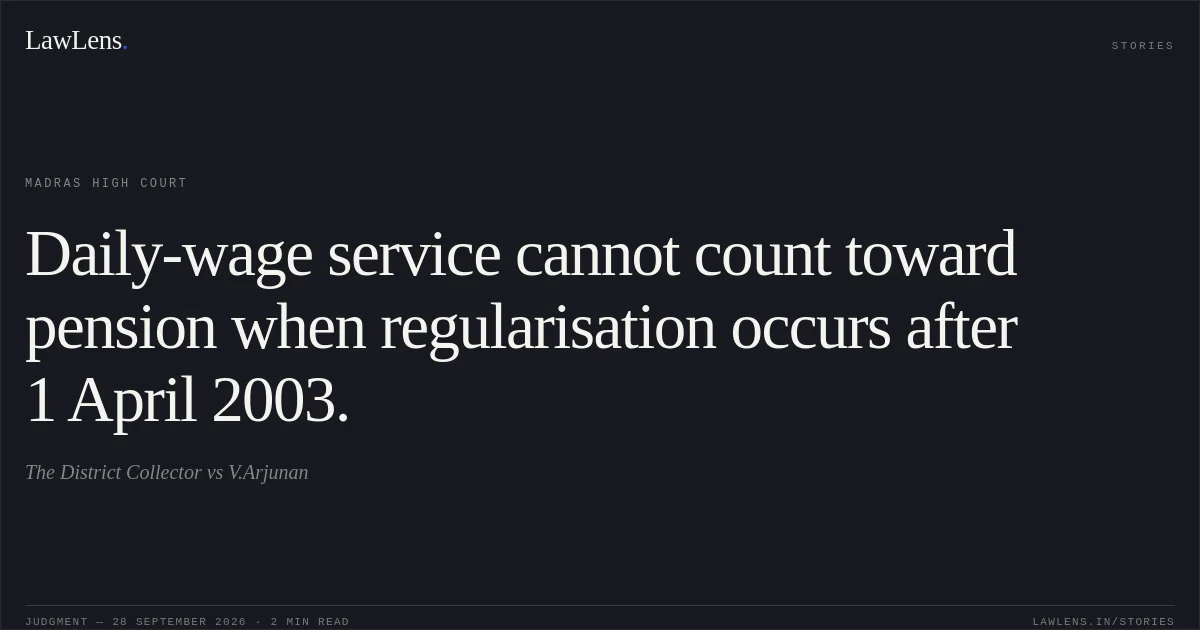
The proviso to Rule 2 of the Tamil Nadu Pension Rules, 1978 excludes from those Rules Government servants appointed on or after 1 April 2003 to posts borne on a pensionable establishment.
Source reference: p. 9, para. 10Rule 11(4) permits half of qualifying non-provincialised, consolidated-pay, honorarium, or daily-wage service to be counted for retirement benefits only subject to its conditions, including absorption into regular service before 1 April 2003.
Source reference: pp. 10–12, para. 11In State of Tamil Nadu v. R. Kaliyamoorthy, 2019-5-LW-673, the Full Bench held that employees appointed or regularised after the cutoff date cannot count half of their past service under Rule 11(4); the ruling was affirmed in State of Tamil Nadu v. P. Arunachalam, (2024) 2 CTC 561.
Source reference: pp. 13–17, paras. 13–14The Court held State of Bihar v. Baliram Singh, Civil Appeal No. 10806 of 2018, inapplicable because it did not concern the Tamil Nadu Pension Rules or a pari materia provision.
Source reference: p. 18, para. 15Reasoning
The earlier writ order required consideration of the respondent’s request but did not grant retrospective service benefits from his daily-wage appointment; the Court also observed that such relief could not generally be granted as a matter of law.
Source reference: p. 8, para. 9The respondent’s appointment to the permanent post and regularisation both took effect in 2011, after the 1 April 2003 cutoff. Applying Rule 2 and the Full Bench ruling in Kaliyamoorthy, the Court concluded that the 1978 Pension Rules did not apply to him and, in any event, his daily-wage service could not be counted under Rule 11(4), which requires regularisation before the cutoff date.
Source reference: pp. 12–18, paras. 12–14Holding
The Court answered the issues against the respondent, allowed the writ appeal, set aside the Single Judge’s order, and sustained the impugned rejection of his request.
It made no order as to costs and closed the connected civil miscellaneous petition.
Source reference: p. 19, para. 16Acts & Sections Cited
1 provisions across 1 statute referred to in this judgment. Linked provisions open on LawLens.
Letters Patent1
Original Court PDF
The District CollectorvsV.Arjunan
Click to open original judgment
Original judgment, available to read, download and summarize on LawLens.in