01Facts
The appellant was engaged as a daily-wage labourer by the Water Resources Department in 1993 and his services were discontinued in 1997.
¶ 3He claimed that he had worked continuously for more than 240 days during the twelve months preceding termination and that the respondents had terminated his services without complying with Sections 25-F and 25-G of the Industrial Disputes Act, 1947 (“ID Act”).
¶ 3Following unsuccessful conciliation proceedings, the dispute was referred to the Labour Court, Bilaspur.
¶ 4The Labour Court found that the appellant had completed more than 240 days of service and that the statutory requirements under Sections 25-F and 25-G had not been followed.
¶ 5It consequently declared the termination illegal and directed reinstatement without back-wages.
¶ 5–8The State challenged the award under Articles 226 and 227 of the Constitution.
¶ 9The learned Single Judge modified the award by substituting reinstatement with monetary compensation at the rate of ₹25,000 per annum for the period during which the appellant had worked as a daily wager.
¶ 9The appellant preferred the present writ appeal, contending that the Single Judge had improperly interfered with the Labour Court’s factual findings and discretionary relief.
¶ 10–1102Issues
i.1. Whether the learned Single Judge was justified in interfering, in exercise of jurisdiction under Articles 226 and 227 of the Constitution, with the Labour Court’s finding that the appellant’s termination violated Sections 25-F and 25-G of the ID Act?
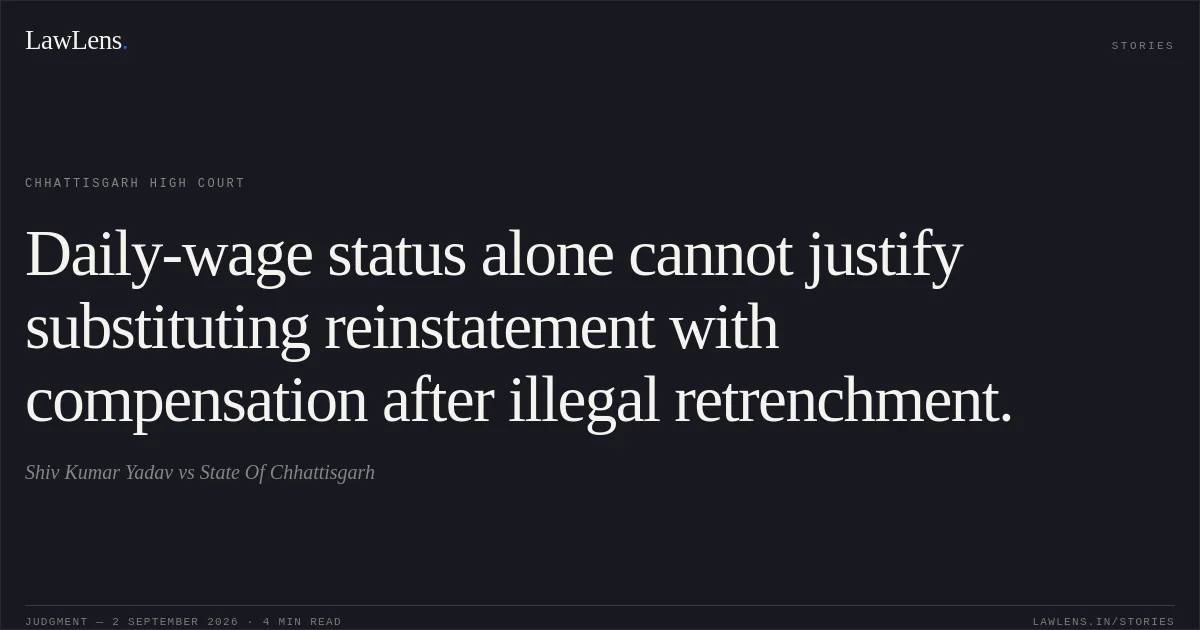
¶ 15, 18–21ii.2. Whether reinstatement granted to a daily-wage employee whose termination was found illegal could be substituted with monetary compensation merely because of the daily-wage nature of his employment and the lapse of time?
¶ 16–17, 21–2803Law Applied
The Court applied Sections 25-F and 25-G of the Industrial Disputes Act, 1947, which require compliance with statutory conditions precedent to retrenchment and adherence to the prescribed principle of “last come, first go,” respectively.
¶ 3, 7It applied the constitutional principles governing judicial review under Articles 226 and 227, namely that the High Court does not ordinarily exercise appellate jurisdiction or re-appreciate evidence, and that interference with a Labour Court’s award is warranted only for jurisdictional error, perversity, error apparent on the face of the record, violation of natural justice, arbitrariness, or comparable illegality.
¶ 15Relying on the Full Bench decision in WA No. 355 of 2014, Surit Ram and connected matters, decided on 29 August 2025, the Court held that illegal retrenchment does not invariably require reinstatement, but neither does the status of a daily-wage or casual employee automatically justify compensation in lieu of reinstatement.
¶ 14–17The appropriate relief must be determined on the facts of each case, including the nature and length of employment, delay, conduct of the workman, feasibility of reinstatement, availability of work or post, closure or reorganisation, and the overall balance of equities.
¶ 14–17Provisions in the judgment · 2
Industrial Disputes Act, 1947 Section 25FSection 25G
04Reasoning
The Labour Court had recorded evidence-based findings that the appellant had worked for more than 240 days and that the respondents had failed to comply with Sections 25-F and 25-G; those findings were neither shown to be perverse nor unsupported by evidence.
¶ 18–19The Labour Court had also exercised discretion by granting reinstatement without back-wages, thereby moulding the relief in light of the circumstances.
¶ 20The Single Judge did not identify any jurisdictional error or evidentiary infirmity in the Labour Court’s findings, but substituted reinstatement principally because the appellant was a daily-wage employee.
¶ 19, 24Applying the Full Bench principles, the Division Bench held that daily-wage status was only one relevant factor and could not operate as an absolute bar to reinstatement.
¶ 22–28The appellant had worked continuously for approximately four years; there was no allegation of misconduct; and no material established that the establishment had closed, that the work had ceased, or that reinstatement was impracticable.
¶ 22–28The Labour Court’s order therefore represented a permissible exercise of discretion that did not warrant interference in writ jurisdiction.
¶ 2605Holding
The Court answered the issues in favour of the appellant.
It held that the Single Judge was not justified in substituting reinstatement with compensation solely on the basis that the appellant was a daily-wage worker.
¶ 24, 27–28The writ appeal was allowed; the order dated 20 June 2016 in WPL No. 169 of 2012 was set aside insofar as it concerned the appellant; and the Labour Court’s award dated 15 March 2012 directing reinstatement without back-wages was restored.
¶ 29–30The respondents were directed to take consequential steps for implementing the award in accordance with law.
¶ 29–30The judgment was expressly confined to the appellant’s individual case and did not determine the entitlement or relief of any other workman.
¶ 31Original Court PDF
Shiv Kumar YadavvsState Of Chhattisgarh
Click to open original judgment
Original judgment, available to read, download and summarize on LawLens.in