Facts
The respondent, a railway employee, was allotted Railway Quarter No. 951/B at Sahebpara, Katihar. After his transfer from Katihar to Kasba in January 2014, he joined at Kasba and subsequently informed the railway authorities that he had vacated the Katihar quarter and sought clearance and allotment of accommodation at Kasba.
Source reference: p.2–3The quarter, however, continued to be occupied by his estranged wife, Smt. Bhawani Thakur. The respondent informed the authorities that he had no control over her occupation and that he was paying maintenance pursuant to proceedings before the Family Court, Katihar.
Source reference: p.3–4Initially, the railway authorities decided not to recover damage rent from the respondent and instead initiated eviction proceedings against his wife under Sections 4 and 5 of the Public Premises (Eviction of Unauthorised Occupants) Act, 1971 (“1971 Act”). Notices in Form-A and Form-B were issued to her in April and July 2017.
Source reference: p.3–5Despite initiating those proceedings, the authorities subsequently treated the respondent as being in unauthorised occupation and began recovering damage rent from his salary.
Source reference: p.5–6The Central Administrative Tribunal allowed the respondent’s O.A., quashed the orders dated 25 January 2022 and 8 June 2022, and directed refund of the damage rent recovered from him.
Source reference: p.2The Tribunal also directed that the respondent be permitted to draw admissible house rent allowance. The railway authorities’ review application was dismissed on 21 July 2025. The Union of India and railway authorities challenged both orders before the High Court.
Source reference: p.2Issues
Whether the railway authorities could recover damage rent from the respondent when they had themselves treated his wife as the unauthorised occupant and initiated eviction proceedings against her under the 1971 Act?
Source reference: para. 11–16Whether, having initiated eviction proceedings under Sections 4 and 5 of the 1971 Act, the authorities were required to conclude those proceedings by passing an appropriate eviction or other final order rather than penalising the respondent through salary deductions?
Source reference: para. 12–14Whether the orders of the CAT quashing the damage-rent recovery orders and directing refund of the recovered amount suffered from any legal infirmity?
Source reference: para. 18–20Law Applied
The Court applied Sections 4 and 5 of the Public Premises (Eviction of Unauthorised Occupants) Act, 1971, under which the Estate Officer must consider the occupant’s response and evidence, conduct a hearing where applicable, and pass a reasoned order determining whether the occupation is unauthorised; if eviction is ordered and not complied with, possession may thereafter be taken using necessary force.
Source reference: para. 12–13The Court relied on S.D. Bandi v. Karnataka State Road Transport Corporation, (2013) 12 SCC 631, for the principle that official quarters are allotted for employment-related purposes, retention beyond eligibility is unauthorised, and the authorities must adopt the statutory eviction process.
Source reference: para. 17The decisions in New Delhi Municipal Committee v. Kalu Ram, (1976) 3 SCC 407, and State of Kerala v. V.R. Kalliyanikutty, AIR 1999 SC 1305, concerning the legal recoverability and limitation of arrears of rent, were held not to govern the present dispute, which concerned the legality of recovering damage rent from the employee while eviction proceedings against the actual occupant remained incomplete.
Source reference: para. 8–9, 18Reasoning
The Court found that the railway authorities had expressly recognised the respondent’s wife as the person in unauthorised occupation by issuing her notices under the 1971 Act.
Source reference: para. 11, 14, 16The respondent had been transferred years earlier, had joined at Kasba, and had repeatedly informed the authorities that he no longer occupied or controlled the Katihar quarter.
Source reference: p.2–4Once the authorities initiated statutory eviction proceedings, they were required to bring those proceedings to a logical conclusion by passing an order under Section 5 or otherwise determining the legal status of the occupation.
Source reference: para. 12–13Instead, without producing any final outcome of those proceedings, they changed course and recovered damage rent from the respondent, despite knowing of the estranged matrimonial relationship and the pending maintenance proceedings.
Source reference: para. 11, 14–16The Court held that the authorities could not simultaneously treat the wife as the unauthorised occupant for eviction purposes and treat the respondent as personally liable for damage rent without establishing his continued occupation or control over the premises.
Source reference: para. 13–16The precedents cited by the petitioners were therefore irrelevant to the central issue.
Source reference: para. 18Holding
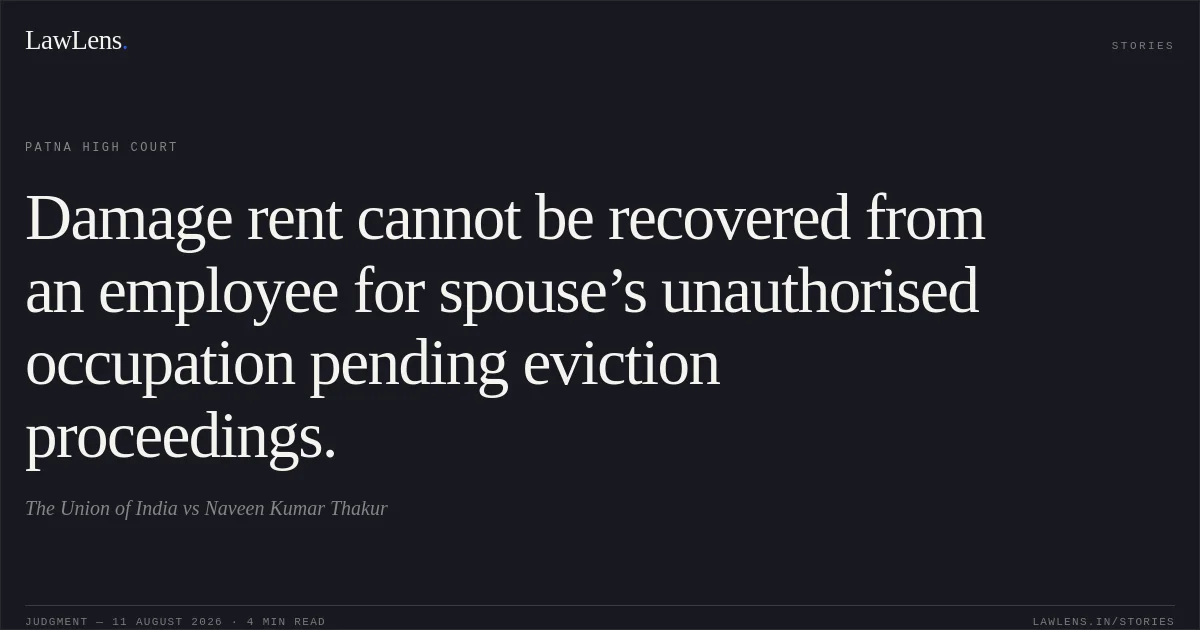
The High Court answered the issues against the railway authorities. It held that the recovery of damage rent from the respondent, while the eviction proceedings against his wife remained unconcluded, was illegal and could not be sustained.
The Court found no infirmity in the CAT’s order dated 17 January 2025 or its review order dated 21 July 2025.
Source reference: para. 19Accordingly, the writ petition was dismissed for want of merit, and the orders quashing the damage-rent recovery orders and directing refund of the amount recovered were affirmed.
Source reference: para. 20Acts & Sections Cited
3 provisions across 1 statute referred to in this judgment. Each provision opens on LawLens.
Original Court PDF
The Union of IndiavsNaveen Kumar Thakur
Click to open original judgment
Original judgment, available to read, download and summarize on LawLens.in