Facts
The dispute arose from a tripartite agreement for electrical works at G.B. Pant Hospital, New Delhi
Source reference: para. 6While the work was scheduled for completion by July 2008, it was finished in November 2011
Source reference: para. 7The delay was regularized without penalty
Source reference: para. 7The Arbitrator awarded the contractor escalation under Clause 10CC (Claim 3) and loss of turnover/profitability (Claim 6)
Source reference: para. 12The Petitioner (PWD) challenged these specific findings under Section 34 of the Arbitration and Conciliation Act, 1996 ("A&C Act"), alleging they were patently illegal and lacked evidentiary support
Source reference: para. 15-16Simultaneously, the Respondent sought enforcement of the award
Source reference: para. 2Issues
1. Whether the Arbitrator committed patent illegality by awarding escalation under Clause 10CC for the prolonged period despite the clause expressly limiting its application to the stipulated period
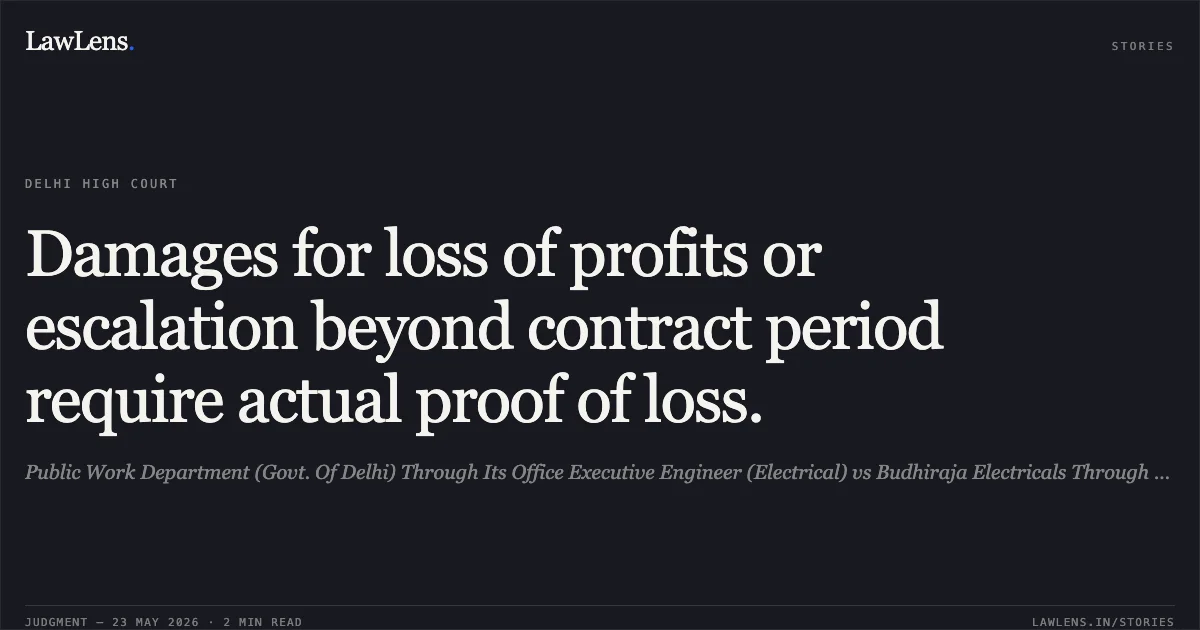
Source reference: para. 18, 382. Whether an award for loss of turnover and profitability can be sustained without evidence of actual loss or missed opportunities, relying solely on a CPWD memorandum formula
Source reference: para. 19, 58Law Applied
The court applied Section 34 of the A&C Act, noting that an award may be set aside for "patent illegality" if it is perverse, irrational, or ignores vital evidence
Source reference: para. 41, 73It relied on Associate Builders v. DDA and Ssangyong Engineering v. NHAI to established that while courts do not act as appellate bodies, an award based on "no evidence" is patently illegal
Source reference: para. 41, 68Regarding damages, the court applied Section 73 of the Indian Contract Act, 1872 (ICA), which requires proof of actual loss
Source reference: para. 46It further cited Kailash Nath Associates v. DDA and Unibros v. All India Radio, holding that a formula (like the Hudson formula or CPWD memo) cannot substitute the requirement of proving actual damages or lost opportunities.
Source reference: para. 59, 63Reasoning
The court found the award for Claim 3 (Escalation) contradictory; the Arbitrator acknowledged that Clause 10CC did not contractually apply to the extended period but used its formula anyway to grant damages under Section 73 of the ICA
Source reference: para. 42-43This was held illegal because the Arbitrator failed to require proof of actual cost increases as necessitated by Section 73
Source reference: para. 45-46Regarding Claim 6 (Loss of Profits), the court determined the Arbitrator reached a conclusion based on a "guess in the dark"
Source reference: para. 63The award relied solely on a notional 15% CPWD memorandum without scrutinizing books of accounts or evidence showing the contractor was prevented from taking other projects
Source reference: para. 56-57Following the Unibros precedent, the court held that even if the employer is at fault for the delay, the contractor must still fulfill the "fourth condition": providing credible evidence of lost profitability
Source reference: para. 65Holding
The Court held these findings were patently illegal due to a total lack of evidentiary foundation and disregard for contractual limits
The Court allowed the Objection Petition and set aside the Impugned Arbitral Award regarding Claim 3 (escalation: ₹38,96,175/-) and Claim 6 (loss of profits: ₹16,23,195/-), along with their respective interest. Consequently, the Enforcement Petition was dismissed to the extent of the set-aside claims but allowed to proceed for the remaining undisputed portions of the award
Source reference: para. 73-74, 78-79Acts & Sections Cited
15 provisions across 3 statutes referred to in this judgment. Each provision opens on LawLens.
Arbitration and Conciliation Act, 1996
Code of Civil Procedure, 19081
Indian Contract Act, 18724
Original Court PDF
Public Work Department (Govt. Of Delhi) Through Its Office Executive Engineer (Electrical)vsBudhiraja Electricals Through Its Partner Mr. Mohinder Lal Budhiraja
Click to open original judgment
Original judgment, available to read, download and summarize on LawLens.in