Facts
The applicant’s mother-in-law owned land (Khasara No. 65/2) in Village Madna, which was acquired by the Railways for a project.
Source reference: p. 2Under the Railways’ rehabilitation scheme, one family member of the land loser is entitled to employment assistance.
Source reference: p. 2Given that the mother-in-law was 65 years old and the applicant’s husband was suffering from a serious ailment rendering him unable to work, the mother-in-law nominated the applicant (her daughter-in-law) for the position.
Source reference: p. 2The respondents rejected the application via order dated 21.01.2020, stating that under the existing policy, only the land loser, spouse, son, or daughter are eligible, and a daughter-in-law is excluded.
Source reference: p. 2-3Issues
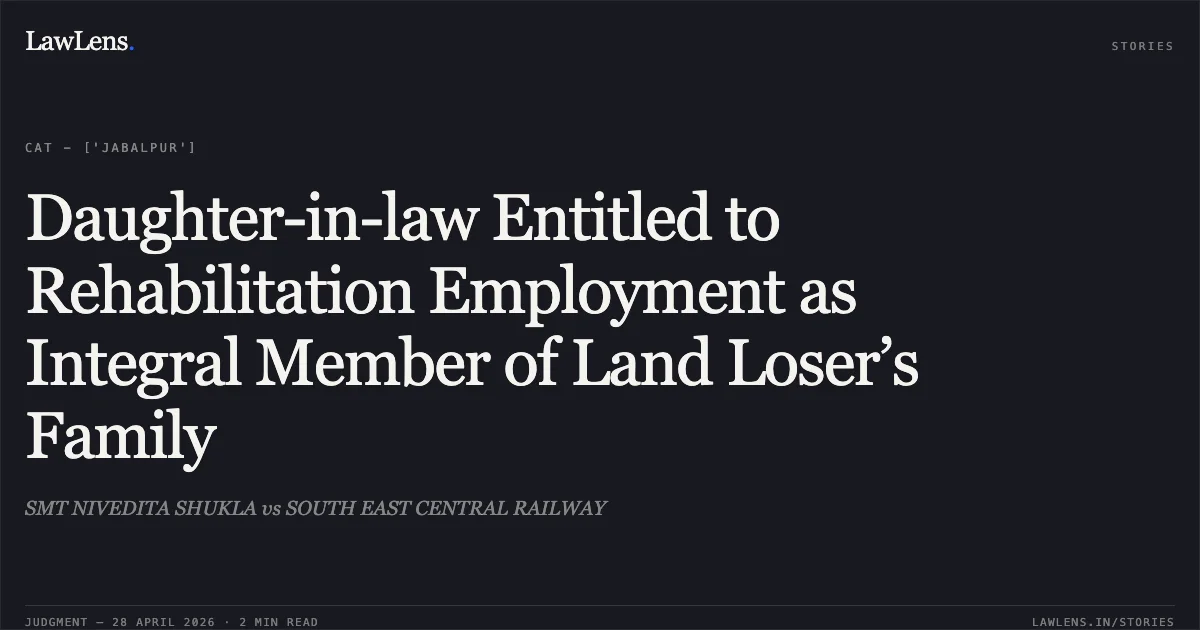
1. Whether a daughter-in-law is entitled to employment assistance on rehabilitation grounds as an integral part of the family, despite her exclusion from the specific list of relations in the Railway policy?
Source reference: p. 3 / para. 5Law Applied
The Tribunal relied on the policy instructions dated 16.07.2010 regarding employment for land losers.
Source reference: p. 3It primarily applied the legal principle established by the Hon’ble High Court of Allahabad in Vibha Tiwari vs. State of U.P. and others (2024), which held that a daughter-in-law is an integral part of the family.
Source reference: p. 3-4The Tribunal followed its own recent precedent in Original Application No. 200/296/2022 (decided on 26.09.2025), which emphasized a liberal interpretation of welfare measures intended to mitigate hardship for displaced families.
Source reference: p. 3-4Reasoning
The Tribunal reasoned that while the 2010 policy instructions do not explicitly name the "daughter-in-law," such administrative instructions cannot "snatch the legitimate right" of a family member when judicial precedents have recognized the daughter-in-law as an integral part of the family unit.
Source reference: p. 3-4The court observed that the rehabilitation scheme is a welfare measure designed to provide relief to families losing their livelihood due to land acquisition; therefore, it requires a liberal rather than a restrictive approach.
Source reference: para. 7In this specific case, the owner (mother-in-law) and the husband were medically or physically unable to take the job and were dependent on the applicant, making her the sole viable candidate for the family’s support.
Source reference: p. 4Consequently, the Tribunal found that the Railways failed to account for the established legal position regarding familial status.
Source reference: p. 4-5Holding
The Tribunal answered the issue in the affirmative, holding that the applicant's case as a daughter-in-law warrants consideration.
It quashed and set aside the impugned order dated 21.01.2020. The respondents were directed to reconsider the applicant’s case for appointment under the Railways and, if found otherwise eligible, issue the necessary appointment order within 90 days. The Original Application was allowed with no order as to costs.
Source reference: p. 5Acts & Sections Cited
1 provisions across 1 statute referred to in this judgment. Each provision opens on LawLens.
Administrative Tribunals Act, 19851
Original Court PDF
SMT NIVEDITA SHUKLAvsSOUTH EAST CENTRAL RAILWAY
Click to open original judgment
Original judgment, available to read, download and summarize on LawLens.in