Facts
The Appellant (daughter-in-law) challenged a trial court decree directing her to vacate the first floor of a property owned by the Respondent (mother-in-law).
Source reference: no citationAfter marriage in 1992, the Appellant lived at her husband’s various military postings.
Source reference: para. 4, 41In 2004, the Respondent allowed the family to occupy the second floor as permissive licensees while the husband sought new employment.
Source reference: para. 5, 40By 2010, the Respondent also permitted them to use the first floor.
Source reference: para. 6Evidence showed the ground floor was occupied independently by the Respondent with a separate kitchen and locked entrances.
Source reference: para. 42, 56Matrimonial discord led to divorce proceedings and a domestic violence petition.
Source reference: para. 10, 22The Respondent terminated the Appellant's license via legal notice in 2021.
Source reference: para. 11The trial court held the property was a "shared household" but ordered eviction by balancing the rights of senior citizens.
Source reference: para. 28, 31Issues
1. Whether the suit property constitutes a "shared household" under Section 2(s) of the DV Act.
Source reference: para. 452. Whether the Appellant has a continued legal right to remain in possession of the property after the termination of a permissive license.
Source reference: para. 45Law Applied
The court applied Section 2(s) of the Protection of Women from Domestic Violence (DV) Act, 2005, which defines "shared household" as a place where the aggrieved person lives or has lived in a domestic relationship.
Source reference: para. 48It relied on the Supreme Court precedent in Satish Chander Ahuja v. Sneha Ahuja, which clarified that a shared household requires living with "some permanency" and an intention to treat the premises as a common home, excluding "fleeting or casual" stays.
Source reference: para. 50-52The court also invoked the principle from S. Vanitha v. Deputy Commissioner, emphasizing that the right of residence must be harmonized with the statutory rights of senior citizens to live in peace under the Maintenance and Welfare of Parents and Senior Citizens Act, 2007.
Source reference: para. 71Reasoning
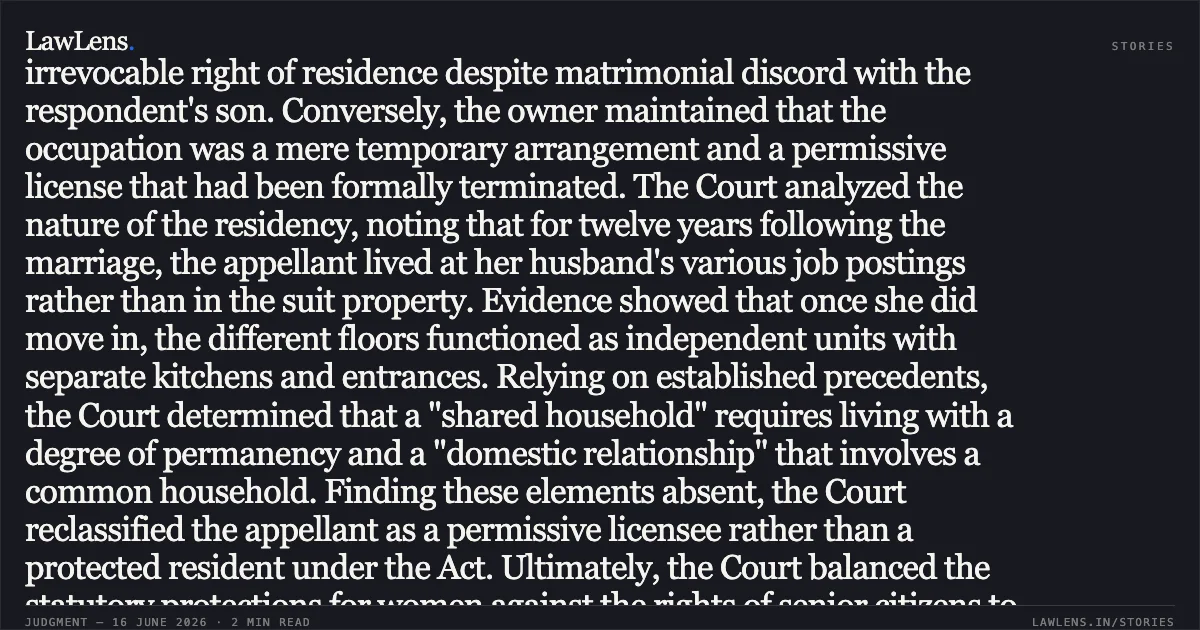
The Court found that the trial court erred in labeling the property a shared household. For the first twelve years of marriage, the Appellant lived elsewhere, visiting only occasionally.
Source reference: para. 54Since 2004, the Appellant resided in separate units with independent entrances and kitchens, never sharing a common household arrangement with the Respondent.
Source reference: para. 56, 58The High Court reasoned that under the Ahuja standard, the relationship was one of a licensor and a permissive licensee rather than a joint domestic household.
Source reference: para. 59-63There was no evidence of a shared "domestic relationship" within that specific property.
Source reference: para. 58The court noted that the husband is currently paying interim maintenance, which includes the right to seek enhanced funds for alternative accommodation, meaning the daughter-in-law's right of residence is enforceable against her husband, not necessarily against the separate property of the mother-in-law.
Source reference: para. 69-70Holding
The Court set aside the trial court’s finding that the property was a "shared household," holding instead that the Appellant was a permissive licensee whose license was validly terminated.
The High Court upheld the decree for mandatory and permanent injunction, ordering the Appellant to vacate the property but affirming the dismissal of the Respondent's claim for mesne profits due to lack of rental evidence.
Source reference: para. 75, 77The appeal was dismissed.
Source reference: para. 78Acts & Sections Cited
3 provisions across 2 statutes referred to in this judgment. Each provision opens on LawLens.
Code of Civil Procedure, 19082
Hindu Marriage Act, 19551
Original Court PDF
Smt. Upinder Kaur MalhotravsSmt. Gurmeet Malhotra
Click to open original judgment
Original judgment, available to read, download and summarize on LawLens.in