Facts
The petitioners, senior citizens aged 76 and 73, are the absolute owners of a property in Sarita Vihar.
Source reference: para. 2Alleging ill-treatment by their daughter-in-law (Respondent No. 4) and son (Respondent No. 7), they obtained an eviction order from the District Magistrate under the Maintenance and Welfare of Parents and Senior Citizens Act, 2007 ("Senior Citizens Act").
Source reference: para. 3, 8On appeal, the Divisional Commissioner upheld the findings of harassment but modified the order, directing the petitioners to provide "permanent alternate accommodation" to Respondent No. 4 and her children, and to share half the property's rental income with her.
Source reference: para. 4, 9The petitioners challenged this modification, arguing that providing permanent accommodation is legally onerous and outside the scope of the Senior Citizens Act and the DV Act.
Source reference: para. 5Issues
1. Whether the authorities under the Senior Citizens Act can direct senior citizens to provide "permanent" alternate accommodation to a daughter-in-law in lieu of her right to a shared household.
Source reference: para. 5, 152. Whether the obligation to provide shelter and maintenance to a daughter-in-law primarily rests upon the in-laws or the estranged husband under the harmonized schemes of the Senior Citizens Act and the DV Act.
Source reference: para. 11, 13Law Applied
The Court applied the Senior Citizens Act, 2007, and the Protection of Women from Domestic Violence Act, 2005 ("DV Act").
Source reference: para. 10The Senior Citizens Act cannot nullify a woman's right to a "shared household" under Section 17 of the DV Act, requiring a harmonious construction of both statutes.
Source reference: S. Vanitha v. Deputy Commissioner, Bengaluru Urban District, para. 10If a relationship is acrimonious, parents can seek eviction, but the husband’s obligation to provide shelter continues.
Source reference: Vinay Varma v. Kanika Pasricha, para. 11The right to residence is protective, not a property right, and can be satisfied by suitable alternate accommodation.
Source reference: Satish Chander Ahuja v. Sneha Ahuja, para. 12Reasoning
The Court observed that the Divisional Commissioner correctly identified the relationship as acrimonious, making cohabitation impossible.
Source reference: para. 13, 14The Court found that the direction to provide "permanent" accommodation lacked statutory backing, as neither the Senior Citizens Act nor the DV Act recognizes a right to permanent housing, only the right to a "shared household" or suitable alternative.
Source reference: para. 15, 16The Court reasoned that while the petitioners are entitled to the peaceful enjoyment of their property as absolute owners, the daughter-in-law’s right to shelter must be balanced.
Source reference: para. 16It determined that the primary liability to maintain the wife rests with the husband (Respondent No. 7), and the in-laws' burden should be limited to providing financial means for a shared household rather than a permanent asset.
Source reference: para. 5, 13Holding
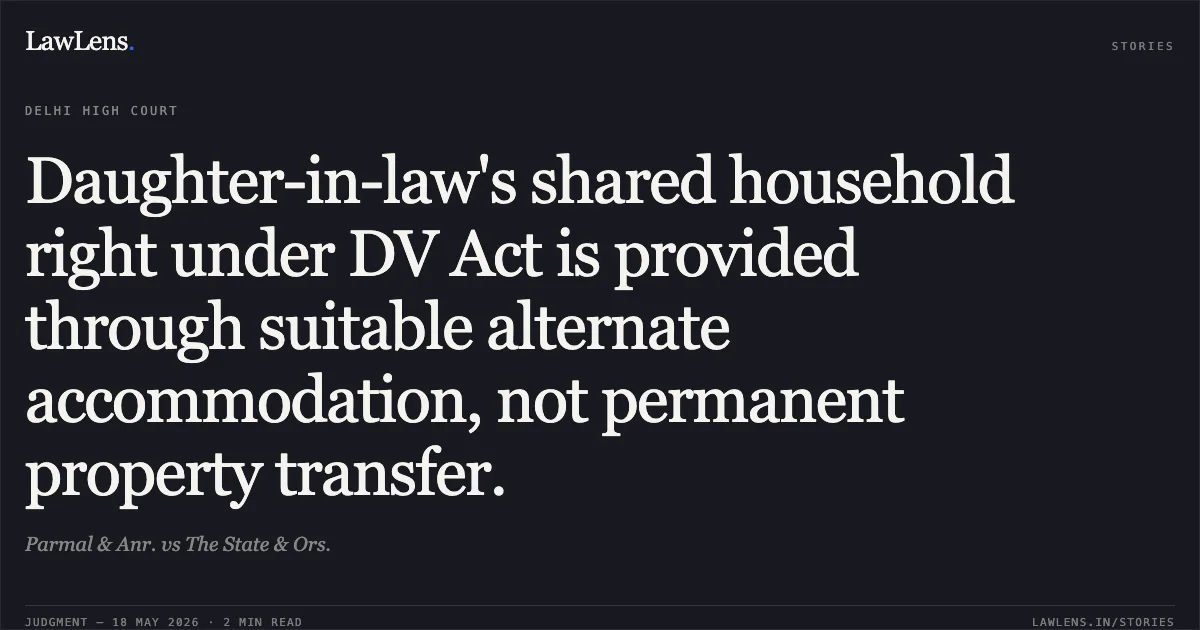
The Court held that the petitioners are entitled to the property but must facilitate the daughter-in-law’s right to shelter.
The Court ordered the petitioners to pay ₹25,000 for a shared household and ₹5,000 for maintenance (total ₹30,000/month) to Respondent No. 4; Upon payment of four months' advance, Respondents No. 4–6 must vacate the premises within 45 days; Failure to pay entitles the Respondents to seek restoration of possession; The petitioners are restrained from creating third-party rights over the property, except for leasing it to generate rent.
Source reference: para. 17(i), 17(ii), 17(iv), 17(v)Acts & Sections Cited
13 provisions across 2 statutes referred to in this judgment. Each provision opens on LawLens.
Maintenance and Welfare of Parents and Senior Citizens Act, 20075
Protection of Women from Domestic Violence Act, 20058
Original Court PDF
Parmal & Anr.vsThe State & Ors.
Click to open original judgment
Original judgment, available to read, download and summarize on LawLens.in


