Facts
The deceased, Sudesh Kumar Kaushik, was employed as a laborer by Respondent No. 2, Mahamaya Rice Industries
Source reference: para 2On August 26, 2017, while performing his duty of checking rice storage, he suffered a brain hemorrhage, fell, and was subsequently declared brought dead at the hospital
Source reference: para 2The Post Mortem report confirmed the cause of death as brain hemorrhage resulting from increased pressure in the blood vessels
Source reference: para 7The grandmother of the deceased (Respondent No. 1) filed a claim under the Employees Compensation Act, 1923.
Source reference: no citationThe Commissioner, Labour Court, Bilaspur, awarded compensation of Rs. 8,30,138/- with 12% interest
Source reference: para 1The Insurance Company appealed, contending they were not liable as the death was due to a medical condition (hemorrhage) rather than an accident
Source reference: para 6Issues
Whether the deceased died due to a brain hemorrhage during the course of employment, and whether fastening liability upon the Insurance Company for such a death is illegal?
Source reference: para 6Law Applied
Section 3 of the Employees Compensation Act, 1923 (formerly Workmen's Compensation Act), which mandates employer liability for compensation if personal injury is caused to an employee by an "accident arising out of and in the course of employment."
Source reference: no citationThe legal principle establishes that if the employment is a contributory cause or the environment of the job accelerated the incident, it qualifies as an accident, regardless of whether the internal cause was a pre-existing medical condition like a hemorrhage
Source reference: para 9Reasoning
The Court observed that the fact the deceased was actively performing his duties (checking storage) at the time of the collapse was undisputed
Source reference: para 9Although the Insurance Company suggested the fall might have been due to an epileptic seizure, the Post Mortem report specifically attributed the death to a brain hemorrhage
Source reference: para 7-8The Court reasoned that for the purpose of granting compensation under the EC Act, the primary determination is whether the death occurred "during the course of employment"
Source reference: para 9It held that the specific medical "cause of death" (brain hemorrhage) does not negate the employer's liability if the link between the employment and the incident is established
Source reference: para 9Since the deceased was on duty when the hemorrhage occurred, it is legally treated as an accident arising out of employment
Source reference: para 10Holding
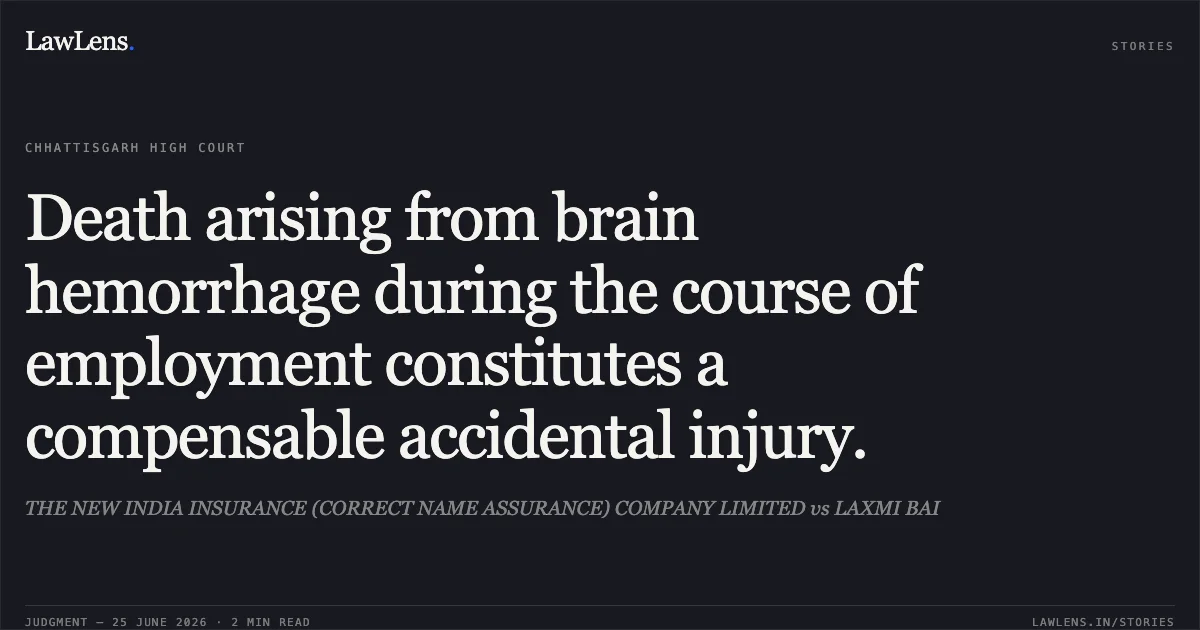
The High Court answered the substantial question of law in the negative, holding that the Insurance Company is liable
The Court affirmed that death due to brain hemorrhage while on duty constitutes an accident under the Employees Compensation Act. The appeal was dismissed, and the Labour Court’s award of Rs. 8,30,138/- with 12% interest was upheld
Source reference: para 11Acts & Sections Cited
1 provisions across 1 statute referred to in this judgment. Linked provisions open on LawLens.
Employee1
Original Court PDF
THE NEW INDIA INSURANCE (CORRECT NAME ASSURANCE) COMPANY LIMITEDvsLAXMI BAI
Click to open original judgment
Original judgment, available to read, download and summarize on LawLens.in