Facts
On 19 September 1997, Rajesh Kumar and Nasim Ahmad allegedly took a room on rent in Nar Singh’s house after paying an advance.
Source reference: paras. 4–10During the night, several persons allegedly entered the house, assaulted and restrained Nar Singh by tying him with ropes and gagging his mouth, causing his death by suffocation.
Source reference: paras. 4–10The assailants also allegedly confronted Nar Singh’s wives, Rekha (PW-3) and Chandra Prabha (PW-9), before fleeing from the premises.
Source reference: paras. 4–10Rahish Khan was subsequently arrested with a knife, while Firoz @ Sagar, Shehzad, Sanjay Kumar and Nasim were allegedly arrested on the basis of his disclosure statement; Rajesh later surrendered.
Source reference: paras. 11–13The Trial Court convicted all six appellants under Section 302 read with Section 34 IPC, and additionally convicted Shehzad and Rahish Khan under the Arms Act.
Source reference: paras. 18–20The appeals challenged the reliability of the eyewitness identification, the Test Identification Parade (TIP), recoveries, alleged dying declaration, disclosure statement and the applicability of Section 302 IPC.
Source reference: paras. 23–64Issues
1. Whether the prosecution proved the identity and involvement of Firoz @ Sagar, Shehzad and Sanjay Kumar beyond reasonable doubt, particularly where they were strangers to the witnesses, were not arrested at the spot, and the TIP was conducted after they had already been exposed to the witnesses.
Source reference: paras. 70–892. Whether the prosecution established the involvement of Rajesh Kumar, Nasim Ahmad and Rahish Khan through the testimonies of PW-3, PW-9 and PW-18, the circumstances of their presence and flight, and the alleged recoveries.
Source reference: paras. 90–1163. Whether the alleged dying declaration of Nar Singh and the statements made before the Magistrate could be relied upon against the appellants.
Source reference: paras. 107–1144. Whether the proved facts constituted murder under Section 302 IPC or culpable homicide not amounting to murder under Section 304 Part II IPC read with Section 34 IPC.
Source reference: paras. 117–1185. Whether the convictions under Sections 25 and 27 of the Arms Act were sustainable.
Source reference: paras. 85–89 and para. 120Law Applied
The Court applied Sections 302 and 34 IPC concerning murder and acts done in furtherance of common intention, and Section 304 Part II IPC concerning culpable homicide not amounting to murder with knowledge that the act was likely to cause death.
Source reference: paras. 117–118It applied the rule that where an accused is a stranger, identification in court must be approached with caution and an early TIP is ordinarily desirable; a TIP loses evidentiary value where the accused has already been exposed to the witnesses, and refusal to participate cannot by itself support identification in such circumstances, as explained in Nazim v. State of Uttarakhand, Rajesh Govind Jagesha v. State of Maharashtra and Raj Kumar @ Bheema v. State (NCT of Delhi).
Source reference: paras. 75–84Statements made to police are inadmissible except to the limited extent permitted by Section 27 of the Evidence Act, and a co-accused’s disclosure implicating others cannot independently establish their guilt.
Source reference: para. 88Contradictions in police statements must be duly proved through the procedure under Section 145 of the Evidence Act and Section 162 Cr.P.C.; unproved omissions cannot be relied upon as contradictions.
Source reference: paras. 98–99A dying declaration must be shown to have been made voluntarily and while the deceased was in a fit condition to speak.
Source reference: paras. 107–110A confession before a Magistrate is governed by Section 164 Cr.P.C.; absent the prescribed safeguards, it cannot be treated as a valid judicial confession, and incriminating circumstances not put to the accused under Section 313 Cr.P.C. cannot be used against him.
Source reference: paras. 111–114For an offence under Section 25 of the Arms Act, possession of the weapon by the accused must be proved.
Source reference: para. 87Reasoning
The Court acquitted Firoz, Shehzad and Sanjay because they were not previously known to PW-3 or PW-9, were arrested several days after the incident, were not described in the FIR or police statements, and were identified in court only after being seen by the witnesses at the court premises before the TIP.
Source reference: paras. 72–84Their subsequent refusal to participate in the TIP therefore could not justify an adverse inference, and the dock identification was held unreliable.
Source reference: paras. 72–84The knife recovered from the lane was found to be unconnected with Shehzad or the offence: it was recovered from an open place, yielded “no reaction” in the FSL examination, and was not linked to any fatal injury.
Source reference: paras. 85–87Rahish’s disclosure statement could not implicate the co-appellants, and the prosecution’s alleged dying declaration was rejected because the medical evidence showed death by suffocation, the deceased was declared brought dead, and the witnesses gave materially inconsistent accounts of the statement.
Source reference: paras. 88, 107–110In contrast, the identity of Rajesh and Nasim was established through evidence that they had obtained and occupied the room shortly before the incident, while Rahish was identified by PW-18 as one of the persons fleeing the premises with an open knife.
Source reference: paras. 92–106, 115The Court treated the inconsistencies in the accounts of PW-3 and PW-9 as attributable to the traumatic circumstances and insufficient to displace the core prosecution case.
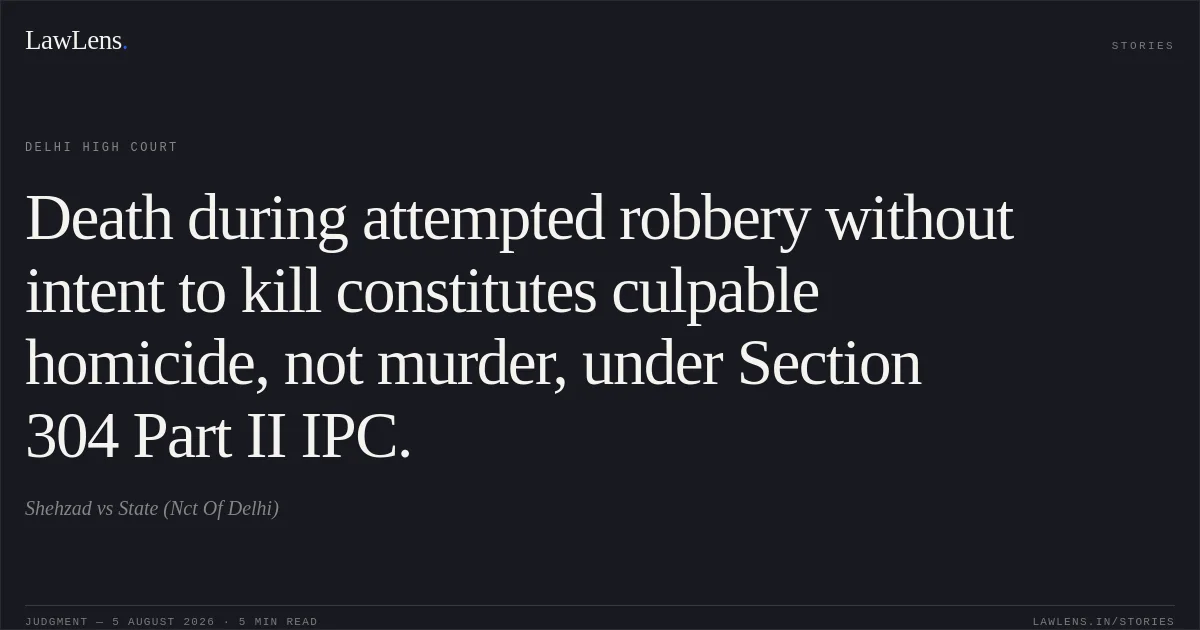
Source reference: paras. 92–106, 115However, the medical evidence did not show a fatal knife injury, and the circumstances suggested that the assailants intended to commit robbery and gagged the deceased to prevent an alarm rather than intending to kill him.
Source reference: paras. 117–118The death was consequently held to be an incidental result of the unlawful act, attracting Section 304 Part II rather than Section 302 IPC.
Source reference: paras. 117–118Holding
The convictions and sentences of Firoz @ Sagar, Shehzad and Sanjay Kumar were set aside, and their appeals were disposed of subject to continuation of their bail bonds for six months under Section 481 BNSS, 2023.
The convictions of Rajesh Kumar, Nasim Ahmad @ Sagar and Rahish Khan under Section 302 read with Section 34 IPC were modified to convictions under Section 304 Part II read with Section 34 IPC.
Source reference: para. 120Rahish Khan’s conviction under Section 25 of the Arms Act was maintained.
Source reference: para. 120The matter was directed to be listed for arguments on the quantum of sentence, and fresh nominal rolls of Rajesh, Nasim and Rahish were requisitioned.
Source reference: paras. 121–122Original Court PDF
ShehzadvsState (Nct Of Delhi)
Click to open original judgment
Original judgment, available to read, download and summarize on LawLens.in