Facts
The petitioner, M/s R.S. Construction, was awarded a contract for building a 5000 MT godown in Jamui and due to delays in execution, the Executive Engineer issued an order dated 29.03.2025 debarring the petitioner from participating in the "immediately succeeding tender".
Source reference: p. 1-2The petitioner completed the work to the respondents' satisfaction, and a work experience certificate was issued on 17.07.2025.
Source reference: p. 2Despite this completion, when the petitioner bid for a new tender (NIT No. 01/SBD/2025-26), the Technical Bid Evaluation Committee rejected their bid on 25.09.2025, citing the earlier debarment order.
Source reference: p. 2-3During the pendency of the writ, the contract was awarded to a third party, leading the petitioner to confine their plea to declaring the debarment order inoperative following the completion of work.
Source reference: p. 3-4Issues
1. Whether the continued operation of the debarment order dated 29.03.2025, despite the subsequent completion of work and issuance of an experience certificate, amounts to an impermissible indefinite debarment.
Source reference: p. 5-6 / para. 10Law Applied
The Court primarily applied the principles of administrative law and the doctrine of proportionality as articulated by the Supreme Court of India in Kulja Industries Ltd. v. Chief General Manager, Western Telecom Project, BSNL (2014); the rule establishes that while the power to debar is inherent in authorities, it is subject to judicial review on the touchstone of natural justice and proportionality.
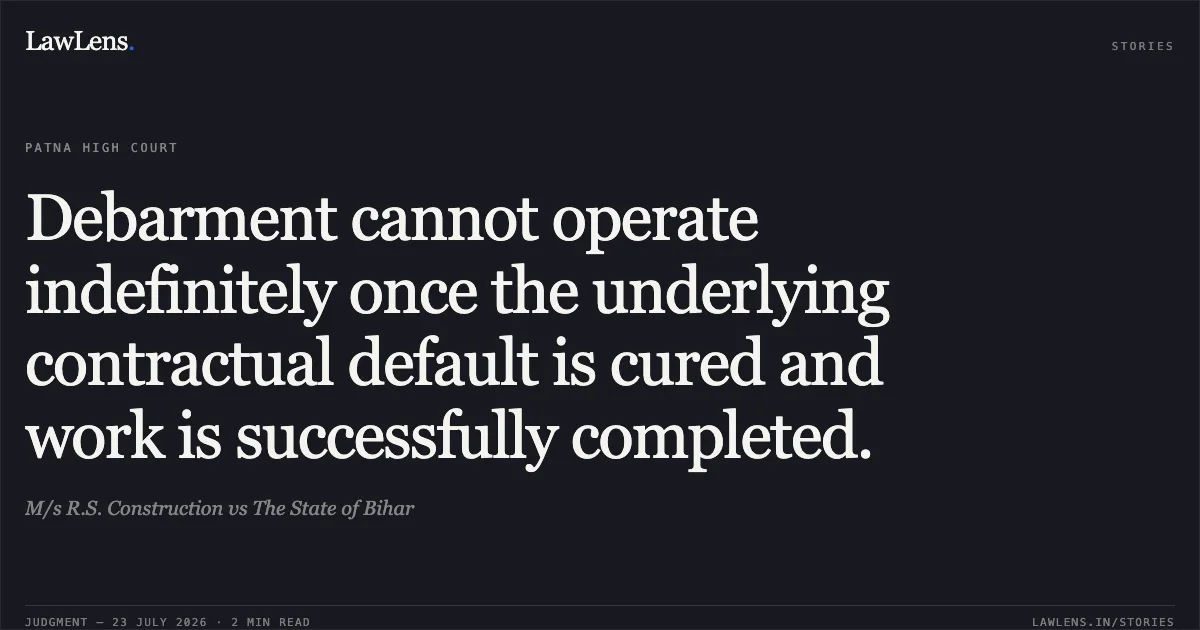
Source reference: p. 4, 7 / para. 13Debarment cannot be permanent or for an indefinite period; it must be for a fixed duration and bear a reasonable nexus to the gravity of the default.
Source reference: p. 7-9Reasoning
The Court observed that the original debarment order dated 29.03.2025 was conspicuously silent regarding its duration or the conditions for its cessation.
Source reference: p. 6 / para. 11The Court found that the authorities continued to rely on it even after the petitioner had cured the default by completing the project and receiving a certificate of satisfaction on 17.07.2025.
Source reference: p. 6, 9Applying Kulja Industries, the Court reasoned that once the contractual obligations were fulfilled and accepted, the "very basis" of the debarment ceased to exist.
Source reference: para. 14In the absence of a fresh order justifying further exclusion, the debarment effectively assumed an "indefinite" character, which is legally unsustainable and arbitrary.
Source reference: p. 9-10Holding
The Court held that the debarment order could not be permitted to operate further after the successful completion and acceptance of the work and declared that the order had outlived its purpose.
The High Court set aside the debarment order dated 29.03.2025 and allowed the writ petition to that extent.
Source reference: p. 10 / para. 16-17Acts & Sections Cited
6 provisions across 1 statute referred to in this judgment. Linked provisions open on LawLens.
Customs (Settlement of Cases) Rules, 20076
Original Court PDF
M/s R.S. ConstructionvsThe State of Bihar
Click to open original judgment
Original judgment, available to read, download and summarize on LawLens.in


