01Facts
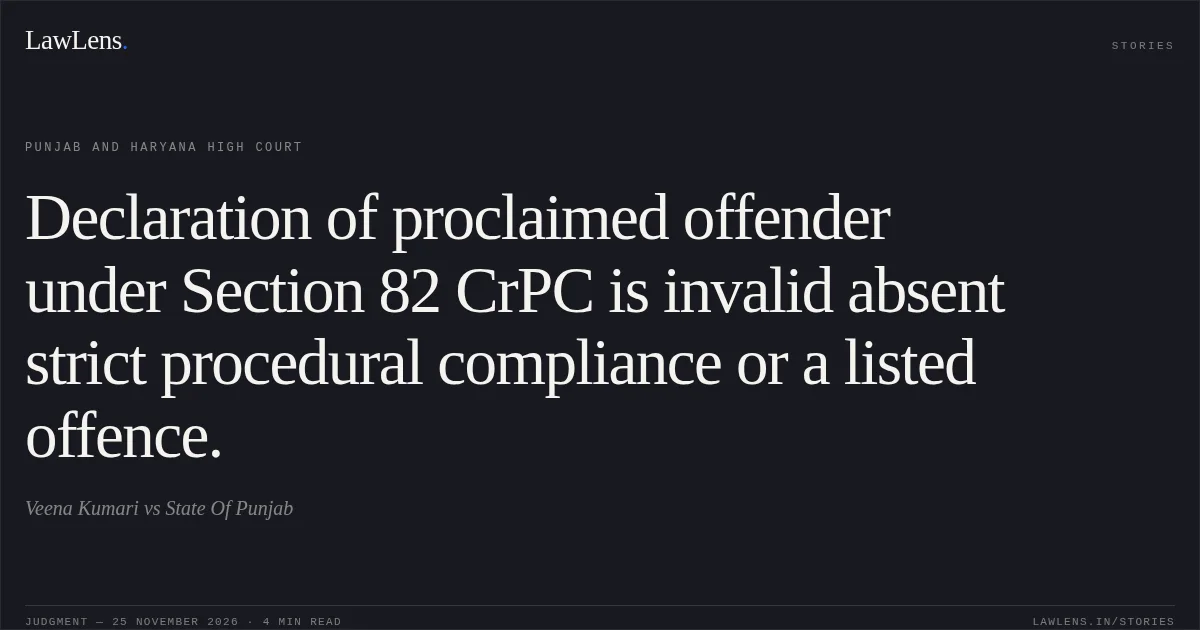
The petitioner, a resident of England, challenged the order dated 01.07.2009 of the Judicial Magistrate 1st Class, Nakodar, declaring her a proclaimed offender in Case No. 286 dated 01.11.2002 under Sections 420, 465, 466, 468 and 471 IPC (P.S. Shahkot, District Jalandhar Rural).
¶ 1 · pp. 1–2She alleged she was falsely implicated and was residing in England throughout the coercive process, a fact known to the complainant and police, yet no service was attempted through the Embassy of India in England.
¶ 2 · p. 2On 19.02.2009 the trial court ordered proclamation under Sections 82/83 CrPC.
¶ 2 · p. 2 · ¶ 6 · p. 4PHG Jagir Singh's statement, recorded on 20.04.2009, stated that he published the proclamation on 18.04.2009 by affixing copies at the Tehsil Complex door, a public place in village Shahkot, and the court notice board.
¶ 2 · pp. 2–3 · ¶ 6 · pp. 4–5The statement did not record that the proclamation was publicly read.
¶ 6 · pp. 4–5The case was then adjourned to 01.07.2009 for declaring the petitioner a proclaimed offender, and the impugned order followed.
¶ 3 · pp. 3–4The State opposed the petition, asserting intentional evasion, but did not dispute the factual submissions drawn from the trial court record.
¶ 4 · p. 402Issues
i.1. Whether the proclamation under Section 82 CrPC was published in the manner mandated by Section 82(2), including public reading at a conspicuous place in the village where the accused ordinarily resides.
¶ 6 · p. 5ii.2. Whether the mandatory minimum period of 30 days under Section 82(1) CrPC was observed before the petitioner was required to appear.
¶ 7 · pp. 5–6iii.3. Whether a person accused of offences under Sections 420, 465, 466, 468 and 471 IPC could be declared a "proclaimed offender" under Section 82(4) CrPC.
¶ 8 · p. 7iv.4. Whether the trial court complied with Section 105 CrPC, given that the accused was residing abroad and was not served through the Embassy of India.
¶ 8 · p. 703Law Applied
The court relied on Section 528 of the BNSS, 2023, as the procedural basis for quashing the impugned order.
¶ 1 · p. 1Section 82(1) CrPC permits a written proclamation only where the court has reason to believe the accused has absconded, requiring appearance at a specified place and time not less than 30 days after publication.
¶ 7 · pp. 5–6Section 82(2)(b)(i) CrPC requires that the proclamation be publicly read at a conspicuous place in the town or village where the accused ordinarily resides.
¶ 6 · p. 5Section 82(4) CrPC confines the power to declare a "proclaimed offender" to offences listed therein, including Sections 302, 304, 364, 367, 382, 392–400, 402, 436, 449, 459 and 460 IPC; a lesser offence leaves only the status of "proclaimed person."
¶ 7 · pp. 6–7 · ¶ 8 · p. 7Section 105 CrPC requires the court to take steps to secure the presence of an accused residing abroad, including service through the Embassy of India, before action is taken against him.
¶ 8 · p. 7An adjournment does not satisfy the requirements of Section 82(1) CrPC; the court described this as "well settled" but cited no authority for that proposition.
¶ 7 · p. 6Provisions in the judgment · 28 · Linked ones open on LawLens
Bharatiya Nagarik Suraksha Sanhita, 2023 Section 528
Code of Criminal Procedure, 1973 Section 82Section 83Section 105
Indian Penal Code, 1860 24 provisions
Section 302Section 304Section 364Section 367Section 382Section 392Section 393Section 394Section 395Section 396Section 397Section 398Section 399Section 400Section 402Section 420Section 436Section 449Section 459Section 460Section 465Section 466Section 468Section 47104Reasoning
The proclamation was held defective because the PHG's statement recorded affixing and notice-board display but not public reading in the accused's village, contrary to Section 82(2)(b)(i).
¶ 6 · p. 5The proclamation was published on 18.04.2009 and required appearance on 20.04.2009, only two days later, which fell far short of the 30-day minimum in Section 82(1).
¶ 7 · pp. 5–6The trial court's adjournment from 20.04.2009 to 01.07.2009 did not cure this defect, and no fresh proclamation requiring appearance on 01.07.2009 existed.
¶ 7 · p. 6The offences charged (Sections 420, 465, 466, 468, 471 IPC) are not listed in Section 82(4), so a proclaimed-offender declaration was impermissible. At most, the petitioner could be declared a "proclaimed person," a status carrying a different consequence under the statute.
¶ 8 · p. 7The undisputed record showed the petitioner was in England and the trial court made no attempt at service through the Indian Embassy, so Section 105 CrPC was overlooked.
¶ 8 · p. 7The State's allegation of deliberate evasion did not answer these procedural defects, and the State did not contest the factual record.
¶ 4 · p. 4 · ¶ 8 · p. 705Holding
The proclamation was not validly published, the 30-day period was not observed, the offences charged do not fall within Section 82(4) CrPC, and Section 105 CrPC was not complied with.
¶ 6–8 · pp. 5–7The petition was allowed and the order dated 01.07.2009 declaring the petitioner a proclaimed offender was quashed.
¶ 9 · p. 7Because the prosecution remains pending, the petitioner must surrender before the trial court/Duty Magistrate within eight weeks, whereupon she is to be admitted to bail on furnishing bonds to the court's satisfaction.
¶ 10 · pp. 7–8If she does not surrender within that period, the petition stands dismissed.
¶ 11 · p. 8Original Court PDF
Veena KumarivsState Of Punjab
Click to open original judgment
Original judgment, available to read, download and summarize on LawLens.in