Facts
The petitioner admitted that he had acted as a surety in an April 2017 loan transaction.
Source reference: p. 1–2He alleged that, in a separate loan transaction in July 2017, he was falsely shown as a guarantor on the basis of signatures forged by respondents 2 and 3, together with bank officials.
Source reference: p. 1–2Copies of the disputed documents were later relied on in arbitral and recovery proceedings against him.
Source reference: p. 1–2The original documents were held by the bank and were not within the petitioner’s control. The Magistrate declined his application under Section 156(3) CrPC, and the revisional court affirmed that decision. The petitioner challenged both orders under Section 528 BNSS.
Source reference: p. 1–2Issues
Whether the Magistrate’s refusal to direct police investigation under Section 156(3) CrPC should be set aside where the complaint alleges forgery and the originals are held by the bank.
Source reference: p. 2–4, 8Whether the disputed originals could instead be secured, preserved and, if appropriate, forensically examined through the pending complaint proceedings.
Source reference: p. 4–8Law Applied
Section 156(3) CrPC confers a discretionary power: a Magistrate must assess whether police investigation is necessary, rather than direct it mechanically; investigation may be appropriate where the complainant cannot collect the evidence or the matter requires police expertise (Mohd. Salim v. State, 2010 SCC OnLine Del 1053; Madhao v. State of Maharashtra, (2013) 5 SCC 615; Skipper Beverages (P) Ltd. v. State, 2001 SCC OnLine Del 448).
Source reference: p. 2–5After taking cognizance, a Magistrate may direct an inquiry under Section 202 CrPC to determine whether there is sufficient ground to issue process, but that inquiry is limited and is not a trial (Vadilal Panchal v. Dattatraya Dulaji Ghadigaonkar, 1960 SCC OnLine SC 79).
Source reference: p. 5–6Section 91 CrPC permits orders for production of documents necessary or desirable at the relevant stage; necessity is assessed in light of the stage and the party seeking production (State of Orissa v. Debendra Nath Padhi, (2005) 1 SCC 568; Om Parkash Sharma v. CBI, (2000) 5 SCC 679).
Source reference: p. 7–8The Court also noted that Section 91 may be used to direct preservation of documents to facilitate a fair trial (Sohail Malik v. State NCT of Delhi, 2025:DHC:6178).
Source reference: p. 8Reasoning
The Court accepted that the complaint alleged a cognizable offence, but held that this alone did not establish that police investigation under Section 156(3) was indispensable.
Source reference: p. 4–8The disputed originals could potentially be obtained and preserved through the pending complaint proceedings, including by an application under Section 91 CrPC, while Section 202 could be considered for inquiry and assistance in securing records or facilitating forensic examination.
Source reference: p. 4–8At the same time, the petitioner could not reasonably be expected to produce originals held by others. The appropriate course was therefore to permit him to identify the disputed documents, their custodians and the proposed comparison signatures, and require the Magistrate to consider the request by a reasoned order.
Source reference: p. 8Holding
The Court declined to set aside the impugned orders or direct registration of an FIR, and disposed of the petition with directions.
The petitioner may apply to the Magistrate for preservation and production of the identified original documents under Section 91 CrPC or another applicable provision; the Magistrate must consider the application expeditiously and by a reasoned order.
Source reference: p. 8–9The Magistrate must also consider whether a Section 202 inquiry and forensic examination are required, and, if so, arrange for transmission of the disputed originals and authenticated comparison material to a competent examiner.
Source reference: p. 8–9The application may not be rejected merely because the Section 156(3) application was previously declined or because no expert opinion already exists; the Court made no finding on whether forgery occurred.
Source reference: p. 9Acts & Sections Cited
11 provisions across 2 statutes referred to in this judgment. Each provision opens on LawLens.
Bharatiya Nagarik Suraksha Sanhita, 20231
Code of Criminal Procedure, 1973
Original Court PDF
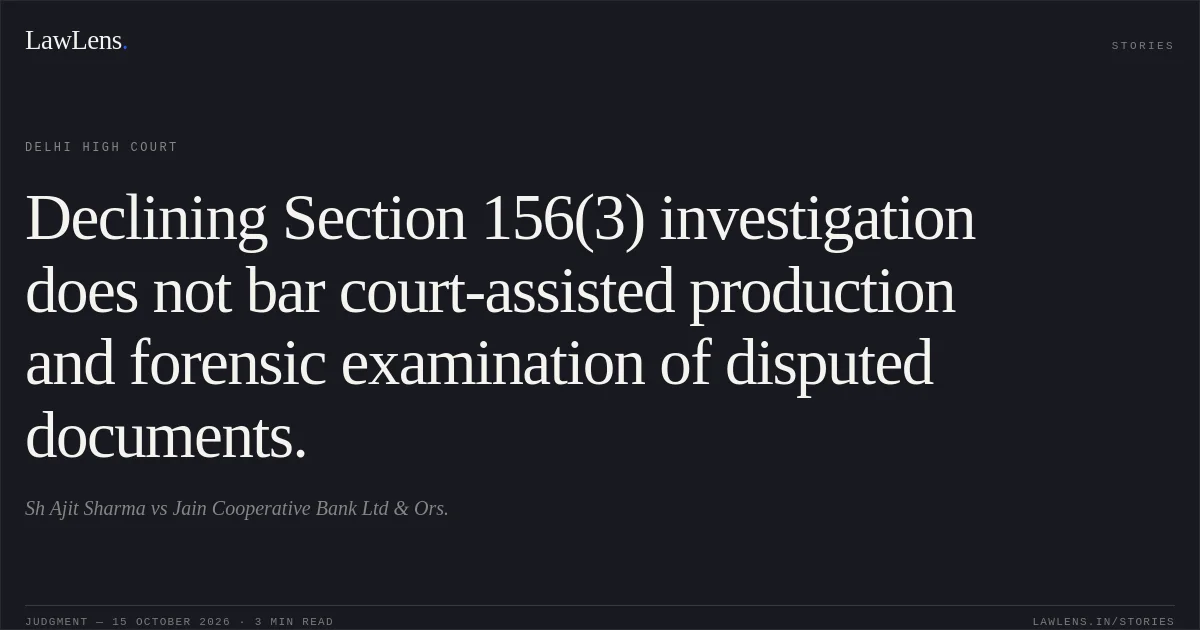
Sh Ajit SharmavsJain Cooperative Bank Ltd & Ors.
Click to open original judgment
Original judgment, available to read, download and summarize on LawLens.in