Facts
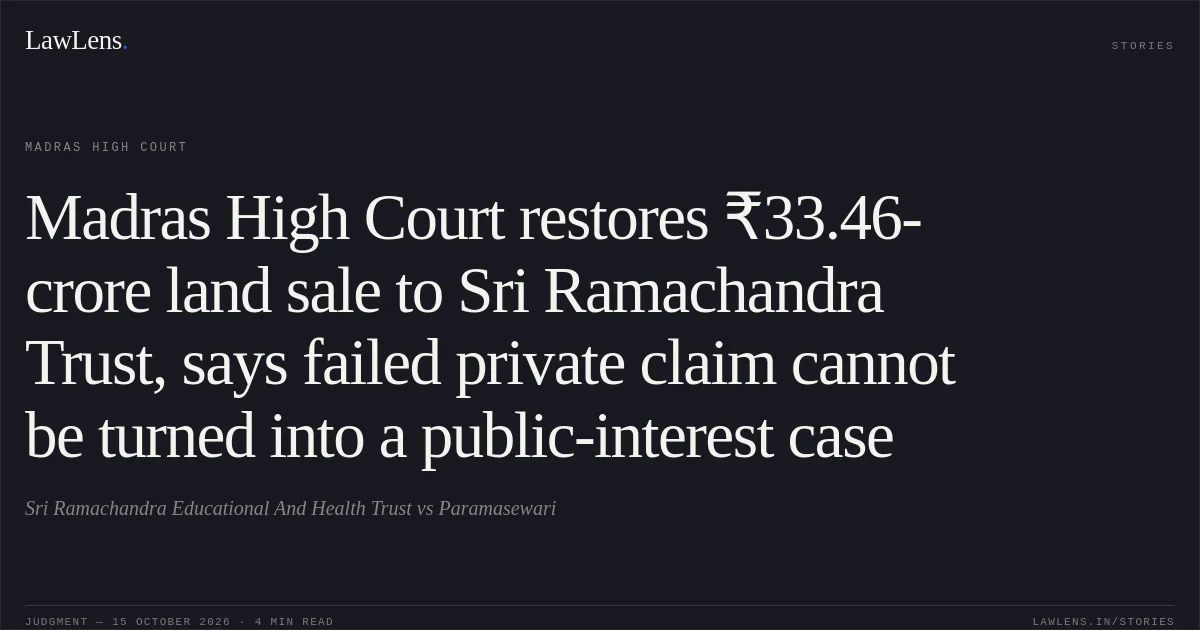
Land measuring 0.94 acre in Survey No. 102/2 was included in a 1978 acquisition for a Tamil Nadu Housing Board scheme. The writ petitioner claimed a share in the land, but twelve sale deeds were executed in 1981 in favour of purchasers, who received compensation after the acquisition award. Those purchasers transferred the land to the Trust in 1995. In 1998, the Government directed allotment of land to the Trust; the Board executed a sale deed for 7.44 acres in 2014 for Rs.33,46,79,000
Source reference: pp. 4–8, paras. 5.1–5.8In 2022, the writ petitioner sought, among other reliefs, reconveyance of her claimed share and the quashing of the Government order, Board resolution and sale deed insofar as they affected that share.
Source reference: pp. 8–13, paras. 6.1, 7.2–7.5The Single Judge rejected her reconveyance claim but quashed the Government order and sale deed in full, ordered a refund with interest, and directed the State to take over the land.
Source reference: pp. 8–13, paras. 6.1, 7.2–7.5The writ petitioner did not appeal; the Trust appealed
Source reference: pp. 3, 13–16, paras. 3, 8Issues
1. Whether a petitioner whose claimed property right and entitlement to reconveyance had been rejected could nevertheless maintain the writ petition to challenge the Government’s decision and the sale to the Trust
Source reference: pp. 18–21, paras. 11–192. Whether the Single Judge could, in that private writ petition, exercise suo motu or public-interest jurisdiction to set aside the entire Government order and sale, and grant relief beyond the petitioner’s pleaded claim
Source reference: pp. 20–23, paras. 16–213. Whether the petitioner’s submissions under Sections 16-B and 48-B of the Land Acquisition Act, 1894, Section 72 of the Tamil Nadu Housing Board Act, and the asserted absence of public purpose justified sustaining the impugned order
Source reference: pp. 26–33, paras. 29–40Law Applied
Under Article 226, a petitioner ordinarily must establish a legal right of their own or a breach of public duty affecting them; exceptions include genuine public-interest proceedings and certain prerogative writs
Source reference: p. 18, para. 13Ayaaubkhan Noorkhan Pathan v. State of Maharashtra, (2013) 4 SCC 465, recognises that a court may exceptionally consider a grievance raised by a person without a personal agenda where those affected cannot come forward; a private claimant who fails on their own claim cannot thereby become a public-interest litigant
Source reference: pp. 19–20, paras. 15–16Relief may be moulded only where the petitioner establishes a right; it cannot be enlarged into a materially different remedy after that right fails
Source reference: p. 22, para. 21Section 48-B of the Land Acquisition Act gives an eligible owner an opportunity to have a reconveyance request considered, but the decision rests with the Government; Section 16-B concerns Government forfeiture of unused acquired land
Source reference: pp. 23, 29, paras. 23, 34Section 3(f)(vi) addresses public purposes for acquisition and does not govern the later Government decision concerning surplus land already vested in the State
Source reference: pp. 30–31, para. 36Under Section 72 of the Housing Board Act, the Board cannot independently dispose of unused land; the Government’s decision is material, as discussed in R. Shanmugam v. State of Tamil Nadu, 2006 (4) CTC 290
Source reference: pp. 26–27, 33, paras. 29, 40Reasoning
The petitioner’s case was a private claim for reconveyance of her asserted share, not a public-interest petition. The Single Judge rejected her enforceable right and entitlement to reconveyance, findings the Division Bench affirmed; she was also shown as a vendor in the 1981 deeds and had not challenged them for decades
Source reference: pp. 22–24, paras. 22–23Having found no right in the petitioner, the writ court should have dismissed the petition rather than invoke suo motu jurisdiction to review the Government’s conduct at large
Source reference: pp. 19–21, paras. 15–19The full quashing of an order covering multiple survey numbers and the cancellation of a 7.44-acre sale exceeded the pleaded request, which concerned only the petitioner’s claimed share; the court also made findings affecting persons who were not before it
Source reference: pp. 21–23, paras. 20–21; pp. 25–26, paras. 26–27The Division Bench further considered the petitioner’s statutory and public-purpose arguments, observing that the Government had made the allotment decision, fixed the price and directed the Board to act, while the alleged misuse and undervaluation were unsupported or matters for the competent authorities or evidentiary proceedings
Source reference: pp. 26–33, paras. 29–40The Court’s central determination, however, was that these issues could not sustain the Single Judge’s broad relief in a petition brought by a claimant whose own right had failed
Source reference: pp. 33–35, paras. 41–42Holding
The appeal was allowed. The findings that the petitioner had no enforceable right, was not the owner when the Section 6 declaration issued, and was not entitled to reconveyance under Section 48-B were affirmed.
The findings on Issues 3 and 4 and the directions quashing G.O.Ms.No.208, setting aside the sale deed, ordering repayment with interest and requiring the State to take over the land were set aside. The Government order, Board resolution and 2014 sale deed were restored, and the writ petition was dismissed without costs
Source reference: pp. 34–36, paras. 42–43Acts & Sections Cited
2 provisions across 1 statute referred to in this judgment. Each provision opens on LawLens.
Registration Act, 19082
Original Court PDF
Sri Ramachandra Educational And Health TrustvsParamasewari
Click to open original judgment
Original judgment, available to read, download and summarize on LawLens.in