Facts
The Appellant (plaintiff) obtained a decree for specific performance on 03.03.2017, directing him to pay the balance consideration of ₹57,50,000 within one month
Source reference: para. 3The Appellant issued a notice to the Respondent (defendant) on 01.04.2017 to execute the sale deed, but the Respondent refused and filed an appeal
Source reference: para. 4-5Although the Appellant applied for execution on 18.07.2017, he did not deposit the money in court until 26.11.2020, following a specific court order to test his bona fides
Source reference: para. 6-9The Respondent subsequently applied under Section 28 of the Specific Relief Act (1963 Act) to rescind the contract due to non-payment within the period stipulated in the decree
Source reference: para. 13The Execution Court dismissed the execution application and rescinded the contract, a decision upheld by the Madhya Pradesh High Court
Source reference: para. 14-15Issues
1. Whether the decree of specific performance passed by the trial court merged in the order of the appellate court when the appeal was dismissed for non-prosecution?
Source reference: para. 19 / para. 202. Whether an application under Section 28 of the 1963 Act is maintainable after the court has granted permission to deposit the balance amount and such deposit has been made?
Source reference: para. 19 / para. 233. Whether the rescission of the contract was vitiated by a failure to consider the equities and the power to extend time for deposit under Section 28?
Source reference: para. 19 / para. 34Law Applied
The court primarily applied Section 28 of the Specific Relief Act, 1963, which allows for the rescission of a contract if the purchaser fails to pay the money within the period allowed by the decree or such further period as the court may allow
Source reference: para. 24It relied on Sardar Mohar Singh v. Mangilal, establishing that a court does not become functus officio after passing a decree and retains the power to extend time
Source reference: para. 25It further applied the principle from Kunhayammed v. State of Kerala regarding the doctrine of merger, noting it does not apply to dismissals for default
Source reference: para. 21Under Order XX Rule 12A of the CPC, the court is required to specify the payment period in a decree for specific performance
Source reference: para. 32Reasoning
The Court first determined that because the Respondent’s appeal was dismissed for non-prosecution, it did not constitute an adjudication on merits; thus, the Trial Court’s decree did not merge into an appellate decree
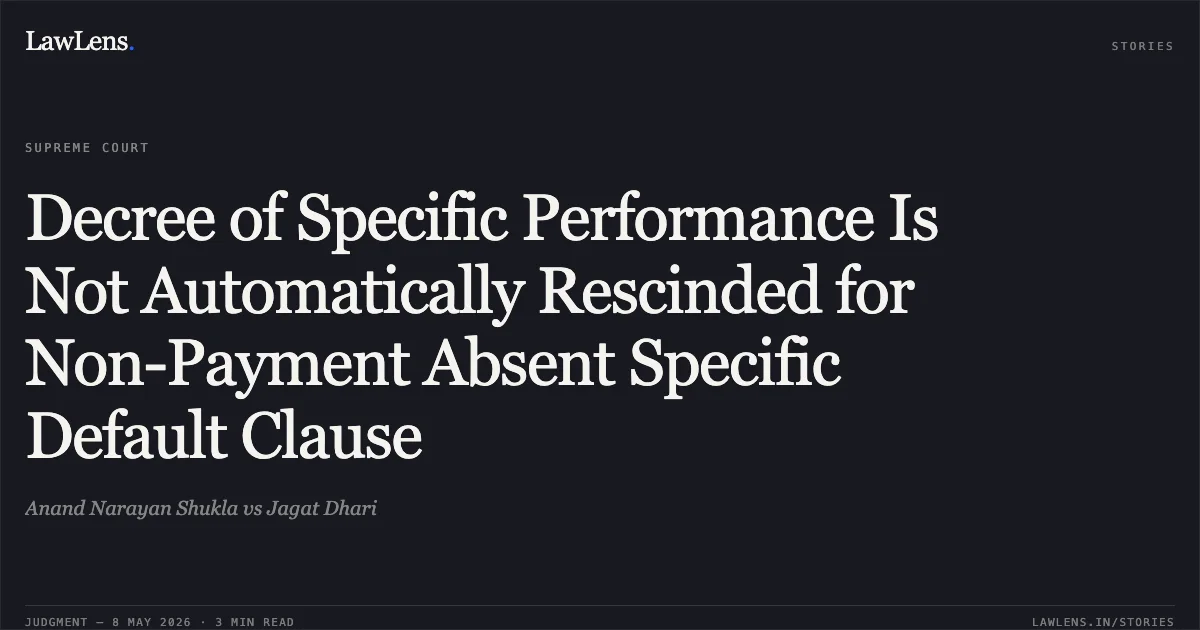
Source reference: para. 22Regarding Section 28, the Court reasoned that the provision is discretionary (“may rescind”) and does not result in automatic rescission unless the decree expressly provides for dismissal upon default
Source reference: para. 24, 33(ii)The Court observed that the lower courts adopted a hyper-technical approach by failing to treat the execution proceedings as a continuation of the suit where time could be enlarged
Source reference: para. 28-30The Court emphasized that specific performance is an equitable relief; therefore, the conduct of the decree-holder must show "willful negligence" or "positive refusal" to perform before rescission is granted
Source reference: para. 32-33the lower courts ignored the fact that the Appellant had attempted notice, the Respondent had filed an appeal, and the deposit was eventually made under court direction
Source reference: para. 36-40Holding
It held that: (1) there was no merger as the appeal was dismissed for default; (2) the court retains jurisdiction to extend time even after the stipulated period has expired; and (3) the power to rescind must be exercised judiciously by balancing equities, such as compensating the vendor for delay rather than terminating the decree
The Supreme Court allowed the appeal and set aside the orders of the High Court and Execution Court. The matter was remanded to the Execution Court to decide the applications for rescission and extension of time afresh as interlocutory applications in the original suit
Source reference: para. 41-42Acts & Sections Cited
6 provisions across 3 statutes referred to in this judgment. Each provision opens on LawLens.
Specific Relief Act, 19631
Code of Civil Procedure, 19084
Limitation Act, 19631
Original Court PDF
Anand Narayan ShuklavsJagat Dhari
Click to open original judgment
Original judgment, available to read, download and summarize on LawLens.in