Facts
The petitioner’s predecessor was granted a mining lease for Silica Sand in 1979 for ten years
Source reference: p.1-2A first renewal was granted from 1989 to 1999
Source reference: p.2Before the expiry of the first renewal, the petitioner applied for a second renewal on 12.06.1998
Source reference: p.2Mining operations were halted in 2011 due to the lack of an Environment Clearance Certificate
Source reference: p.2During the pendency of the renewal application, the MMDR (Amendment) Act, 2015 introduced Section 8A, and Silica Sand was subsequently declared a "minor mineral" in 2015
Source reference: p.3-4The petitioner previously approached the High Court in 2016, which directed the authorities to consider his application under the U.P. Minor Minerals (Concession) Rules, 1963
Source reference: p.3The respondent authority rejected the application on 26.04.2017, citing the lack of a provision for second renewal under the 1963 Rules and alleging the lease had lapsed
Source reference: p.4-5Issues
1. Whether the petitioner is entitled to a deemed extension of the mining lease for 50 years under Section 8A(6) of the MMDR (Amendment) Act, 2015
Source reference: p.5 / para. 232. Whether the second renewal application filed in 1998 constituted a "valid application" as required to trigger statutory benefits
Source reference: p.18 / para. 523. Whether the transition of Silica Sand from a major to a minor mineral subjects the lease exclusively to the U.P. Minor Mineral (Concession) Rules, 1963
Source reference: p.11-12 / para. 44Law Applied
Section 8A(6) of the MMDR Act, 1957 (as amended in 2015), which provides for the deemed extension of leases for non-captive mines up to March 31, 2020, or for 50 years from the date of grant, provided all terms and conditions of the lease are complied with
Source reference: p.14-15Common Cause v. Union of India (2016) 11 SCC 455, which clarified that such benefits only accrue if a "valid application" for renewal was pending and no breaches of lease terms occurred
Source reference: p.24-26Goa Foundation v. Union of India (2014) 6 SCC 590, establishing that Rule 24A(6) regarding deemed extensions does not apply to second renewals
Source reference: p.22-23Section 14 and 15 of the MMDR Act were cited to establish the State’s power over minor minerals
Source reference: p.4, 13Reasoning
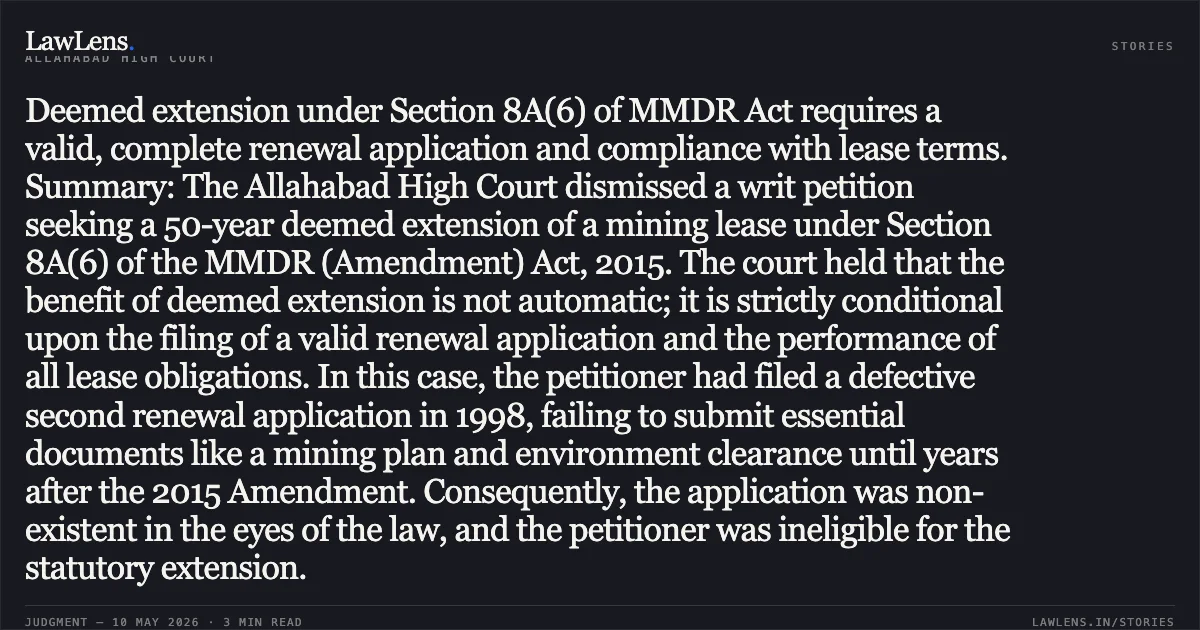
The Court reasoned that for Section 8A(6) to apply, the renewal application must be "valid" and the lessee must have complied with all lease conditions
Source reference: para. 65, 85Upon examining the petitioner’s 1998 Form-J application, the Court found it fundamentally defective as it lacked a "No Dues Certificate" and a mandatory mining plan
Source reference: para. 54-57These deficiencies were only cured in 2013 and 2015 respectively—long after the 2015 Amendment came into force
Source reference: para. 56, 80Furthermore, the petitioner continued mining operations after 1999 without a valid mining plan or Environment Clearance (obtained only in 2016), which constituted a breach of the "terms and conditions" of the lease
Source reference: para. 79-82While the Court noted the respondent's finding of "lapse" was technically incorrect under Rule 28(1), it held that the petitioner was ineligible for the benefit because a defective application is "no application in the eye of law"
Source reference: para. 98-103Holding
The Court held that the petitioner is not entitled to a statutory extension under Section 8A(6) of the 2015 Act because his renewal application was invalid and he failed to comply with the essential terms of the lease (specifically the requirement for a mining plan and environmental clearances)
The Court dismissed the writ petition, concluding that while some findings in the impugned order were technically flawed, quashing it would be a "futile writ" as the petitioner has no legal right to the extension
Source reference: para. 103-104Resultantly, the petition was dismissed without costs
Source reference: para. 104Acts & Sections Cited
11 provisions across 2 statutes referred to in this judgment. Each provision opens on LawLens.
Mines and Minerals (Development and Regulation) Act, 1957
Original Court PDF
Rameshwar Dutt AwasthivsState Of U.P. And 4 Others
Click to open original judgment
Original judgment, available to read, download and summarize on LawLens.in


