Facts
The petitioner, President of Lanchamukta Karnataka Vedike, alleged that Siddartha Vihar Trust, despite having secular charitable objects benefiting persons irrespective of caste, creed or religion, falsely claimed eligibility under the Scheduled Caste category to obtain allotment of civic amenity sites from the Bangalore Development Authority (“BDA”).
Source reference: p.4–5; paras. 3.1–3.2It was further alleged that the Trust secured a 50% concession in the lease amount, obtained an alternative and allegedly more valuable site, and retained the property without constructing the proposed institution, allegedly through the influence of the trustees and collusion with BDA officials.
Source reference: p.5–6; paras. 3.2–3.3After the petitioner’s complaints to the High Grounds Police Station and the Superintendent of Police, Karnataka Lokayukta, allegedly did not result in registration of an FIR, he filed a private complaint before the Special Court seeking investigation under Section 175(3) of the Bharatiya Nagarik Suraksha Sanhita, 2023 (“BNSS”).
Source reference: p.5–6; paras. 3.3–3.4By order dated 11 August 2026, the LXXXI Additional City Civil and Sessions Judge declined to refer the matter for investigation, holding that the supporting affidavit did not satisfy Section 333(2) of the BNSS, and instead directed an enquiry under Section 223 of the BNSS.
Source reference: p.19–20; para. 7The petitioner challenged that course of action, contending that the affidavit defect was curable and that the allegations required investigation into official records, BDA decision-making and the role of public servants.
Source reference: p.7–9; paras. 4.1–4.3Issues
Whether the Special Court was justified in directing an enquiry under Section 223 of the BNSS instead of following the procedure under Section 175(3) of the BNSS?
Source reference: p.9–10; para. 7Whether the alleged defect in the complainant’s affidavit under Sections 175(3) and 333(2) of the BNSS was incurable, or whether the complainant ought to have been given an opportunity to rectify it before the Court proceeded further?
Source reference: p.23–24; paras. 11–12Whether, in a complaint involving alleged corruption and public servants, the statutory safeguards under Sections 175(3) and 175(4) of the BNSS were required to be followed before deciding whether to order investigation?
Source reference: p.17–19; paras. 13–15Law Applied
Section 175(3) of the BNSS empowers a Magistrate competent to take cognizance to order investigation, but requires consideration of the complainant’s application to the Superintendent of Police, such enquiry as the Court considers necessary, and the submissions of the police officer.
Source reference: p.15–17; paras. 10–12Section 175(4) provides an additional safeguard where the accusation concerns a public servant acting in the course of official duty, including consideration of a superior officer’s report and the public servant’s assertions.
Source reference: p.17–19; para. 13Section 333(2) requires an affidavit to distinguish facts based on personal knowledge from facts based on reasonable belief and to state the grounds of such belief.
Source reference: p.18–19; para. 14Section 223 governs examination of the complainant and witnesses in complaint proceedings, whereas Section 175(3) is the investigative route where evidence must be collected beyond the complainant’s personal knowledge.
Source reference: p.21–22; para. 10Relying on Om Prakash Ambadkar v. State of Maharashtra, 2025 SCC OnLine SC 238, XXX v. State of Kerala, 2026 SCC OnLine SC 114, and S.N. Vijayalakshmi v. State of Karnataka, 2025 SCC OnLine SC 1575, the Court held that the affidavit requirement is mandatory as a safeguard but that its non-filing or defective filing is a curable procedural defect, which must be rectified before any substantive order directing investigation is made.
Source reference: p.15–19, 27–30; paras. 10–18The Court also relied on Priyanka Srivastava v. State of Uttar Pradesh and Babu Venkatesh v. State of Karnataka concerning the mandatory nature and purpose of the affidavit requirement.
Source reference: p.28–30; para. 18Reasoning
The Court held that the allegations concerned alleged manipulation of BDA records, misuse of public office, grant of an undue advantage, irregular concession of lease charges and allotment of an alternative public property.
Source reference: p.20–22; paras. 8–10Determining who processed the applications, the basis for treating the Trust as eligible under the Scheduled Caste category, the official notings, the role of BDA officials and any collusion could not reasonably be established by the complainant alone through a Section 223 enquiry; these matters required collection and examination of official records through investigation.
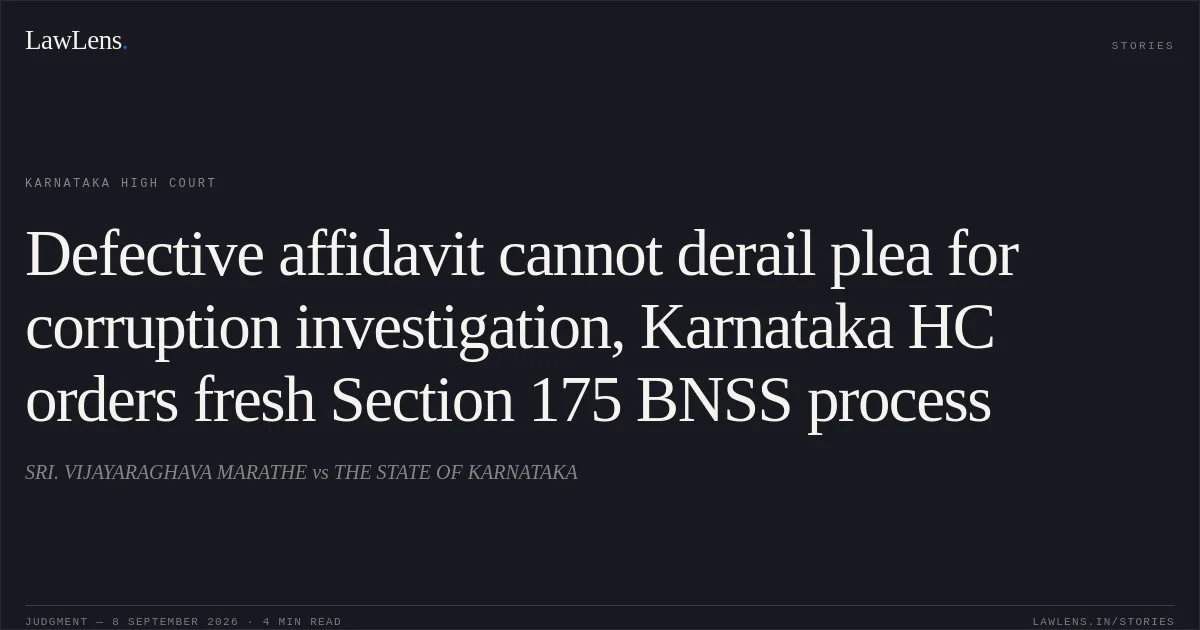
Source reference: p.20–22; paras. 8–10Although the Special Court correctly identified the requirements under Sections 175(3), 175(4) and 333(2) of the BNSS, it erred by treating the defective affidavit as a reason to abandon the Section 175 procedure altogether.
Source reference: p.22–24; paras. 11–12The defect was procedural and capable of rectification.
Source reference: p.23–26; paras. 13–17The Court emphasised that the affidavit safeguard remained mandatory, but it could not be converted into a procedural bar preventing consideration of an otherwise investigable complaint.
Source reference: p.23–26; paras. 13–17Accordingly, the complainant had to be given an opportunity to file a properly verified affidavit, after which the Special Court was required to consider the prayer for investigation in accordance with Sections 175(3) and 175(4) of the BNSS and the applicable provisions of the Prevention of Corruption Act.
Source reference: p.24–26; paras. 15–17Holding
The criminal petition was allowed in part.
The High Court set aside the order dated 11 August 2026 insofar as it directed an enquiry under Section 223 of the BNSS.
Source reference: p.35; para. 26(i)–(ii)The matter was remitted to the Special Court with directions to permit the complainant to cure the defect in the affidavit and thereafter proceed strictly under Section 175 of the BNSS, including compliance with the safeguards under Sections 175(3) and 175(4), wherever applicable.
Source reference: p.34–36; paras. 24, 26(ii)–(iii)The High Court expressly clarified that it had not adjudicated the merits or truth of the allegations, leaving that question to the concerned Court after following the prescribed procedure.
Source reference: p.34–36; paras. 24–26Acts & Sections Cited
21 provisions across 5 statutes referred to in this judgment. Each provision opens on LawLens.
Bharatiya Nagarik Suraksha Sanhita, 20237
Bharatiya Nyaya Sanhita, 20235
Prevention of Corruption Act, 19881
Code of Criminal Procedure, 19733
Indian Penal Code, 18605
Original Court PDF
SRI. VIJAYARAGHAVA MARATHEvsTHE STATE OF KARNATAKA
Click to open original judgment
Original judgment, available to read, download and summarize on LawLens.in