Facts
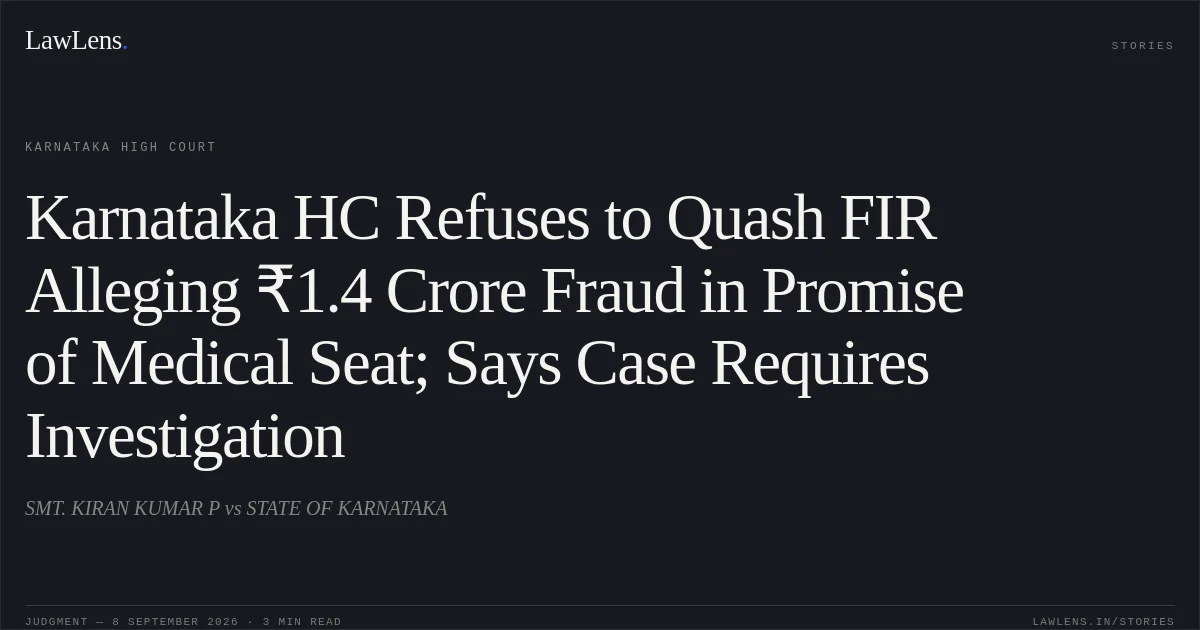
The petitioners, accused Nos. 1 and 2, respectively, challenged Crime No. 220/2026 registered by Bagalagunte Police for offences under Sections 406, 420 and 34 of the IPC, invoking the High Court’s inherent jurisdiction under Section 482 CrPC/Section 528 BNSS.
Source reference: pp. 3–4, para. 1The complainant alleged that accused No. 1, whom she met at Prakriya Hospital, represented that she and her husband had influential contacts and could secure an MBBS seat for the complainant’s daughter.
Source reference: pp. 4–6, para. 4Relying on this representation, the complainant paid ₹35,00,000 in cash and transferred a further ₹1,05,00,000 to accused No. 2’s bank account between July and September 2023.
Source reference: pp. 4–6, para. 4; pp. 8–11The accused allegedly collected the daughter’s documents, repeatedly delayed the admission, and ultimately failed either to secure the medical seat or refund the ₹1,40,00,000.
Source reference: pp. 4–6, para. 4; pp. 8–11The complaint was lodged on 6 June 2026; a zero FIR registered at Kaggalipura Police Station was transferred to Bagalagunte Police Station, where the crime was registered on 7 June 2026.
Source reference: pp. 6, 11–12, para. 4The petitioners contended that the dispute was merely civil in nature, that the criminal process had been initiated for recovery of money, and that there was substantial delay in lodging the complaint.
Source reference: p. 6, para. 5The State opposed quashing on the ground that the allegations disclosed cognizable offences and investigation was still in progress.
Source reference: p. 7, para. 6Issues
Whether the allegations in the complaint, taken at face value, prima facie disclose the offences of criminal breach of trust under Sections 405/406 IPC and cheating under Sections 415/420 IPC?
Source reference: pp. 12–20, paras. 8–14Whether the criminal proceedings should be quashed under the High Court’s inherent jurisdiction on the ground that the dispute is essentially civil or monetary and the complaint was lodged after delay?
Source reference: pp. 12–13, para. 9; pp. 20–22, paras. 15–18Law Applied
The Court applied Sections 405 and 406 IPC, under which criminal breach of trust requires entrustment of property or dominion over property followed by dishonest misappropriation, conversion, or use contrary to the terms of the entrustment.
Source reference: pp. 14–18, paras. 11–12It applied Sections 415 and 420 IPC, holding that cheating requires deception and dishonest or fraudulent inducement which causes the person deceived to deliver property or suffer harm; for Section 420, the dishonest intention must exist at the inception of the transaction.
Source reference: pp. 16–20, paras. 11 and 13–14The Court also applied Section 34 IPC concerning acts done by several persons in furtherance of common intention, and the principles governing exercise of inherent jurisdiction under Section 482 CrPC/Section 528 BNSS.
Source reference: no citationAt the quashing stage, the Court must assess whether the complaint, taken at face value, discloses cognizable offences; it should not conduct a mini-trial or terminate investigation where the allegations prima facie require investigation.
Source reference: pp. 12–13, 18–22, paras. 8–18Reasoning
The Court held that the alleged payment of ₹1,40,00,000 was not presented merely as an ordinary loan or commercial advance, but as money entrusted for the specific purpose of securing an MBBS seat.
Source reference: p. 18, para. 12The allegation that neither the seat was secured nor the money returned, coupled with the assertion that the amount was dishonestly appropriated, prima facie satisfied the elements of entrustment and dishonest misappropriation under Sections 405 and 406 IPC.
Source reference: p. 18, para. 12The complaint also alleged that the petitioners represented that they possessed influential contacts and could secure admission, thereby inducing the complainant to part with the money.
Source reference: pp. 19–20, paras. 13–14The Court considered this sufficient, at the threshold, to disclose deception and dishonest intention connected with the inducement, rather than a mere subsequent breach of contract.
Source reference: pp. 19–20, paras. 13–14The fact that the complainant delayed approaching the police and that the transaction involved recovery of money did not, by itself, justify quashing.
Source reference: pp. 20–22, paras. 15–18The continued assurances and alleged postponements were matters for investigation, and the label of “civil dispute” could not extinguish an otherwise prima facie criminal allegation.
Source reference: pp. 20–22, paras. 15–18Holding
The Court answered both issues against the petitioners.
It held that the complaint prima facie disclosed the ingredients of offences under Sections 406 and 420 IPC and that the allegations required investigation.
Source reference: pp. 18–22, paras. 12–18Delay in lodging the complaint and the possibility of a monetary recovery component were insufficient grounds to invoke the inherent jurisdiction to quash the FIR.
Source reference: pp. 18–22, paras. 12–18Finding no merit in the petitions, the High Court rejected Criminal Petition Nos. 10705 and 10794 of 2026, leaving Crime No. 220/2026 to proceed in accordance with law.
Source reference: p. 22, para. 19Acts & Sections Cited
7 provisions across 3 statutes referred to in this judgment. Each provision opens on LawLens.
Code of Criminal Procedure, 19731
Bharatiya Nagarik Suraksha Sanhita, 20231
Indian Penal Code, 18605
Original Court PDF
SMT. KIRAN KUMAR PvsSTATE OF KARNATAKA
Click to open original judgment
Original judgment, available to read, download and summarize on LawLens.in