Facts
The appellant filed an Election Petition challenging the election of the respondent, the returned candidate from No. 7 Karimganj Parliamentary Constituency, Assam, in the 2024 Lok Sabha elections.
Source reference: pp. 1–4; paras. 1–4, 7The High Court dismissed the Election Petition under Section 86 of the Representation of the People Act, 1951 (“RoP Act”), principally on the ground that the copies served on the respondent were not properly attested.
Source reference: pp. 1–4; paras. 1–4, 7The objections concerned: (i) the absence of visible notarisation or attestation on the copy of the affidavit in Form-25 filed under Section 83(1) of the RoP Act and Rule 94A of the Conduct of Elections Rules, 1961; (ii) the use of different endorsements—“attested to be true copy of the petition” and “certified to be true copy”—on different pages; and (iii) alleged missing pages 11, 16, 21 and 22.
Source reference: pp. 1–4; paras. 1–4, 7The High Court accepted the attestation objection but rejected the allegation regarding missing pages as an afterthought. The appellant appealed to the Supreme Court.
Source reference: pp. 1–4; paras. 1–4, 7Issues
1. Whether the use of different rubber-stamp endorsements on the copies of the Election Petition resulted in non-compliance with Section 81(3) of the RoP Act and warranted dismissal under Section 86.
Source reference: pp. 3–6; paras. 5, 8–92. Whether the absence of visible notarisation or attestation on the copy of the Form-25 affidavit served on the returned candidate constituted a defect requiring dismissal of the entire Election Petition under Section 86.
Source reference: pp. 6–12; paras. 10–213. Whether the alleged missing pages from the copy of the Election Petition justified interference with the High Court’s order.
Source reference: p. 4; para. 7Law Applied
Section 81(3) of the RoP Act requires an Election Petition to be accompanied by copies for the respondents, each copy being attested by the Election Petitioner under his or her own signature as a true copy of the petition; no particular form or wording of attestation is prescribed.
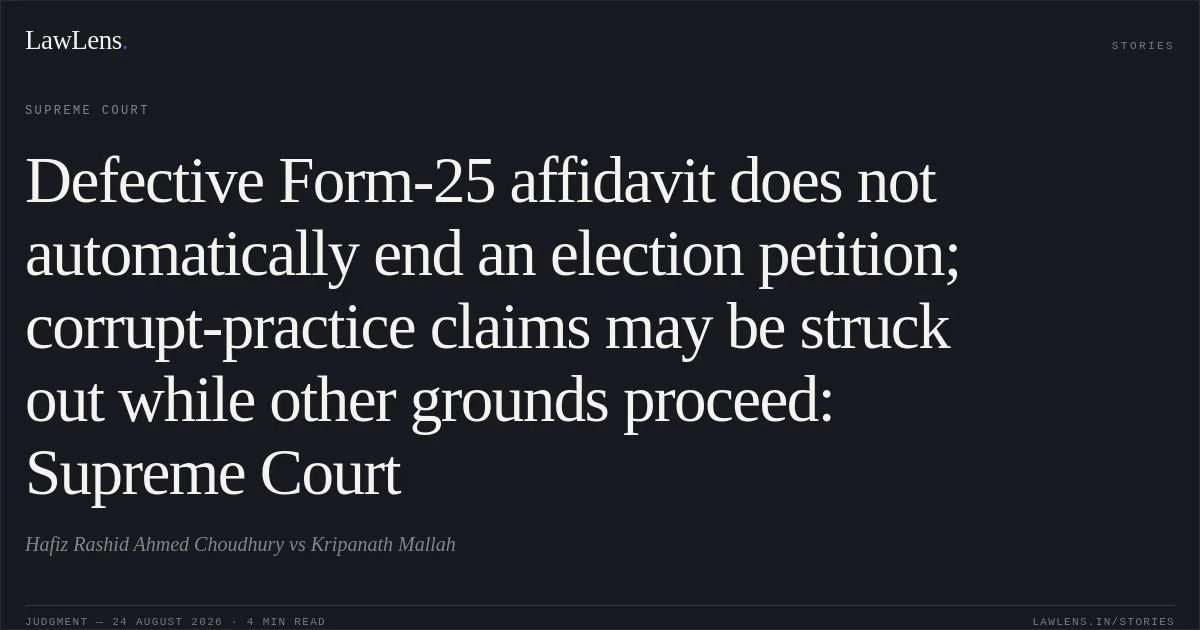
Source reference: pp. 5–6; para. 8Section 86 mandates dismissal only for non-compliance with Sections 81, 82 or 117, whereas defects relating to Section 83, including the proviso concerning the affidavit supporting allegations of corrupt practices, do not ordinarily warrant peremptory dismissal.
Source reference: pp. 5–6; para. 8Rule 94A of the Conduct of Elections Rules, 1961 and Form-25 require the affidavit alleging corrupt practices to be affirmed before a Magistrate of the First Class, Notary or Commissioner of Oaths.
Source reference: pp. 5–6; para. 8In F.A. Sapa v. Singora, the Court held that the petitioner’s signature certifying the copy as true is sufficient and that no prescribed form of attestation is necessary.
Source reference: pp. 5–6; para. 8Dr. Shipra v. Shanti Lal Khoiwal was held not to have been overruled by T.M. Jacob v. C. Poulose; rather, T.M. Jacob distinguished cases where the copy contained an endorsement indicating due affirmation but omitted the notary’s particulars from cases showing no indication of attestation at all.
Source reference: pp. 8–10; paras. 13–16However, the Constitution Bench ruling in Murarka Radhey Shyam Ram Kumar v. Roop Singh Rathore holds that defects in verification or absence of an endorsement in the copy are not fatal where they do not mislead the returned candidate, and that the copy need only be sufficiently true to avoid a reasonable possibility of misunderstanding.
Source reference: pp. 12–14; paras. 22–25Reasoning
The Supreme Court held that the different endorsements used on pages 1–84 and pages 85–185 conveyed the same substantive meaning—that the copies were true copies of the Election Petition.
Source reference: pp. 5–6; para. 9Since Section 81(3) prescribes the petitioner’s certification but does not prescribe any particular wording, the High Court erred in treating the variation in rubber stamps as non-compliance.
Source reference: pp. 5–6; para. 9As to Form-25, the Court noted that the copies supplied to the respondent contained no indication of notarisation or affirmation, making the case factually similar to Dr. Shipra rather than T.M. Jacob.
Source reference: pp. 6–11; paras. 10–20Nevertheless, the Court applied the controlling principle in Murarka Radhey Shyam Ram Kumar: even if the copy lacked the attestation endorsement, the defect did not automatically attract Section 86 because Section 86 concerns non-compliance with Sections 81, 82 and 117, not every defect under Section 83.
Source reference: pp. 11–14; paras. 21–25The High Court was therefore directed to verify whether the original Form-25 affidavit filed before it had in fact been duly affirmed before the Commissioner of Affidavits.
Source reference: p. 14; para. 26If duly affirmed, the Election Petition was to proceed on merits; if not, only the allegations of corrupt practices were to be excluded, while independent grounds of challenge could still be adjudicated.
Source reference: p. 14; para. 26The finding regarding missing pages was a factual conclusion that the objection was an afterthought, and the Supreme Court found no reason to interfere with it.
Source reference: p. 4; para. 7Holding
The appeal was allowed and the High Court’s order dismissing the Election Petition was set aside.
The Election Petition was restored to the High Court for fresh consideration.
Source reference: pp. 14–15; paras. 26–28The High Court was directed to verify whether the original Form-25 affidavit had been duly attested and affirmed.
Source reference: pp. 14–15; paras. 26–28If so, the petition was to proceed on merits; if not, the allegations of corrupt practices could not be pursued, but any other independent grounds of challenge were to be tried and decided.
Source reference: pp. 14–15; paras. 26–28Acts & Sections Cited
5 provisions across 1 statute referred to in this judgment. Each provision opens on LawLens.
Representation of the People Act, 19515
Original Court PDF
Hafiz Rashid Ahmed ChoudhuryvsKripanath Mallah
Click to open original judgment
Original judgment, available to read, download and summarize on LawLens.in