Facts
Defendant No. 1’s Written Statement was taken on record on 13 August 2024, and the Plaintiffs were directed to file a replication within 30 days, by 12 September 2024.
Source reference: p.2, para. 2.1The Plaintiffs filed the replication and an application for condonation of delay, but both remained under Registry objections.
Source reference: pp.2–3, paras. 2.1–2.3The Plaintiffs contended that the replication had initially been filed on 24 September 2024, with an 11-day delay, and that subsequent delay in curing defects was caused by the length of the Written Statement, verification requirements, loss of the original hard copy, and change of counsel.
Source reference: pp.2–3, paras. 2.1–2.3The Defendants asserted that the replication was first filed on 26 September 2024, re-filed on 5 November 2024, and continued to remain defective beyond the permissible period under the Delhi High Court (Original Side) Rules, 2018 (“DHC Rules”).
Source reference: pp.4–6, paras. 3.1–3.6By order dated 20 May 2025, the Joint Registrar declined to grant further time and held that neither the replication nor the accompanying condonation application could form part of the record.
Source reference: p.6, para. 5The Plaintiffs challenged that order under Rule 5 of Chapter II of the DHC Rules.
Source reference: p.1, para. 1Issues
1. Whether the Plaintiffs’ replication and accompanying application for condonation of delay could be taken on record despite their failure to cure Registry defects within the time prescribed by Chapter IV Rule 3 of the DHC Rules.
Source reference: pp.6–8, paras. 5–92. Whether the Plaintiffs had shown sufficient cause and bona fide circumstances warranting condonation of the delay of more than six months in curing the defects.
Source reference: p.7, paras. 6–7; p.8, paras. 10–113. Whether the Joint Registrar erred in refusing further time and closing the Plaintiffs’ right to rely on the replication.
Source reference: pp.6–9, paras. 5–12Law Applied
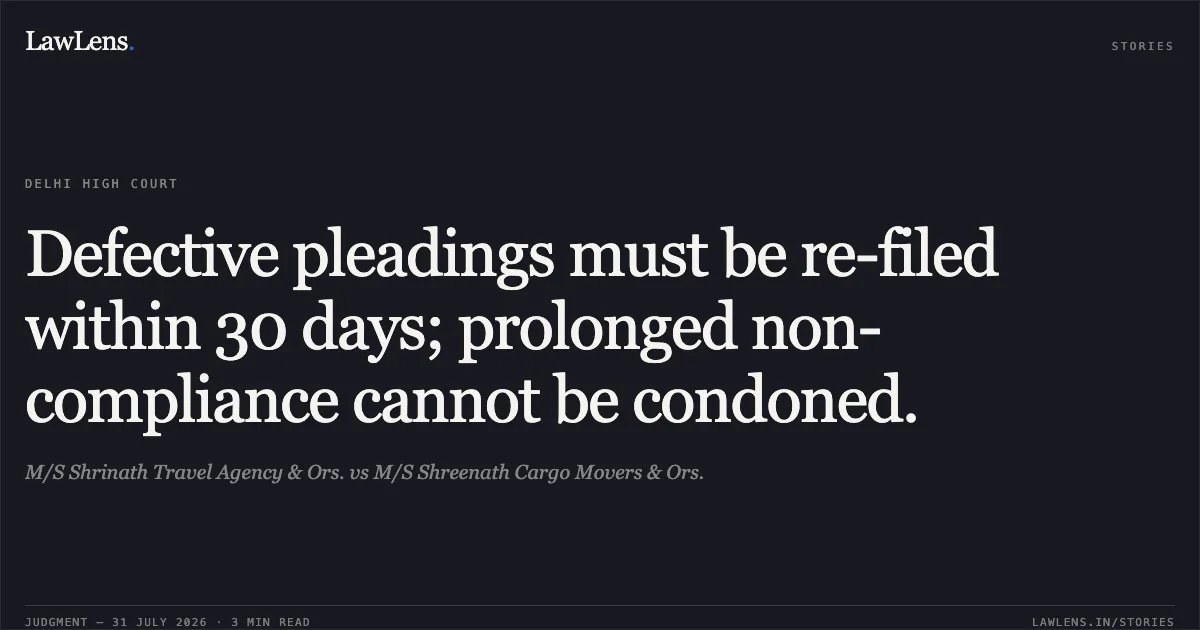
Chapter IV Rule 3(a) of the DHC Rules requires a defective pleading or document to be amended and re-filed within seven days at a time and within an aggregate period of 30 days; under Rule 3(c), a filing beyond that period must be accompanied by an application for condonation of delay.
Source reference: p.7, para. 8The Court relied on COSCO (India) Ltd. v. Paramsukh Nirman Pvt. Ltd., 2019 SCC OnLine Del 9633, for the principle that the prescribed period for curing defects cannot ordinarily be bypassed through general inherent powers, although defects capable of cure may be remedied within the stipulated period.
Source reference: p.8, para. 9The Court considered InKal Airways Pvt. Ltd. v. Spicejet Ltd. & Anr., 2025 SCC OnLine Del 3737, which recognises that re-filing delays may, in appropriate cases, be viewed more leniently, but held that repeated extensions cannot be granted contrary to the DHC Rules.
Source reference: pp.3, 7, paras. 2.4, 7It also considered the Defendants’ reliance on Gautam Gambhir v. Jai Ambay Traders, 273 (2020) DLT 4, and Jammu and Kashmir State Power Development Corporation v. K.J.M.C. Global Market (India) Ltd., 2017 (162) DRJ 548, concerning the mandatory nature of the applicable filing and re-filing requirements.
Source reference: pp.4–5, paras. 3.3–3.4In commercial proceedings, delay may be condoned only where sufficient cause is shown and the applicant has not acted negligently.
Source reference: p.8, para. 11Reasoning
The Court found that the Plaintiffs had been granted multiple opportunities to cure the defects, but the replication and condonation application remained defective even on the date of the Impugned Order.
Source reference: p.7, para. 6The explanation based on change of counsel and the alleged loss of the original application did not constitute sufficient cause for a delay exceeding six months, particularly when the Plaintiffs repeatedly sought further extensions instead of complying with the Registrar’s directions.
Source reference: p.7, para. 7Although InKal Airways supports a liberal approach to bona fide re-filing delays, that principle could not justify continued non-compliance with the express 30-day limit in Chapter IV Rule 3 of the DHC Rules.
Source reference: p.7, para. 7The prolonged failure to remove defects also undermined the Plaintiffs’ claim of bona fides, and their conduct fell below the standard required for discretionary relief in a commercial suit.
Source reference: p.8, paras. 10–11Holding
The Court held that the Plaintiffs had neither complied with the prescribed procedure nor demonstrated sufficient cause or bona fide circumstances warranting further indulgence.
It found no infirmity in the Joint Registrar’s order dated 20 May 2025 refusing to take the replication and condonation application on record.
Source reference: p.9, para. 12The appeal, OA No. 108/2025, was accordingly dismissed, with no order as to costs.
Source reference: p.9, para. 12Original Court PDF
M/S Shrinath Travel Agency & Ors.vsM/S Shreenath Cargo Movers & Ors.
Click to open original judgment
Original judgment, available to read, download and summarize on LawLens.in


