Facts
The Petitioner originally filed OA 3689/2015 before the Central Administrative Tribunal (CAT), which was disposed of on 23 June 2021 with directions to the UPSC to exercise discretion under Rule 15 of the Ministry of Statistical Services Examination Rules, 2015, in favor of Physically Handicapped candidates.
Source reference: para 1The UPSC filed a Review Application (RA 59/2023) via e-mail on 2 December 2021 due to COVID-19 protocols.
Source reference: para 3The RA remained in the Registry under defects, which UPSC claimed were never communicated to them.
Source reference: para 11Meanwhile, the Petitioner filed a contempt petition (CP 87/2022).
Source reference: para 4UPSC eventually cured the defects in April 2023 and filed MA 3097/2025 seeking to list the RA.
Source reference: paras 5-7The Tribunal allowed the MA on 6 January 2026, directing the RA to be heard on merits.
Source reference: para 8Issues
1. Whether the Review Application was barred by limitation given the delay in filing and curing of Registry defects
Source reference: para 62. Whether the Tribunal erred in condoning the delay in re-filing despite the absence of a formal condonation application and alleged lack of communication from the Registry
Source reference: para 7, 13Law Applied
Rule 5(3) of the Central Administrative Tribunal (Procedure) Rules, 1987, which mandates the Registry to communicate defects in filings to the concerned party.
Source reference: para 11, 13(vi)Supreme Court’s suo motu directions in Re: Cognizance for Extension of Limitation (2022) 3 SCC 117, which extended limitation periods for all judicial and quasi-judicial proceedings until 28 February 2022 due to the COVID-19 pandemic.
Source reference: para 13(iv)Reasoning
The Court observed that the RA was filed on 2 December 2021, well within the extended limitation period granted by the Supreme Court.
Source reference: para 13(iv)Regarding the delay in re-filing (curing defects), the Court noted that the UPSC’s assertion—that the Registry failed to communicate the defects—remained unrebutted as the Petitioner did not file a counter-affidavit to the MA.
Source reference: para 13(i)-(ii)Under Rule 5(3) of the CAT (Procedure) Rules, the clock for curing defects does not start until such communication occurs; thus, there was no legal delay in re-filing.
Source reference: para 13(vi)Furthermore, the Court found the Registry's objections (e.g., lack of limitation application or certified copies) to be factually incorrect or procedurally waived due to the prevailing COVID-19 protocols.
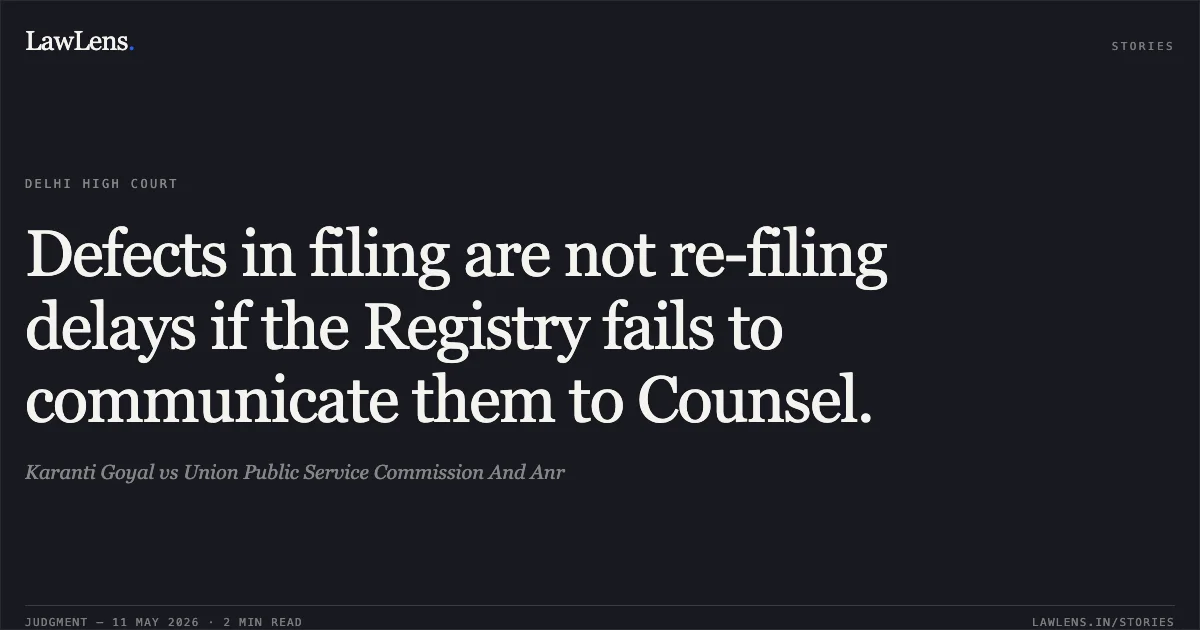
Source reference: para 13(viii)-(xi)The Court concluded that the fault for the delay lay with the Registry, not the UPSC.
Source reference: para 13(xi)Holding
The High Court dismissed the writ petition, holding that the Tribunal did not err in directing the RA to be heard on merits.
The Court affirmed that because the initial filing was within the pandemic-extended limitation and the Registry failed to notify the respondent of defects, the application could not be dismissed on technical grounds of delay.
Source reference: para 13The final order sustained the Tribunal's decision to allow MA 3097/2025.
Source reference: para 15Acts & Sections Cited
2 provisions across 2 statutes referred to in this judgment. Linked provisions open on LawLens.
Administrative Tribunals Act, 19851
Persons With Disabilities (Equal Opportunities, Protection Of Rights And Full Participation) Act, 19951
Original Court PDF
Karanti GoyalvsUnion Public Service Commission And Anr
Click to open original judgment
Original judgment, available to read, download and summarize on LawLens.in


