Facts
The respondent (plaintiff) filed a suit for specific performance of an agreement to sell
Source reference: para. 2The petitioner (defendant) appeared but failed to file a written statement within the statutory period or the extended time granted by the court; consequently, the trial court closed the defendant’s right to file a written statement on 05.07.2022
Source reference: para. 2While the defendant was permitted to cross-examine the plaintiff's witnesses, the trial court, vide order dated 11.11.2025, returned the evidence affidavit filed by the defendant and closed his right to lead independent evidence
Source reference: paras. 1-2The defendant challenged this order, contending he had a right to lead evidence to prove the suit was prohibited by law (Income Tax Act) even without a written statement
Source reference: para. 3Issues
1. Whether a defendant whose right to file a written statement has been closed can be permitted to lead independent evidence to demolish the plaintiff’s case
Source reference: para. 102. Whether the right to participate in proceedings and cross-examine witnesses inherently includes the right to adduce evidence in the absence of formal pleadings
Source reference: para. 17Law Applied
The court applied Order VIII Rule 1 of the CPC regarding the timeline for filing written statements
Source reference: para. 6Order VIII Rule 10 regarding the consequences of failure to do so
Source reference: para. 7It emphasized Order VI Rules 1 and 2, which define "pleadings" and mandate that evidence must follow material facts pleaded
Source reference: para. 11The court relied on the Supreme Court’s rulings in Modula India v. Kamakshya Singh Deo, which held that while a defendant without a defense can cross-examine, they cannot lead their own evidence
Source reference: para. 23Kaushik Narsinhbhai Patel v. M/S. S.J.R. Prime Corporation, which affirmed that no amount of evidence can be looked into without a foundation in pleadings
Source reference: para. 24The court also cited Bachhaj Nahar v. Nilima Mandal regarding the necessity of issues arising from pleadings
Source reference: para. 16Reasoning
The Court reasoned that the primary object of pleadings is to narrow the parties to definite issues and prevent surprise
Source reference: para. 14It held that under the CPC, evidence "cannot be let in without the pleading"
Source reference: para. 18While the defendant remains persona grata and may cross-examine the plaintiff’s witnesses to point out weaknesses or inconsistencies, this participation is "hedged in by several limitations"
Source reference: para. 20The Court clarified that since the defendant’s right to file a written statement was closed, there were no "material facts" on record for the defendant to prove through evidence
Source reference: para. 17Allowing the defendant to lead evidence under the guise of demonstrating a legal bar (such as the Income Tax Act) would effectively bypass the forfeiture of the right to file a written statement and cause prejudice to the plaintiff
Source reference: paras. 23-24The Court distinguished the petitioner’s reliance on Pandit Gopi Charan Bajpai, noting it did not override the established principle that evidence without pleadings is a "futile" exercise
Source reference: paras. 19, 26Holding
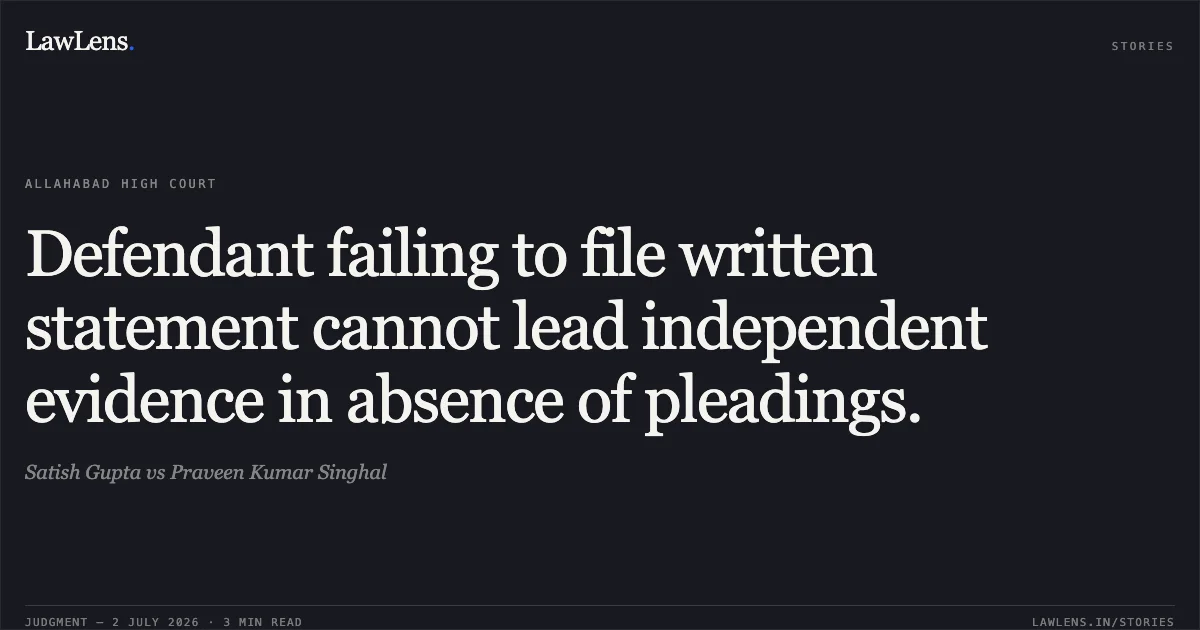
The Court answered that a defendant who has failed to file a written statement cannot be permitted to lead independent evidence, as there are no pleadings to form the basis of such evidence
The High Court upheld the trial court's order dated 11.11.2025, ruling that the petitioner's right is limited to cross-examination and legal arguments based on the existing record
Source reference: paras. 24, 27The petition was dismissed
Source reference: para. 28Acts & Sections Cited
2 provisions across 2 statutes referred to in this judgment. Each provision opens on LawLens.
Indian Contract Act, 18721
Consumer Protection Act, 20191
Original Court PDF
Satish GuptavsPraveen Kumar Singhal
Click to open original judgment
Original judgment, available to read, download and summarize on LawLens.in