Facts
The petitioner, as plaintiff, instituted a partition suit seeking allotment of a 1/5th share in the suit properties and consequential reliefs.
Source reference: para. 4During the pendency of the suit, respondents 1 to 3, who were defendants 1, 3 and 4, filed I.A. No. 3 of 2021 under Order VI Rule 17 of the Code of Civil Procedure, 1908, seeking amendment of the pleadings and inclusion of nine additional properties in the schedule. The III Additional District and Sessions Judge, Vellore at Tirupattur, allowed the application by order dated 27 September 2022. The plaintiff challenged that order under Article 227 of the Constitution of India.
Source reference: para. 4Issues
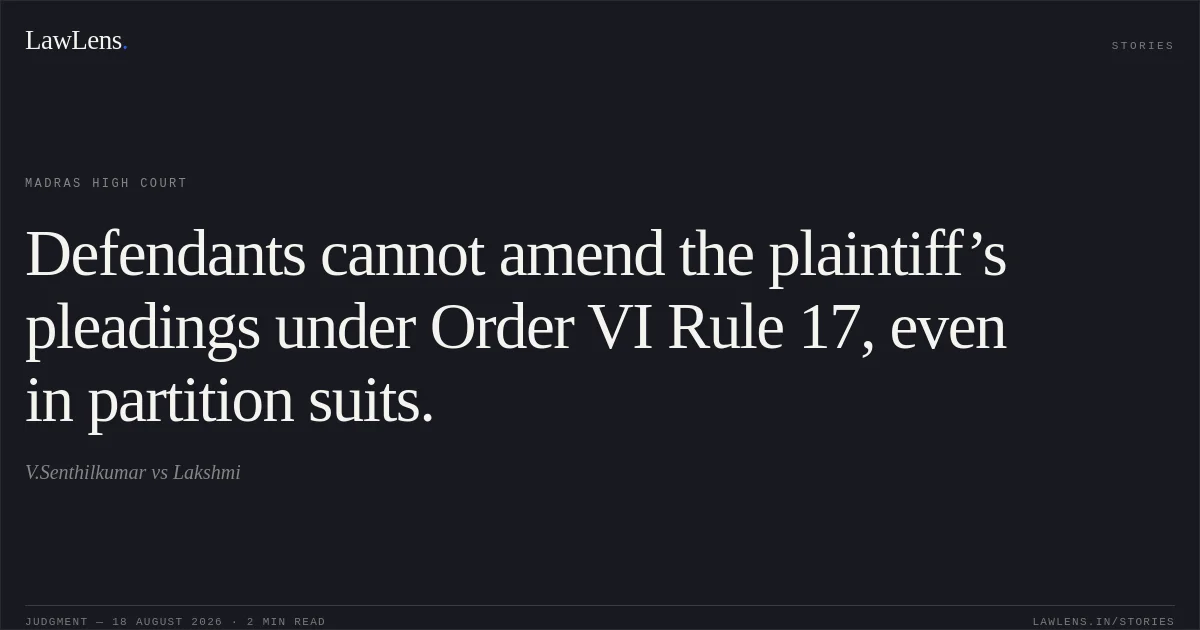
Whether defendants in a partition suit can maintain an application under Order VI Rule 17 CPC to amend the pleadings filed by the plaintiff and add properties to the suit schedule?
Source reference: paras. 5–6Whether the trial court’s order allowing the defendants’ amendment application was legally sustainable?
Source reference: paras. 9–10Law Applied
The Court applied Order VI Rule 17 CPC, which permits amendment of a party’s own pleadings, and held that, as a general rule, the respective party to the pleading—plaintiff or defendant—must seek its amendment.
Source reference: para. 7The Court relied on the Division Bench decision in Solavaiammal v. Ezhumalai Goundar, 2011 (5) LW 859, which recognised that although parties to a partition suit may stand on an equal footing regarding entitlement to a decree, the opposite party cannot ordinarily seek amendment of the other party’s pleadings.
Source reference: para. 7The Court also considered O.M. Subramaniam & Ors., which clarified that the liberal approach in partition suits does not apply where there is a contest regarding the inclusion or partibility of a particular property.
Source reference: para. 8Reasoning
The respondents were defendants, while the pleadings sought to be amended were those filed by the plaintiff.
Source reference: paras. 6–10Although partition suits are treated differently because all parties may claim a share in the common property, that procedural equality does not authorise one party to amend the pleadings of another.
Source reference: paras. 6–10The defendants’ attempt to add nine properties to the plaintiff’s suit schedule effectively sought to alter the plaintiff’s pleadings. Applying Order VI Rule 17 CPC and the precedents cited, the Court found that the trial court had permitted an amendment which the defendants were not competent to seek.
Source reference: paras. 6–10The order therefore suffered from illegality warranting supervisory interference under Article 227.
Source reference: paras. 6–10Holding
The Court answered the issues against the respondents and held that the defendants could not maintain the application under Order VI Rule 17 CPC to amend the plaintiff’s pleadings, even though the suit was one for partition.
The order dated 27 September 2022 in I.A. No. 3 of 2021 in O.S. No. 59 of 2021 was set aside. The Civil Revision Petition was allowed without costs, and the connected miscellaneous petition was closed.
Source reference: paras. 9–11Original Court PDF
V.SenthilkumarvsLakshmi
Click to open original judgment
Original judgment, available to read, download and summarize on LawLens.in