Facts
The respondent Charity filed O.S. Nos. 631 and 640 of 2020 seeking recovery of possession, rent arrears and damages.
Source reference: pp. 4–7, paras. 3–6After PW1’s evidence was closed when the petitioners did not cross-examine him, the petitioners obtained permission to reopen the evidence and recall PW1, but the cross-examination was again closed on 7 February 2026.
Source reference: pp. 4–7, paras. 3–6In earlier revisions, the High Court directed the petitioners to deposit ₹2 lakh in each suit and ordered expeditious disposal.
Source reference: pp. 4–7, paras. 3–6The petitioners later deposited those sums and applied under Order XVIII Rule 17 CPC to reopen the cases to examine defence witnesses.
Source reference: pp. 4–7, paras. 3–6The trial court dismissed the applications, citing non-compliance with the earlier deposit direction and the absence of an adequate explanation for the delay.
Source reference: pp. 4–7, paras. 3–6The petitioners challenged those dismissals under Article 227 of the Constitution.
Source reference: pp. 4–7, paras. 3–6Issues
1. Whether the trial court’s refusal to reopen the cases for the petitioners to examine their witnesses warranted interference under Article 227.
Source reference: pp. 6–7, paras. 5, 92. Whether the petitioners should be given a further opportunity to present defence evidence, and, if so, on what conditions.
Source reference: p. 7, paras. 7–10Law Applied
The petitions invoked Article 227 of the Constitution, under which the High Court considered whether the trial court’s orders disclosed perversity warranting supervisory interference.
Source reference: p. 7, para. 9The applications were made under Order XVIII Rule 17 CPC, seeking to reopen the cases to examine defence witnesses.
Source reference: p. 4, para. 1The judgment cites no precedent and states no broader rule under that provision; it grants a final opportunity in the circumstances, subject to costs and a strict timeline.
Source reference: p. 7, paras. 9–10Reasoning
The High Court found no perversity in the trial court’s orders, given the petitioners’ conduct and their earlier failure to comply with the deposit direction.
Source reference: p. 7, para. 9However, as the required ₹2 lakh had since been deposited in each suit, and the claims included recovery of possession, the Court considered it appropriate to allow one last opportunity to present defence evidence, conditional on payment of costs.
Source reference: pp. 6–7, paras. 6, 9–10Holding
Both revision petitions were disposed of on terms.
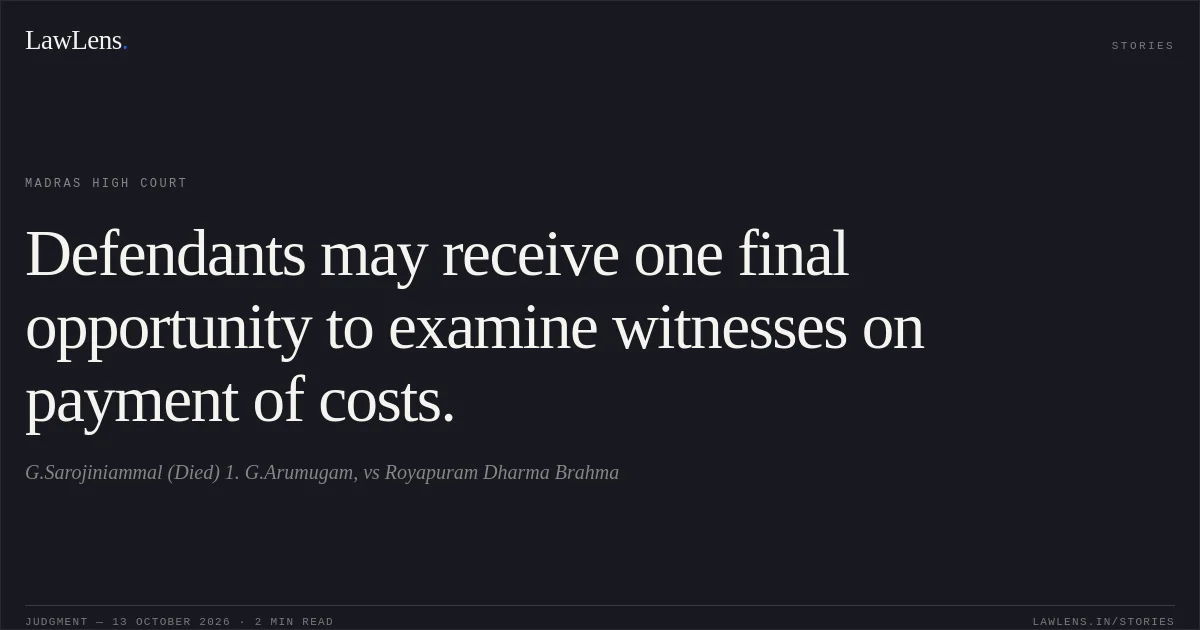
The petitioners were directed to pay ₹5,000 in costs in each suit to the plaintiff within one week; upon compliance, the trial court must permit the defendants to examine their witnesses.
Source reference: pp. 7–8, paras. 10–11If they fail to pay, the trial court’s dismissal orders stand revived.
Source reference: pp. 7–8, paras. 10–11The trial court was directed to complete both suits within eight weeks of receiving the order and to file a compliance report.
Source reference: pp. 7–8, paras. 10–11No costs were awarded in the revisions, and the connected miscellaneous petition was closed.
Source reference: pp. 7–8, paras. 10–11Original Court PDF
G.Sarojiniammal (Died) 1. G.Arumugam,vsRoyapuram Dharma Brahma
Click to open original judgment
Original judgment, available to read, download and summarize on LawLens.in