Facts
In 2001, the Government of Uttarakhand initiated the recruitment of 253 Sub-Inspectors.
Source reference: p. 1-2I.I.T. Roorkee handled the examination, while a committee chaired by the revisionist (Rakesh Mittal, then A.D.G.) prepared final results.
Source reference: p. 2Discrepancies in marks led to a C.B.I. investigation and subsequent charge-sheeting of the revisionist under Section 120-B r/w Sections 420, 467, 471, 468 of the IPC and the Prevention of Corruption Act.
Source reference: p. 1-2During trial, the revisionist moved an application under Section 319 of the Cr.P.C. to summon Shree A.B. Lal (Respondent 2) and Shree Ganesh Chand Pant (Respondent 3) as additional accused, alleging they conspired to frame him to ensure A.B. Lal’s elevation to D.G.P.
Source reference: p. 2The Trial Court rejected the application on 30.01.2025, which the revisionist challenged herein.
Source reference: p. 1Issues
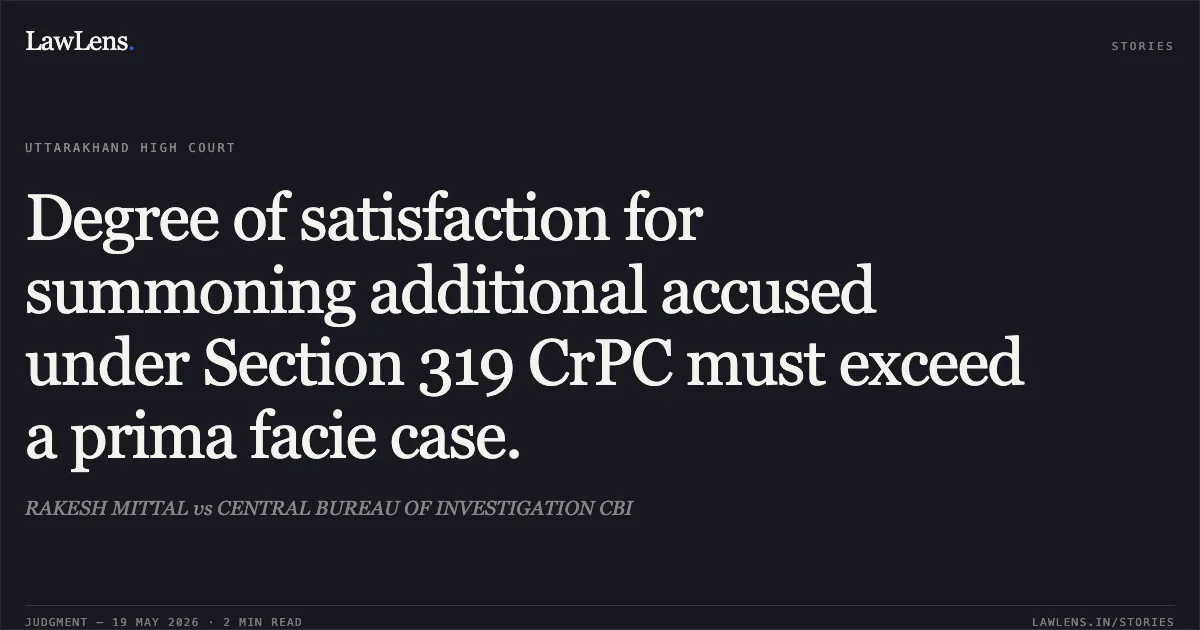
1. Whether there existed sufficient evidence of a degree higher than a prima facie case to summon Respondents 2 and 3 as additional accused under Section 319 of the Cr.P.C.
Source reference: p. 72. Whether the presence of Respondents 2 and 3 at I.I.T. Roorkee and the alleged temporary custody of a data floppy constituted "complicity" warranting trial.
Source reference: p. 3-4Law Applied
Section 319 of the Cr.P.C., which grants discretionary and extraordinary power to summon persons not yet accused if evidence reveals their involvement.
Source reference: p. 6The Constitution Bench decision in Hardeep Singh v. State of Punjab (2014) 3 SCC 92, which established that the degree of satisfaction required for summoning under Section 319 is higher than for framing a charge; it requires "much stronger evidence than mere probability of complicity" but short of a certainty of conviction.
Source reference: p. 7Periyasami v. S. Nallasami (2019) 4 SCC 342 regarding the limits of this power.
Source reference: p. 6Reasoning
The court found the revisionist’s allegations of "unauthorized presence" and "tampering" to be bald assertions without factual basis.
Source reference: p. 7-8Scientific evidence from the F.S.L. Report indicated that the floppy data was first copied on 24.07.2002—after it was handed to the revisionist—and his laptop contained both original and altered marks.
Source reference: p. 4Witness statements confirmed that Respondents 2 and 3 were authorized by superior officers to assist I.I.T. Roorkee regarding state reservation policies.
Source reference: p. 5, 8The court noted that the conspiracy motive (promotion to D.G.P.) was untenable as several officers senior to Respondent 2 existed; thus, the revisionist’s removal would not have automatically resulted in Respondent 2's promotion.
Source reference: p. 4-5, 8Applying the Hardeep Singh standard, the court determined that the evidence did not meet the requisite "strong satisfaction" threshold for impleading additional parties.
Source reference: p. 7-8Holding
The High Court held that the Trial Court’s order did not suffer from illegality or procedural irregularity as the satisfaction required under Section 319 Cr.P.C. was not met.
The court answered that the presence of respondents at I.I.T. Roorkee was part of their official duty and no iota of evidence suggested their complicity in the crime.
Source reference: p. 6, 8Consequently, the criminal revision was dismissed.
Source reference: p. 8Acts & Sections Cited
6 provisions across 3 statutes referred to in this judgment. Each provision opens on LawLens.
Indian Penal Code, 18604
Prevention of Corruption Act, 19881
Code of Criminal Procedure, 19731
Original Court PDF
RAKESH MITTALvsCENTRAL BUREAU OF INVESTIGATION CBI
Click to open original judgment
Original judgment, available to read, download and summarize on LawLens.in