Facts
The respondent was initially appointed under the Government of India and, upon the formation of the Food Corporation of India (FCI), opted for transfer to the FCI under Section 12-A of the Food Corporation of India Act.
Source reference: p.3He opted for the terminal benefits applicable to Central Government employees. However, after his retirement on 30 April 1998, his pensionary and terminal benefits were calculated using industrial dearness allowance rather than Central dearness allowance (CDA).
Source reference: pp.3–4The Supreme Court, in Union of India v. P.N. Natarajan, (2010) 12 SCC 405, held that employees who had opted for Central Government benefits were entitled to CDA and directed revision of their pensionary benefits.
Source reference: p.4The respondent submitted a representation on 8 July 2015, approximately 17 years after retirement, and subsequently filed W.P. No. 1975 of 2020. The Single Judge granted relief by order dated 4 September 2023. The Union of India and other authorities challenged that order in the present writ appeal.
Source reference: pp.2–4Issues
Whether the respondent’s delay in approaching the Court, including his status as an alleged “fence-sitter,” barred him from claiming revised pensionary benefits and CDA pursuant to the Supreme Court’s decision in P.N. Natarajan.
Source reference: pp.4–5Whether the respondent was entitled to revision of his pensionary benefits and payment of CDA from the date of the Supreme Court’s judgment, namely 10 February 2010, rather than from the date of his retirement or the date of his representation.
Source reference: pp.5–6Law Applied
Section 12-A of the Food Corporation of India Act permitted employees transferred to the FCI to opt either for the Government scale of pay or the Corporation’s scale and to elect the applicable terminal benefits.
Source reference: p.3The Court applied the rule in Union of India v. P.N. Natarajan, (2010) 12 SCC 405, that employees who had opted for Central Government benefits were entitled to Central dearness allowance and corresponding revision of terminal and pensionary benefits.
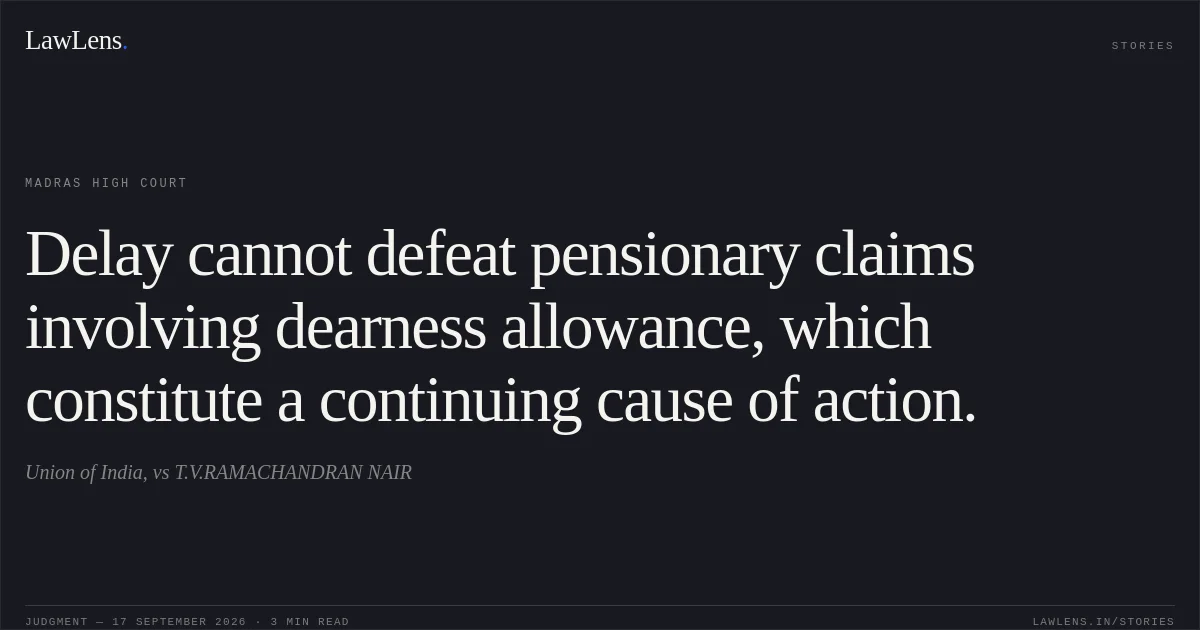
Source reference: p.4It further applied the principle that pension-related claims may constitute a continuing cause of action because pension and dearness allowance are recurring monthly benefits.
Source reference: pp.4–5Relying on Maya Banerjee v. Union of India, 2026 INSC 959, and the principle stated in S.K. Mastan Bee, the Court held that delay should not automatically defeat a genuine claim for pensionary benefits, particularly where the benefit ought to have been extended to similarly situated employees without requiring separate litigation.
Source reference: pp.5–6Reasoning
The Court accepted that the respondent had approached the Court belatedly, having retired in 1998 and made his representation only in 2015.
Source reference: p.4However, it held that the delay was not decisive because the claim concerned recurring pensionary payments and CDA, giving rise to a continuing cause of action.
Source reference: pp.4–5Since the respondent had opted for Central Government terminal benefits, he was legally situated like the employees covered by P.N. Natarajan and was entitled to CDA rather than benefits calculated solely on the basis of industrial dearness allowance.
Source reference: pp.3–4The Court also emphasised the obligation of the FCI and the Central Government, as model employers, to extend the benefit of a binding Supreme Court judgment to all similarly placed employees instead of compelling each employee to litigate separately.
Source reference: p.5Nevertheless, to balance the respondent’s delay with the applicable entitlement, the Court restricted the monetary benefit to the date of the Supreme Court’s judgment, 10 February 2010, rather than granting it from the date of retirement.
Source reference: pp.5–6Holding
The writ appeal was disposed of without costs. The Court upheld the respondent’s entitlement to revised pensionary benefits, including CDA, but directed that the benefit be calculated only from 10 February 2010, the date of the judgment in P.N. Natarajan.
The appellants were directed to revise the respondent’s pensionary benefits in accordance with subsequent Pay Commission revisions and to pay all consequential monetary benefits within three months from receipt of the order.
Source reference: pp.6–7The connected miscellaneous petition was closed.
Source reference: p.7Acts & Sections Cited
1 provisions across 1 statute referred to in this judgment. Linked provisions open on LawLens.
Food Corporations Act, 19641
Original Court PDF
Union of India,vsT.V.RAMACHANDRAN NAIR
Click to open original judgment
Original judgment, available to read, download and summarize on LawLens.in