Facts
The Appellant, Hareram Chaudhary, was convicted by the Trial Court on 29.03.2018 for the murder of Thakur Ram Sahai Singh, Head Secretary of the Thakur Sadanand Tatvagyan Parishad
Source reference: p. 1-2The prosecution alleged that on the night of 15/16.05.2015, the Appellant shot the deceased in the head while he was sleeping in the Ashram’s threshing ground, witnessed by P.W.1 and P.W.2 under generator light
Source reference: p. 2The motive was attributed to the Appellant’s expulsion from the Ashram due to disciplinary violations and his desire to seize control of the institution
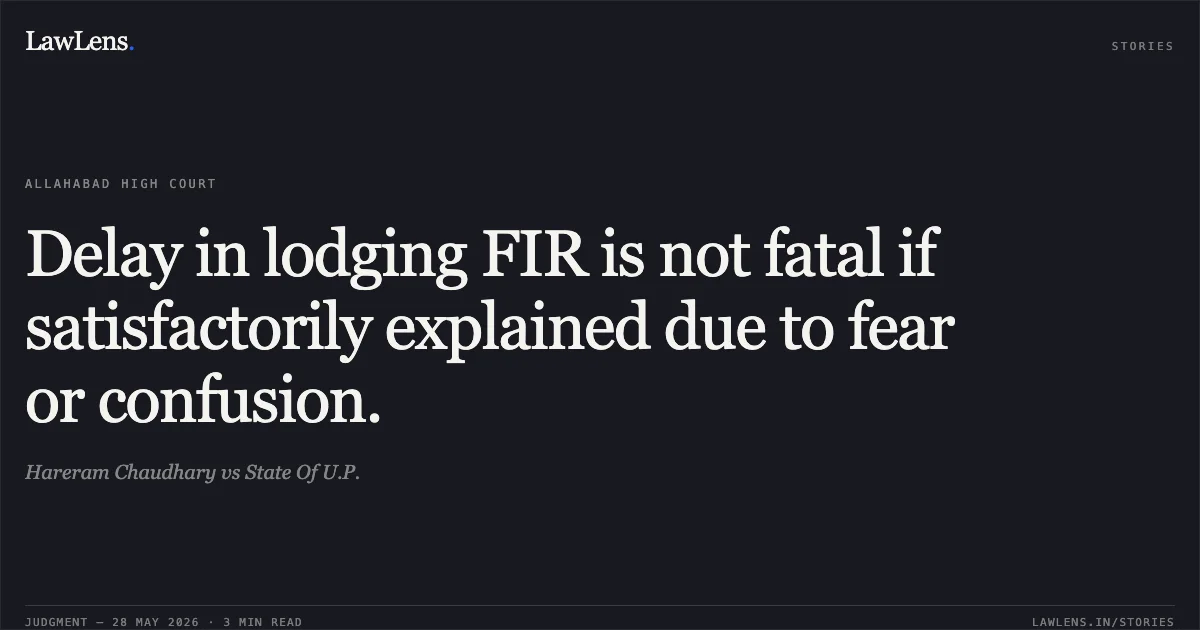
Source reference: p. 18-19The FIR was lodged with an 11-hour delay
Source reference: p. 12The Trial Court sentenced the Appellant to life imprisonment under Section 302 IPC and 3 years’ R.I. under Section 3/25 of the Arms Act
Source reference: p. 2The Appellant challenged the conviction on grounds of delayed FIR, lack of motive, and questionable witness presence
Source reference: p. 9-10Issues
1. Whether the 11-hour delay in lodging the FIR was fatal to the prosecution case
Source reference: p. 12-13 / para. 252. Whether the ocular testimony of P.W.1 and P.W.2 was reliable despite minor contradictions and the non-examination of other witnesses
Source reference: p. 21 / para. 413. Whether the prosecution sufficiently proved the motive and the recovery of the weapon of assault
Source reference: p. 17, 27 / para. 34, 50Law Applied
the court primarily applied Section 302 of the Indian Penal Code regarding murder and Section 3/25 of the Arms Act
Source reference: p. 2It applied the principle from Tara Singh v. State of Punjab and State of H.P. v. Gian Chand, holding that delay in FIR is not fatal if plausibly explained
Source reference: p. 15-16Regarding motive, it relied on Subhash Aggarwal v. State of NCT of Delhi, which posits that motive is secondary when reliable ocular evidence exists
Source reference: p. 17-18Under Section 27 of the Indian Evidence Act, the court applied the "discovery of fact" principle as elucidated in Anter Singh v. State of Rajasthan regarding the recovery of the firearm
Source reference: p. 28-29Finally, it followed Baban Shankar Daphal v. State of Maharashtra concerning the impact of minor contradictions in witness testimonies
Source reference: p. 26Reasoning
The High Court found the 11-hour FIR delay satisfactorily explained by the atmosphere of fear following the murder of the Ashram's head and the subsequent deliberation among residents
Source reference: p. 14-15The Court held that the testimonies of P.W.1 and P.W.2 were natural and consistent; their presence was justified by ongoing festival preparations, and generator light provided sufficient visibility for identification
Source reference: p. 22-24The Court dismissed the defense's plea of alibi, noting material inconsistencies in the testimonies of D.W.1, D.W.2, and D.W.3
Source reference: p. 33The medical evidence, specifically the firearm entry/exit wounds described by P.W.4, directly corroborated the eye-witness accounts
Source reference: p. 34Furthermore, the recovery of the .315 bore pistol at the Appellant’s pointing out was deemed admissible and credible, reinforcing the prosecution’s version of his arrest while attempting to visit his family
Source reference: p. 27-28, 33Holding
The Court answered all issues in favor of the prosecution, holding that the delay in FIR was justified [p. 17] and the ocular evidence was robust enough to sustain conviction even if motive were secondary
The Court dismissed the criminal appeal, confirming the Trial Court's judgment of conviction and the sentence of life imprisonment [p. 35-36]. The Appellant was ordered to serve out the remainder of his sentence
Source reference: p. 36Acts & Sections Cited
18 provisions across 4 statutes referred to in this judgment. Each provision opens on LawLens.
Code of Criminal Procedure, 19734
Indian Penal Code, 1860
Arms Act, 19592
Original Court PDF
Hareram ChaudharyvsState Of U.P.
Click to open original judgment
Original judgment, available to read, download and summarize on LawLens.in