Facts
The petitioner was detained by an order dated 16.04.2025 issued by the Divisional Commissioner, Jammu, under Section 3(1) of the PITNDPS Act, 1988, to prevent him from engaging in illicit drug trafficking.
Source reference: para. 1The detention was based on three FIRs (65/2020, 62/2022, and 171/2024).
Source reference: para. 3The petitioner challenged the order through his wife, contending that he was already on bail in all cases, the grounds were stale (the last incident was four months prior), and that procedural safeguards under Article 22(5) were violated as documents were not properly explained or furnished in a language he understood.
Source reference: para. 2Issues
1. Whether the detention order is valid when the detenu was already enlarged on bail in all predicate FIRs and the detaining authority failed to justify why ordinary law was insufficient.
Source reference: para. 92. Whether the "live and proximate link" between the alleged activities and the detention order was snapped due to a four-month delay.
Source reference: para. 103. Whether the failure to furnish all relied-upon documents and explain them in a language understood by the detenu violates constitutional safeguards.
Source reference: para. 13-15Law Applied
Section 3 of the Prevention of Illicit Traffic in Narcotic Drugs and Psychotropic Substances (PITNDPS) Act, 1988 regarding the power to detain.
Source reference: para. 8Rekha v. State of Tamil Nadu (2011) which holds that preventive detention can only be used if ordinary criminal law is insufficient to deal with the situation.
Source reference: para. 9Rajinder Arora v. Union of India (2006) and Sushanta Kumar Banile v. State of Tripura (2022) regarding the snapping of the "live link" due to delay.
Source reference: para. 11-12Article 22(5) of the Constitution of India, as interpreted in Shalini Soni v. Union of India (1980), which mandates the communication of the full factual material to the detenu to enable an effective representation.
Source reference: para. 15Reasoning
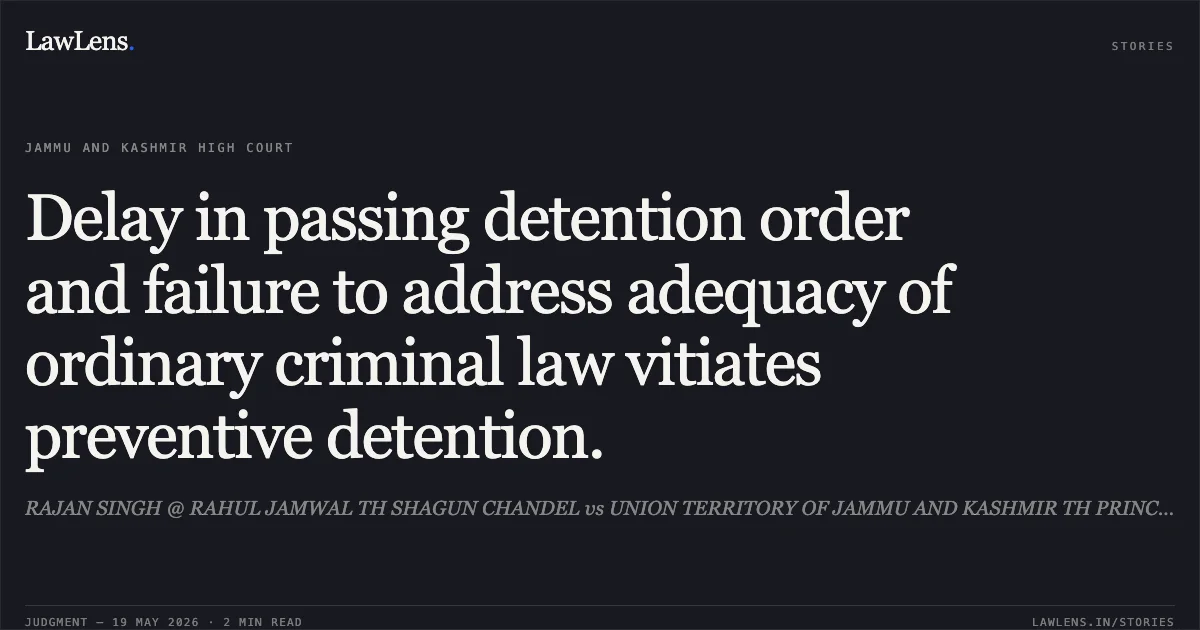
The court found that the detaining authority failed to demonstrate how normal criminal law was inadequate, especially since the petitioner had not violated bail conditions and the State had not challenged the bail orders.
Source reference: para. 9, 19The court observed a delay of approximately 121 days between the last alleged criminal act (14.12.2024) and the detention order (16.04.2025), concluding that this gap snapped the "live and proximate link" necessary for preventive detention.
Source reference: para. 10, 18The court scrutinized the record and found that the execution officer failed to furnish the entire set of documents to the detenu and did not explain the grounds in his vernacular language, thereby rendering his right to make a representation illusory and violating Article 22(5).
Source reference: para. 13, 21Holding
The court answered the issues in the affirmative for the petitioner, holding that the detention order suffered from non-application of mind and procedural illegalities.
The court quashed the detention order (No. PITNDPS 20 of 2025 dated 16.04.2025) and directed the immediate release of the petitioner from preventive custody.
Source reference: para. 22Acts & Sections Cited
4 provisions across 2 statutes referred to in this judgment. Each provision opens on LawLens.
Prevention of Illicit Traffic in Narcotic Drugs and Psychotropic Substances Act, 19881
Narcotic Drugs and Psychotropic Substances Act, 19853
Original Court PDF
RAJAN SINGH @ RAHUL JAMWAL TH SHAGUN CHANDELvsUNION TERRITORY OF JAMMU AND KASHMIR TH PRINCIPAL SECY HOME AND ORS
Click to open original judgment
Original judgment, available to read, download and summarize on LawLens.in