Facts
The appellant was convicted by the Sessions Judge, Biswanath, in Sessions Case No. 148/2013 under Section 376 of the Indian Penal Code and sentenced to 10 years’ rigorous imprisonment with a fine of ₹5,000, with two months’ rigorous imprisonment in default.
Source reference: p.2The prosecution alleged that, on 16 March 2013, the minor victim, aged approximately nine years, was taken by the appellant to his house while she was proceeding to school, where he removed her undergarment and inserted his finger into her private parts.
Source reference: pp.2–3She later returned home with bleeding, following which her father took her for medical treatment and lodged the FIR on 20 March 2013.
Source reference: pp.2–3The victim supported the prosecution case before the Court and stated that she had also disclosed the occurrence to the doctor and before the Magistrate.
Source reference: p.3The medical officer found vaginal bleeding and laceration in the lower vaginal wall, though she stated that such injury could also result from a fall on a hard substance.
Source reference: p.4The appellant denied the allegations under Section 313 CrPC and did not adduce defence evidence.
Source reference: p.3Issues
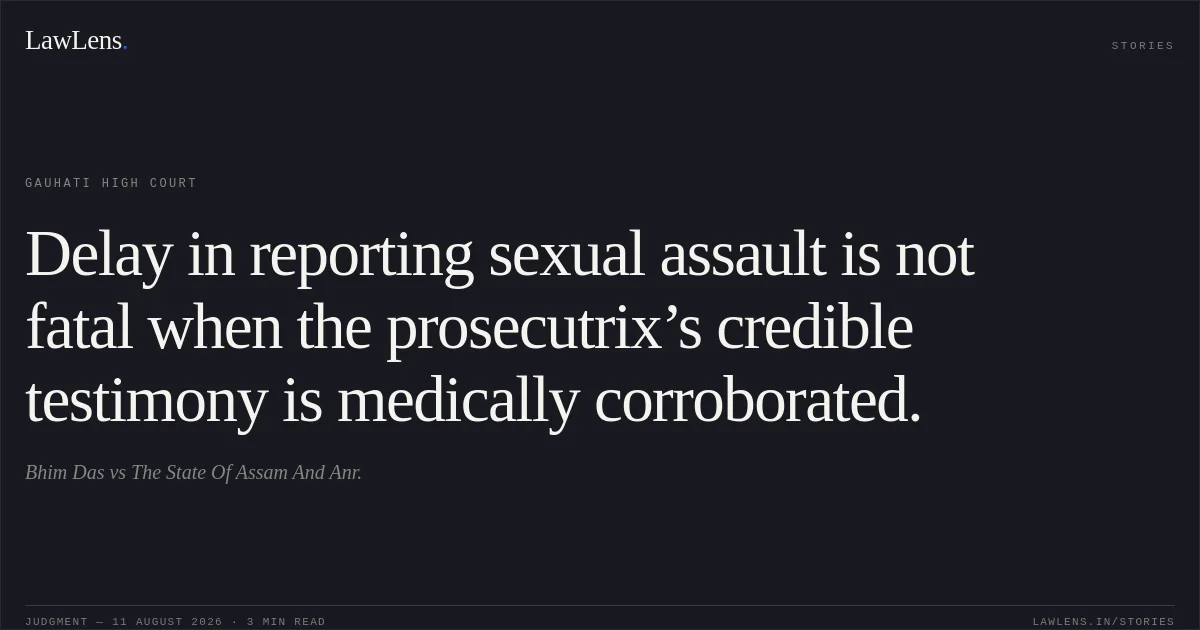
Whether the four-day delay in lodging the FIR and in medically examining the victim rendered the prosecution case doubtful in the absence of a complete explanation.
Source reference: pp.4–6Whether the testimony of the minor victim, considered with the medical evidence and the surrounding circumstances, was sufficient to sustain the appellant’s conviction under Section 376 IPC.
Source reference: pp.3–4, 7–8Whether the possibility that the injury was caused by an accidental fall, or that the victim was tutored, created reasonable doubt warranting interference with the conviction.
Source reference: pp.4, 7–8Law Applied
The Court applied Section 376 IPC concerning punishment for rape and Section 374(2) CrPC governing appeals against convictions.
Source reference: p.2It relied on State of Himachal Pradesh v. Gian Chand, which holds that delay in lodging an FIR is not by itself fatal, but may become significant where it is unexplained and creates a possibility of embellishment.
Source reference: p.5It further applied the principle in State of Himachal Pradesh v. Prem Singh that delay in sexual-offence cases must be assessed in light of the special circumstances surrounding such offences.
Source reference: p.6Relying on Rajoo v. State of Madhya Pradesh, the Court recognised that the testimony of a prosecutrix must be carefully scrutinised and cannot automatically be treated as gospel truth.
Source reference: p.5At the same time, a credible and consistent testimony of the victim, particularly when corroborated by medical evidence, may by itself sustain a conviction.
Source reference: pp.7–8The Court also referred to Munish Mubar v. State of Haryana regarding the evidentiary significance of an accused’s failure to explain incriminating circumstances under Section 313 CrPC.
Source reference: p.6Reasoning
The Court held that the delay was sufficiently explained by the evidence that the victim was initially taken to a hospital where treatment was refused, after which she was taken to the civil hospital and the FIR was lodged; the intervening delay did not, in the circumstances, establish fabrication.
Source reference: pp.6–7The Court found no evidence of prior enmity between the appellant and the informant that could motivate a false allegation of such gravity.
Source reference: p.7The victim’s account that the appellant inserted his finger into her private parts was consistent, remained substantially unshaken in cross-examination, and was corroborated by the findings of vaginal bleeding and laceration.
Source reference: pp.3–4, 7–8Although the medical officer stated that the injury could result from falling on a hard substance, the Court considered that explanation highly unlikely having regard to the situs of the injury.
Source reference: p.7The victim’s statement that her father told her what to state before the Magistrate and the Court was not treated as proof of tutoring; given her young age and unfamiliarity with court proceedings, the Court considered such explanation natural and insufficient to discredit her substantive testimony.
Source reference: pp.7–8Holding
The Court answered the issues against the appellant.
It held that the delay in lodging the FIR and the medical examination did not undermine the prosecution case, and that the credible testimony of the minor victim, supported by medical evidence and the absence of any apparent motive for false implication, proved the charge under Section 376 IPC beyond reasonable doubt.
Source reference: pp.7–8The appeal was dismissed, the conviction and sentence of 10 years’ rigorous imprisonment with a fine of ₹5,000, and two months’ rigorous imprisonment in default, were affirmed, and the trial court record was directed to be returned.
Source reference: p.8Acts & Sections Cited
3 provisions across 2 statutes referred to in this judgment. Each provision opens on LawLens.
Code of Criminal Procedure, 19732
Indian Penal Code, 18601
Original Court PDF
Bhim DasvsThe State Of Assam And Anr.
Click to open original judgment
Original judgment, available to read, download and summarize on LawLens.in