Facts
The appellant’s wife died while in service on January 14, 2017.
Source reference: para. 2His initial application for compassionate appointment was rejected on June 13, 2017, by the District Education Officer, Guna, because the appellant lacked the minimum educational qualifications required for the post of Samvida Sala Sikshak, Class III.
Source reference: para. 2In 2021, following a State circular dated February 1, 2021—which allowed aspirants a seven-year window to acquire qualifications—the appellant submitted a consent form to wait.
Source reference: para. 2He eventually filed a writ petition on April 6, 2026, which was dismissed by the learned Single Judge on the grounds of delay.
Source reference: para. 2, 3The appellant then preferred this writ appeal under Section 2(1) of the Madhya Pradesh Uchcha Nyayalaya (Khand Nyayapeeth Ko Appeal) Adhiniyam, 2005.
Source reference: para. 1Issues
1. Whether the delay in seeking legal recourse against the rejection of a compassionate appointment application frustrates the primary objective of the scheme.
Source reference: para. 52. Whether the learned Single Judge erred in dismissing the writ petition on the grounds of laches and delay despite the interim circular issued by the State.
Source reference: para. 7, 8Law Applied
The Court primarily applied the principles governing compassionate appointment as an exception to Articles 14 and 16 of the Constitution, emphasizing that it is not a vested right or an alternative source of recruitment.
Source reference: para. 6, 7.2It relied heavily on the Supreme Court ruling in State of West Bengal vs. Debabrata Tiwari & Ors. (2023), which established that the sense of immediacy is the sine qua non for such appointments to mitigate sudden financial crises.
Source reference: para. 6The court also invoked the doctrine of laches as articulated in State of M.P. vs. Nandlal Jaiswal (1986) and State of Uttaranchal vs. Shiv Charan Singh Bhandari (2013), holding that stale claims cannot be revived by mere representations.
Source reference: para. 8, 9Reasoning
The Court reasoned that compassionate appointment is intended specifically to meet the immediate financial hardship caused by the death of a breadwinner.
Source reference: para. 5In this case, nine years had passed since the death of the appellant's wife (2017) and seven years since the initial rejection of his application.
Source reference: para. 7The Court noted that the appellant failed to challenge the 2017 rejection order promptly and failed to demonstrate that he had actually acquired the necessary qualifications even by 2026.
Source reference: para. 4, 7Applying the Debabrata Tiwari precedent, the Court found that the family's survival over several years indicated that the "urgency" justifying a departure from standard recruitment rules had evaporated.
Source reference: para. 6, 7.3The Court further clarified that the 2021 circular did not grant a fresh cause of action to revive a "dead grievance" or waive the requirement of diligence.
Source reference: para. 9, 10Holding
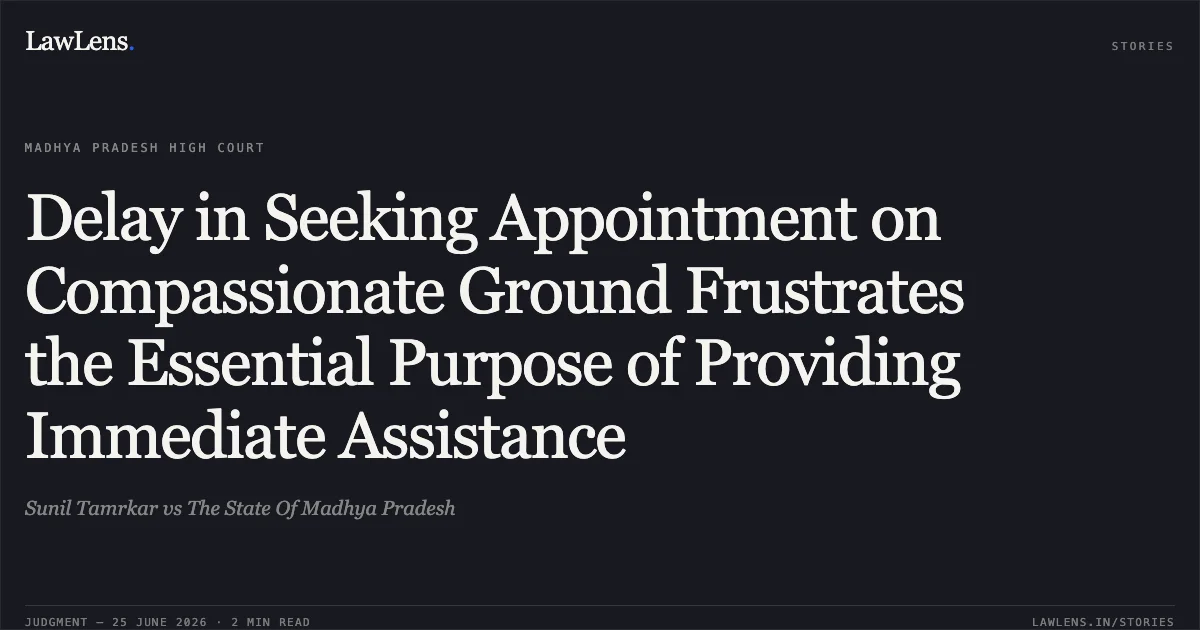
The Division Bench upheld the Single Judge's order, answering that the inordinate delay in challenging the rejection frustrated the purpose of compassionate appointment.
The Court held that the appellant's claim was barred by laches and the lack of requisite qualifications.
Source reference: para. 7Consequently, the writ appeal was dismissed, and no interference with the impugned order was warranted.
Source reference: para. 10Acts & Sections Cited
1 provisions across 1 statute referred to in this judgment. Linked provisions open on LawLens.
M.P. Uchcha Nyayalaya (Khand Nyayapeeth Ko Appeal) Adhiniyam, 20051
Original Court PDF
Sunil TamrkarvsThe State Of Madhya Pradesh
Click to open original judgment
Original judgment, available to read, download and summarize on LawLens.in