Facts
The petitioner was an employee of Shri Hazareshwar Higher Secondary School, a private aided institution taken over by the State Government on 01.07.1995.
Source reference: para. 3While 131 posts were sanctioned for absorption based on a 1995 screening committee report, the petitioner was excluded.
Source reference: no citationFollowing extensive litigation regarding the validity of the screening process, a Division Bench in W.A. No. 59/2006 upheld the absorption of the initial 131 persons by consent of all parties and directed the remaining staff to submit representations.
Source reference: para. 5, 11(iii)The petitioner’s claim was rejected on 08.06.2015 (Annexure P/1) on grounds of non-availability of posts and lack of qualifications.
Source reference: para. 8Although aware of this order in 2015 via contempt proceedings, the petitioner challenged it only in 2022, seeking parity with similarly situated employees who obtained favorable orders in 2021.
Source reference: para. 8-10, 19Issues
1. Whether the petitioner is entitled to absorption into government service despite the non-availability of sanctioned posts and a 30-year gap since the school’s takeover.
Source reference: para. 18, 262. Whether the writ petition is barred by the doctrine of delay and laches, and whether the petitioner can be classified as a "fence-sitter".
Source reference: para. 12, 19-21Law Applied
The Court applied the principle that discretionary relief under Article 226 of the Constitution of India may be denied even if the law favors the applicant, particularly if the relief is opposed to public policy or involves significant delay.
Source reference: para. 26It relied on BSNL v. Ghanshyam Dass (2011) 4 SCC 374, which establishes that "fence-sitters" who do not approach the court timeously cannot claim parity with proactive litigants once rights have accrued to others.
Source reference: para. 20Furthermore, the court cited Chandra Singh v. State of Rajasthan (2003) 6 SCC 545, affirming that the issuance of a writ is a discretionary remedy exercised to meet the ends of substantial justice.
Source reference: para. 26Reasoning
The Court noted that the initial 131 sanctioned posts were already filled, and the petitioner had previously consented to the Division Bench order upholding those absorptions; thus, no vacancy existed to accommodate him.
Source reference: para. 17-18The Court rejected the petitioner’s claim for absorption in other schools within the district, holding that rights were limited to the specific school taken over.
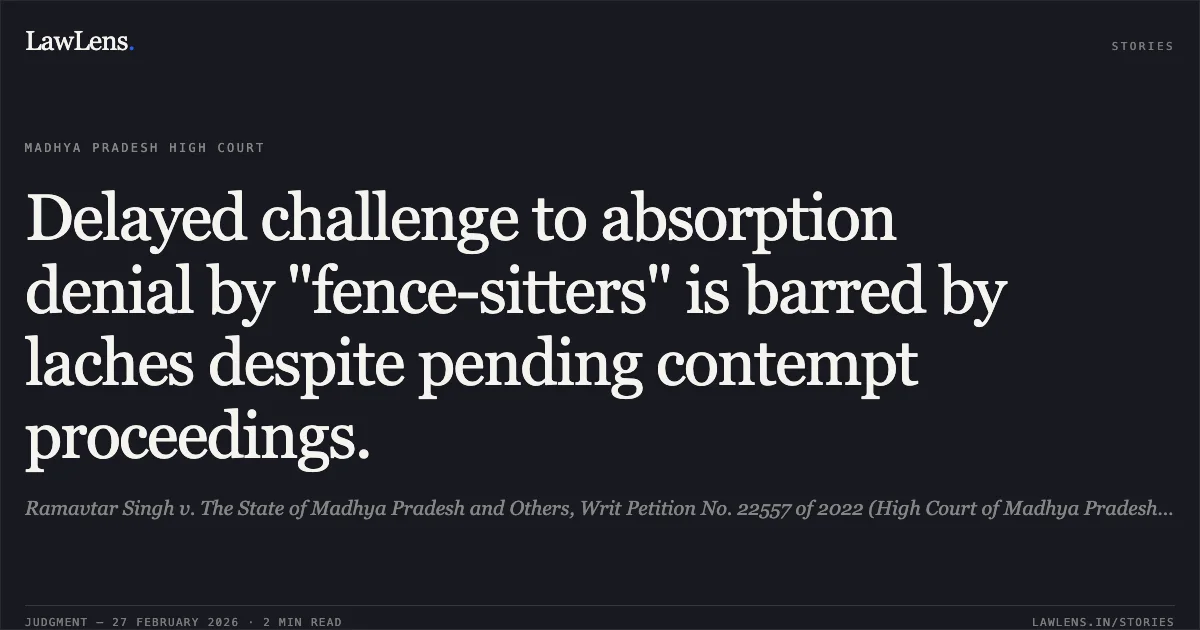
Source reference: para. 13, 18Crucially, the Court found the petitioner’s explanation for the seven-year delay in challenging the 2015 order—pending contempt proceedings—to be factually incorrect and legally insufficient.
Source reference: para. 23-24Because the petitioner waited for others to secure favorable judgments before filing his own petition, he was deemed a "fence-sitter" ineligible for discretionary relief.
Source reference: para. 21The Court emphasized that directing absorption after 30 years without the petitioner having worked on the post would be inappropriate.
Source reference: para. 26Holding
The Court answered both issues in the negative, holding that the petitioner could not be absorbed due to a lack of sanctioned posts and that the petition was barred by inordinate delay and laches.
The Court upheld the impugned order dated 08.06.2015 and dismissed the writ petition as being without substance.
Source reference: para. 27, 4Original Court PDF
Ramavtar Singh v. The State of Madhya Pradesh and Others, Writ Petition No. 22557 of 2022 (High Court of Madhya Pradesh at Gwalior).
Click to open original judgment
Original judgment, available to read, download and summarize on LawLens.in