Facts
The petitioner initiated contempt proceedings under Section 12 of the Contempt of Courts Act, 1971, alleging non-compliance with the High Court’s order dated 22 June 2026 in CRLMP No. 690 of 2026.
Source reference: p. 1That order directed the IIC, Angul Police Station, to execute a bailable warrant against a witness before 29 June 2026
Source reference: p. 1; p. 2In his show-cause affidavit, the IIC stated that the warrant could not be traced at the police station.
Source reference: p. 3He sought a fresh warrant on 2 September 2026; after it was issued and received, the warrant was executed on 18 September 2026, and the witness furnished a bond and was directed to appear before the JMFC.
Source reference: pp. 3–4The deponent tendered an unconditional apology.
Source reference: p. 4The petitioner did not appear at the contempt hearing.
Source reference: p. 5Issues
Whether the delayed execution of the bailable warrant amounted to wilful disobedience of the High Court’s order and civil contempt
Source reference: pp. 5–6Whether the deponent’s unconditional apology should be accepted and the contempt proceeding dropped
Source reference: p. 7Law Applied
Section 12 of the Contempt of Courts Act, 1971, read with Article 215 of the Constitution, provides the basis for the contempt proceeding
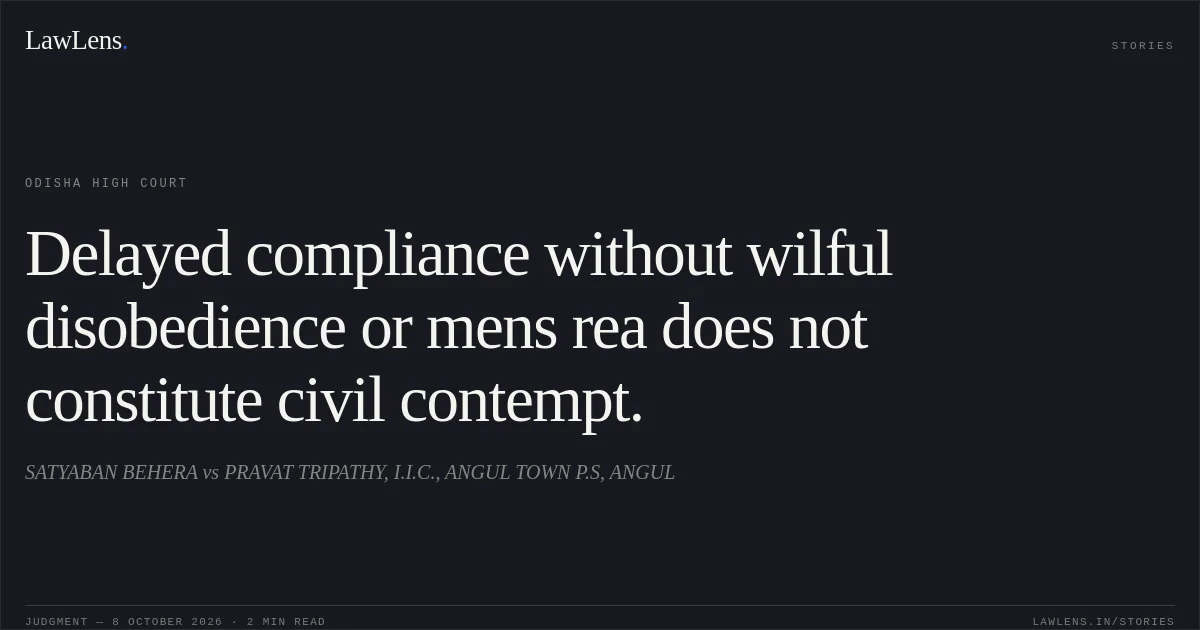
Source reference: p. 1Civil contempt requires deliberate and intentional breach; delay alone does not establish the mens rea necessary for wilful disobedience.
Source reference: pp. 5–6Relying on A.K. Jayaprakash (dead) through LRs v. S.S. Mallikarjuna Rao, 2025 INSC 1003, and the principles cited there from Ashok Paper Kamgar Union v. Dharam Godha, (2003) 11 SCC 1, and Rama Narang v. Ramesh Narang, (2006) 11 SCC 114, the Court held that contempt jurisdiction is not a remedy for personal grievances and that delayed compliance does not, by itself, prove wilful contempt
Source reference: pp. 5–6Reasoning
The Court found that the warrant had not been executed by the deadline of 29 June 2026 and that the explanation was that the original warrant could not be traced
Source reference: p. 6The steps to obtain and execute a fresh warrant were taken only after the State’s counsel was directed on 31 August 2026 to obtain instructions; the warrant was ultimately executed on 18 September 2026
Source reference: pp. 6–7Although the Court characterised the conduct as lax and the compliance as delayed, it concluded that the delay and the stated circumstances did not establish the deliberate disobedience or mens rea required for civil contempt.
Source reference: p. 7It also took account of the unconditional apology
Source reference: p. 7Holding
The Court held that, despite delayed compliance, wilful disobedience had not been established and the charge of civil contempt could not be sustained
It accepted the deponent’s unconditional apology and dropped the contempt proceeding.
Source reference: p. 7Acts & Sections Cited
1 provisions across 1 statute referred to in this judgment. Each provision opens on LawLens.
Contempt of Courts Act, 19711
Original Court PDF
SATYABAN BEHERAvsPRAVAT TRIPATHY, I.I.C., ANGUL TOWN P.S, ANGUL
Click to open original judgment
Original judgment, available to read, download and summarize on LawLens.in