Facts
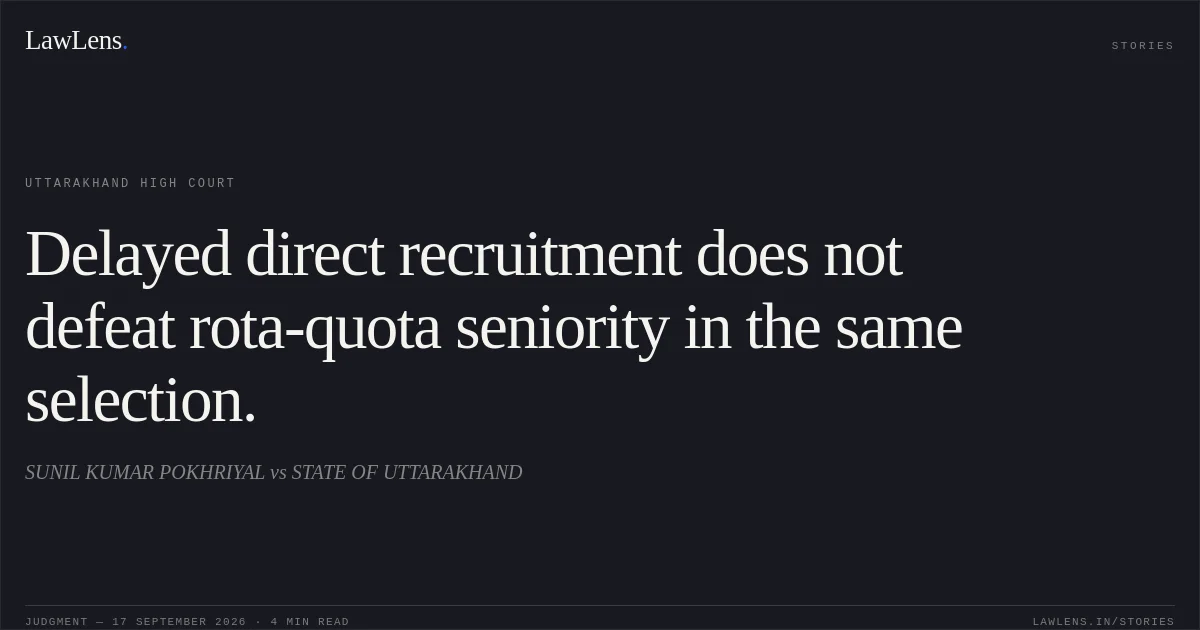
The dispute concerned inter se seniority between Assistant Engineers appointed through direct recruitment (“DRs”) and those promoted (“PRs”) in the Uttarakhand Power Corporation Limited (“UPCL”). Recruitment was governed by the U.P. State Electricity Board Services of Engineers Regulations, 1970, which prescribed approximately equal quotas for direct recruitment and promotion.
Source reference: paras. 1–2For the 2008–09 recruitment exercise, UPCL identified 72 vacancies for direct recruitment and 53 vacancies for promotion on 1 November 2008.
Source reference: para. 3Promotions were made through DPCs held on 19 November 2008 and 30 June 2009, while the direct-recruitment process, initiated by advertisement dated 26 February 2009, concluded later; 39 DRs joined between December 2009 and January 2010, and 29 vacancies were carried forward.
Source reference: paras. 5–6By judgment dated 27 June 2024, the High Court directed UPCL to reckon seniority from the DRs’ date of joining and to keep in view the rota-quota principle.
Source reference: paras. 9–15A High-Level Committee thereafter recommended preparation of a combined seniority list by interspacing PRs and DRs in a 1:1 cyclic order. UPCL issued the impugned seniority list accordingly.
Source reference: para. 16Issues
Whether the PRs and DRs recruited against vacancies identified for the 2008–09 recruitment exercise formed part of “any one selection” under Regulation 8(3) of the U.P. State Electricity Board Employees Seniority Regulations, 1998, despite the DRs being appointed after the PRs.
Source reference: paras. 21, 34–36, 48–50Whether the DRs could be interspaced with the PRs in the prescribed rota-quota order, or whether their later appointment required them to be assigned seniority only from the subsequent recruitment year under Regulation 8(3), proviso clause (ii).
Source reference: paras. 35, 51, 55Whether the principle that an employee ordinarily cannot receive seniority from a date anterior to entry into the cadre barred application of the statutory rota-quota rule in the present case.
Source reference: paras. 61–62, 75–79Law Applied
The Court applied Regulation 3 of the 1998 Seniority Regulations, which gives those Regulations overriding effect; Regulation 4(i), defining “substantive appointment”; and Regulation 8(1), which generally reckons seniority from the date of substantive appointment, subject to the succeeding sub-regulations.
Source reference: paras. 18–21, 33Regulation 8(3) specifically provides that where appointments by promotion and direct recruitment are made “as a result of any one selection,” their inter se seniority must be fixed in cyclic order according to the prescribed quota, with the first position assigned to a promotee; its proviso addresses excess appointments, carried-forward vacancies and appointments from another source.
Source reference: para. 21The Service Regulations, 1970 continued to govern the recruitment process, including the annual source-wise quota under Regulation 5, the combined waiting list under Regulation 15, and appointments in the order of that list under Regulation 17.
Source reference: paras. 36–47The Court relied on Rakesh Nautiyal v. State of Uttarakhand , Dr. Sunita Pandey v. State of Uttarakhand , Mervyn Coutindo v. Collector of Customs , Union of India v. S.D. Gupta , M. Subba Reddy v. A.P. State Road Transport Corporation , Union of India v. N.R. Parmar , and Amit Singh v. Ravindra Nath Pandey for the propositions that “one selection” is not synonymous with selection completed within one recruitment year, and that administrative delay in recruitment from one source does not, by itself, defeat a statutory quota-rota arrangement.
Source reference: paras. 50, 54, 56, 58, 60, 73–74The Court distinguished authorities such as K. Meghachandra Singh , Dinesh Kumar Sharma , Ganga Vishan Gujrati and Uttaranchal Forest Rangers’ Association because those cases concerned retrospective seniority based merely on vacancies or entry into the cadre, whereas the present case involved inter se placement expressly regulated by Regulation 8(3).
Source reference: paras. 61, 66–72Reasoning
The Court held that Regulation 8(1) was only the general rule and was expressly subject to Regulations 8(2) and 8(3); therefore, the specific rota-quota mechanism in Regulation 8(3) prevailed for determining inter se seniority between PRs and DRs.
Source reference: para. 33The expression “any one selection” was interpreted by reference to the recruitment scheme under the Service Regulations, particularly the combined waiting list under Regulation 15, which represented the culmination of the selection process from both sources.
Source reference: paras. 36–48The selection process commenced when the vacancies for both quotas were identified on 1 November 2008 and the direct-recruitment process was initiated against those vacancies. Its later completion in December 2009–January 2010 resulted from administrative delay and did not convert it into a fresh selection for carried-forward vacancies.
Source reference: paras. 48–51, 75–79Applying the principles in Mervyn Coutindo , S.D. Gupta and M. Subba Reddy , the Court held that the PRs could not obtain an advantage merely because their selection concluded earlier, since that would make seniority depend on the fortuitous or potentially manipulable timing of recruitment.
Source reference: paras. 52–59, 76–80The case therefore did not involve impermissible retrospective seniority based solely on an earlier vacancy; it involved statutory interspacing of two groups recruited through one composite selection exercise.
Source reference: paras. 62, 75, 79Holding
The Court held that the PRs and DRs formed part of one selection for purposes of Regulation 8(3) of the 1998 Seniority Regulations.
The DRs’ delayed appointment did not disentitle them from placement in the prescribed rota-quota order, and the seniority list interspacing PRs and DRs in the applicable cyclic order was legally valid.
Source reference: paras. 79–81The challenge to the High-Level Committee’s recommendations and UPCL’s final seniority list was dismissed. The connected writ petitions were dismissed without costs, and any pending applications were also disposed of.
Source reference: paras. 81–83Original Court PDF
SUNIL KUMAR POKHRIYALvsSTATE OF UTTARAKHAND
Click to open original judgment
Original judgment, available to read, download and summarize on LawLens.in