Facts
The appellants, legal heirs of deceased Abhay Kumar Mishra, filed a claim application following an incident on 20.12.2011.
Source reference: p. 2-3, para 3The deceased, travelling from Delhi to Siwan on a reserved ticket (PNR No. 2430180156), allegedly fell from the Amrapali Express near Jaswant Nagar Railway Station and died.
Source reference: p. 2-3, para 3The Railway Claims Tribunal dismissed the claim on 30.03.2022, holding that the deceased was neither a bona fide passenger nor a victim of an "untoward incident"
Source reference: p. 2, para 2The appellants challenged this before the High Court with a 200-day delay, citing economic hardship and illiteracy.
Source reference: p. 1, para 1-2The respondent argued the deceased was "run over" while trespassing, citing a Divisional Railway Manager (DRM) report and the non-recovery of the physical journey ticket.
Source reference: p. 3, para 5Issues
1. Whether the delay of 200 days in filing the appeal should be condoned.
Source reference: p. 1, para 12. Whether the deceased was a bona fide passenger under the Railways Act, 1989.
Source reference: p. 4, para 73. Whether the incident falls within the definition of an "untoward incident" under the Railways Act, 1989.
Source reference: p. 4, para 7Law Applied
The Court applied the principle from Mohsina vs. Union of India, which permits condonation of significant delays for claimants from weak economic backgrounds.
Source reference: p. 1-2, para 3Regarding the merits, the Court relied on Union of India v. Rina Devi, establishing that once a claimant provides material (such as PNR details and oral testimony) to show travel, the burden of proof shifts to the Railways to disprove bona fide status.
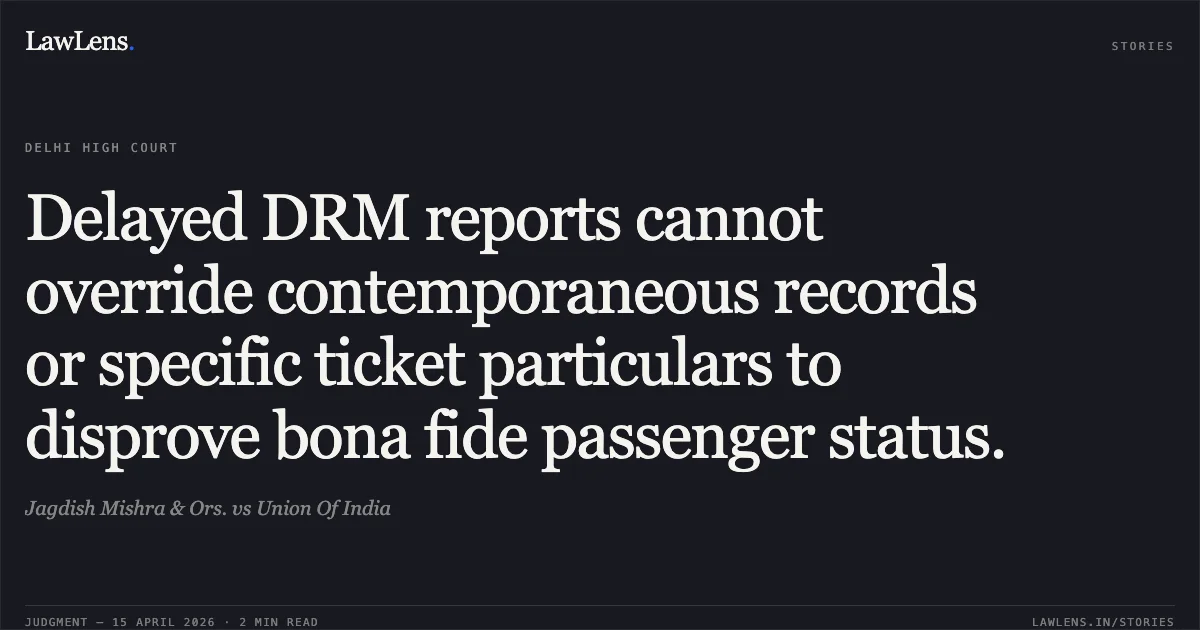
Source reference: p. 7, para 16Additionally, per Bhola vs. Union of India, a DRM report prepared after an inordinate delay (exceeding the 5-year record retention policy) lacks evidentiary value and cannot override contemporaneous records like the Station Master’s memo.
Source reference: p. 5-6, para 10-11Reasoning
The Court first condoned the 200-day delay, citing the beneficial nature of the legislation and the appellants' poverty.
Source reference: p. 2, para 4-5On the "untoward incident" issue, the Court found the Tribunal’s reliance on the DRM report flawed because it was prepared nine years after the incident, long after the five-year record-retention period had expired.
Source reference: p. 4, para 9The contemporaneous Station Master’s memo did not mention a "run-over" or trespass, making the Railway's later theory conjectural.
Source reference: p. 4, para 8Regarding the bona fide passenger status, the Court held that the appellants discharged their initial burden by providing specific ticket particulars and PNR details, which remained consistent throughout.
Source reference: p. 6, para 12The Court noted that the deceased had already travelled 300 km from the origin point when the body was found, and the Railways failed to produce any evidence (like the Train Signal Register) to rebut the claim or explain the passenger's presence on the track otherwise.
Source reference: p. 7, para 15-16Holding
The High Court set aside the Tribunal’s judgment, holding that the deceased was a bona fide passenger and the death resulted from an "untoward incident"
The Court allowed the appeal and remanded the matter to the Tribunal to assess and disburse compensation within two months of the order.
Source reference: p. 7, para 17-18The parties were directed to appear before the Tribunal on 30.04.2026.
Source reference: p. 8, para 17Acts & Sections Cited
1 provisions across 1 statute referred to in this judgment. Each provision opens on LawLens.
Railway Claims Tribunal Act, 19871
Original Court PDF
Jagdish Mishra & Ors.vsUnion Of India
Click to open original judgment
Original judgment, available to read, download and summarize on LawLens.in