Facts
Late Dharambir Singh, husband of the respondent, had worked as a casual labourer with Jawaharlal Nehru University and was appointed on an ad hoc basis with effect from 12 June 2001 after undergoing medical examination. He was subsequently appointed regularly on 19 October 2004 but died on 20 November 2004, approximately one month later.
Source reference: p.2, paras. 3, 6–7The respondent was granted compassionate appointment on 3 March 2005.
Source reference: p.2, para. 4In 2018, approximately fourteen years after her husband’s death, the respondent sought family pension and arrears. The University rejected her claim on 2 September 2019, stating that her husband had not undergone the requisite medical examination before his regular appointment. A further representation made in 2022 was rejected on 30 May 2022.
Source reference: p.2–3, para. 4The respondent challenged both communications in W.P.(C) No. 5455/2024. The learned Single Judge allowed the writ petition, relying on Clause 9 of Chapter XIII of the Handbook on Personnel Officers, 1987, and directed payment of family pension and arrears. The University preferred the present intra-court appeal.
Source reference: p.2, para. 2; p.3–5, paras. 5–8Issues
Whether the respondent was entitled to family pension notwithstanding that her deceased husband was not medically examined afresh at the time of his regular appointment?
Source reference: p.3–5, paras. 5–8Whether the respondent was entitled to arrears of family pension for the entire period from her husband’s death, or whether such arrears had to be restricted due to delay and laches?
Source reference: p.5–9, paras. 9–18Law Applied
The Court applied Clause 9(iv)(a) and the Note to Clause 9 of Chapter XIII of the Handbook on Personnel Officers, 1987, which provide that a person who has already undergone medical examination by an appropriate and recognised medical authority need not undergo a fresh examination at the time of appointment to a new post, irrespective of whether the previous employment was permanent, quasi-permanent, or temporary.
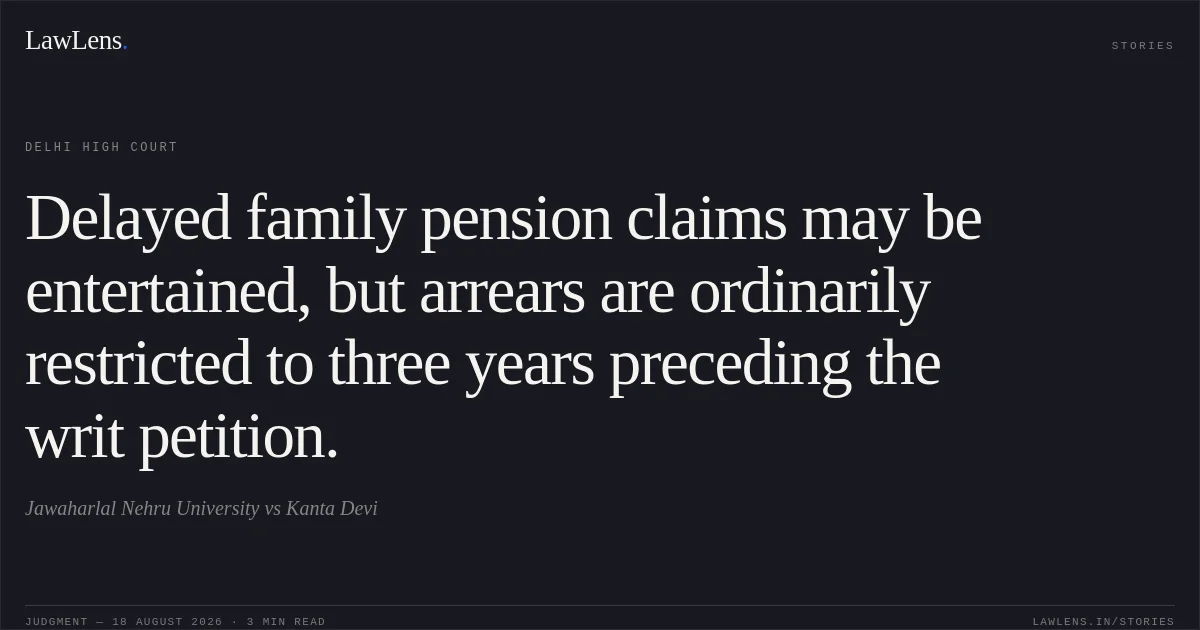
Source reference: p.3–4, para. 5The Court also relied on Union of India v. Tarsem Singh, (2008) 8 SCC 648, read with Shiv Dass v. Union of India, (2007) 9 SCC 274, holding that pension-related non-payment may constitute a continuing wrong, but arrears arising from recurring or successive wrongs should ordinarily be restricted to three years before the filing of the writ petition where the claim is belated.
Source reference: p.6–8, paras. 11–16Reasoning
The University had admitted in its counter-affidavit that Dharambir Singh underwent medical examination before his ad hoc appointment in 2001.
Source reference: p.4–5, paras. 6–7Applying Clause 9 of Chapter XIII, the Court held that a fresh medical examination was not necessary when he was subsequently appointed regularly. Consequently, the University could not deny family pension on the ground that no separate medical examination had been conducted before the regular appointment.
Source reference: p.5, para. 8However, the respondent had waited approximately fourteen years after her husband’s death before claiming family pension and had provided no reasonable explanation for the delay.
Source reference: p.5–6, paras. 10–11Although the underlying pension entitlement was not defeated because pension involves a continuing and recurring cause of action, Tarsem Singh required restriction of arrears to the period of three years preceding the filing of the writ petition. Since the writ petition was instituted on 8 April 2024, arrears could ordinarily be granted only from 8 April 2021.
Source reference: p.7–9, paras. 16–18Holding
The appeal was partly allowed. The Court upheld the respondent’s entitlement to family pension and rejected the University’s objection based on the absence of a fresh medical examination at the time of regular appointment.
However, modifying the Single Judge’s judgment, it directed that the respondent be paid monthly family pension from 31 July 2025, the date of the Single Judge’s judgment, while arrears were restricted to three years preceding the filing of the writ petition, i.e., from 8 April 2021.
Source reference: p.9, para. 18The appeal was disposed of without any order as to costs.
Source reference: p.9, para. 19Acts & Sections Cited
1 provisions across 1 statute referred to in this judgment. Linked provisions open on LawLens.
Handbook on Personnel Officers, 19871
Original Court PDF
Jawaharlal Nehru UniversityvsKanta Devi
Click to open original judgment
Original judgment, available to read, download and summarize on LawLens.in