Facts
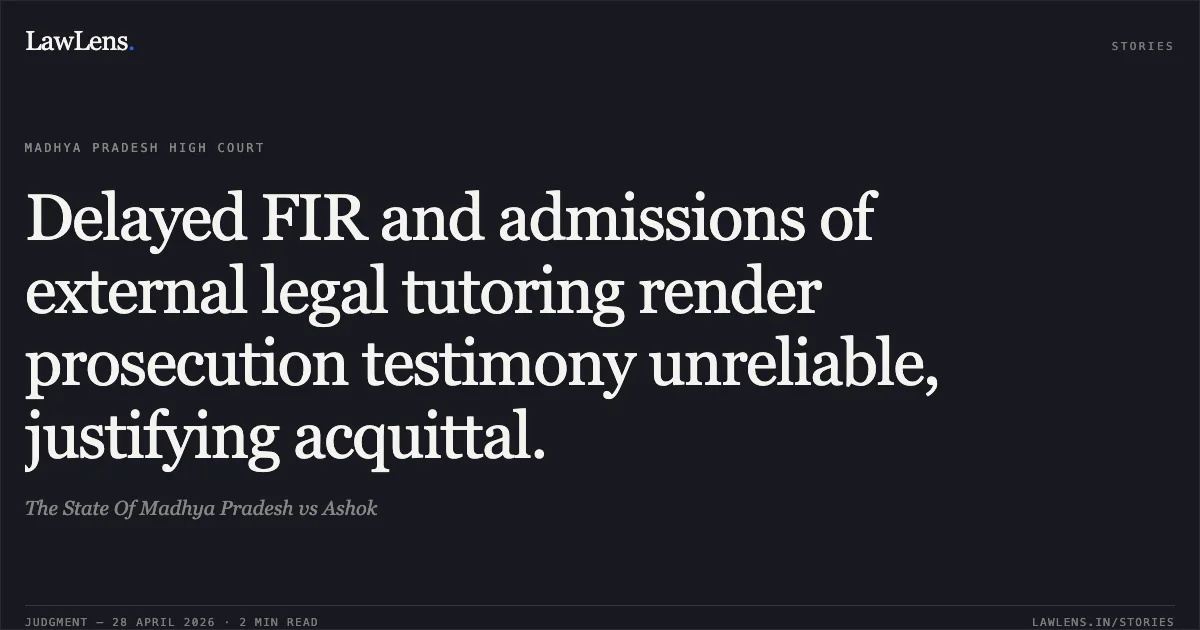
The State appealed against the judgment dated 13.05.2014 by the ACJM, Khandwa, which acquitted the respondents of assault charges
Source reference: para 1The prosecution alleged that on 14.06.2009, a dispute arose over an irrigation pipe, leading the respondents to assault Rupabai (PW-1) and Mohanlal (PW-2) with sticks
Source reference: para 2Although an "adam check" (non-cognizable report) was allegedly made on 16.06.2009, the formal FIR (Ex.P/10) was registered only on 18.07.2009—after a delay of over one month—following an X-ray report showing a fracture
Source reference: para 2, 10During the trial, the accused pleaded innocence, claiming false implication due to a land dispute
Source reference: para 3Issues
1. Whether the delay of one month and four days in lodging the FIR, coupled with the non-production of the original "adam check" report, is fatal to the prosecution's case?
Source reference: para 102. Whether the testimonies of the injured witnesses (PW-1 and PW-2) are reliable, given admissions of prior rivalry and legal tutoring?
Source reference: para 11-143. Whether the High Court should interfere with an order of acquittal when the Trial Court’s view is a "possible view"?
Source reference: para 18-22Law Applied
Section 378 of the Code of Criminal Procedure, 1973, regarding appeals against acquittal
Source reference: para 1Evidentiary principle that material contradictions and the possibility of "tutoring" negate the reliability of witnesses
Source reference: para 11Standards set by the Supreme Court in H.D. Sundara v. State of Karnataka (2023) and Babu Sahebagouda Rudragoudar v. State of Karnataka (2024), which mandate that an appellate court should not overturn an acquittal if the trial court’s view is "possible" and not "patently perverse," even if a second view exists
Source reference: para 18-19Reasoning
The Court found the prosecution's case highly doubtful due to the unexplained delay of 34 days in registering the FIR and the failure to produce the original preliminary report (adam check)
Source reference: para 10The Court noted significant admissions by PW-1 (Rupabai), who stated that her advocate drafted the report, she was coached on her testimony, and she filed a "false case" because the accused did not follow her directions
Source reference: para 11, 13Similarly, PW-2 admitted his statement was recorded 20 days late and that his testimony was read to him by an advocate prior to the hearing
Source reference: para 14The medical evidence failed to corroborate the exaggerated claims of PW-1 regarding the extent of her injuries (claims of her hand being cut)
Source reference: para 12Consequently, the Court held that the Trial Court rightly identified these material contradictions and previous enmities as grounds for doubt
Source reference: para 17Holding
The High Court answered the issues in the negative, holding that the prosecution failed to establish guilt beyond a reasonable doubt
The Court affirmed that the acquittal reinforced the presumption of innocence and that the Trial Court's findings were neither perverse nor illegal. The appeal was dismissed, and the acquittal of the respondents was upheld
Source reference: para 22, 23Acts & Sections Cited
2 provisions across 1 statute referred to in this judgment. Each provision opens on LawLens.
Code of Criminal Procedure, 19732
Original Court PDF
The State Of Madhya PradeshvsAshok
Click to open original judgment
Original judgment, available to read, download and summarize on LawLens.in