Facts
The Appellant, representing HT consumers in Jharkhand, challenged the Jharkhand State Electricity Regulatory Commission’s (JSERC) Impugned Order dated 19.04.2017
Source reference: p. 3This order determined the True-up for Damodar Valley Corporation (DVC) for FY 2006-07 to 2013-14 and the Annual Performance Review for FY 2014-15
Source reference: p. 2The Appellant contended that JSERC erred by: (a) restricting Non-Tariff Income (NTI) to Delayed Payment Surcharge (DPS) only; (b) allowing Unscheduled Interchange (UI) charges as power purchase costs; and (c) allowing recovery of Water and Pollution Cess in the distribution ARR despite being generation-related expenses
Source reference: p. 4DVC is a vertically integrated utility where generation/transmission is regulated by CERC and distribution in Jharkhand by JSERC
Source reference: p. 6Issues
1. Whether JSERC erred in restricting the "Non-Tariff Income" (NTI) of DVC’s distribution business to only Delayed Payment Surcharge (DPS)
Source reference: p. 5 / para. 82. Whether Unscheduled Interchange (UI) charges, including alleged penal charges, are permissible as part of power purchase costs in the ARR
Source reference: p. 5 / para. 83. Whether Water and Pollution Cess, typically linked to generation, can be recovered through the distribution business ARR
Source reference: p. 5 / para. 8Law Applied
Regulation 21.1 of the JSERC (Terms and Conditions for Determination of Thermal Generation Tariff) Regulations, 2004, and Regulation 6.49 of the 2010 Regulations regarding NTI
Source reference: p. 5-9Availability Based Tariff (ABT) mechanism and CERC (Unscheduled Interchange Charges and related matter) Regulations, 2012, which distinguish between normal UI charges and "Additional UI Charges" (penalties)
Source reference: p. 15-21Central Power Distribution Co. v. CERC (2007) regarding UI as a grid discipline mechanism
Source reference: p. 22The Tribunal’s own judgment in DVC v. JSERC (Appeal 227 of 2025) which finalized the NTI scope for DVC
Source reference: p. 11-13Section 61 of the Electricity Act, 2003 was applied to balance consumer interest with cost recovery
Source reference: p. 26Reasoning
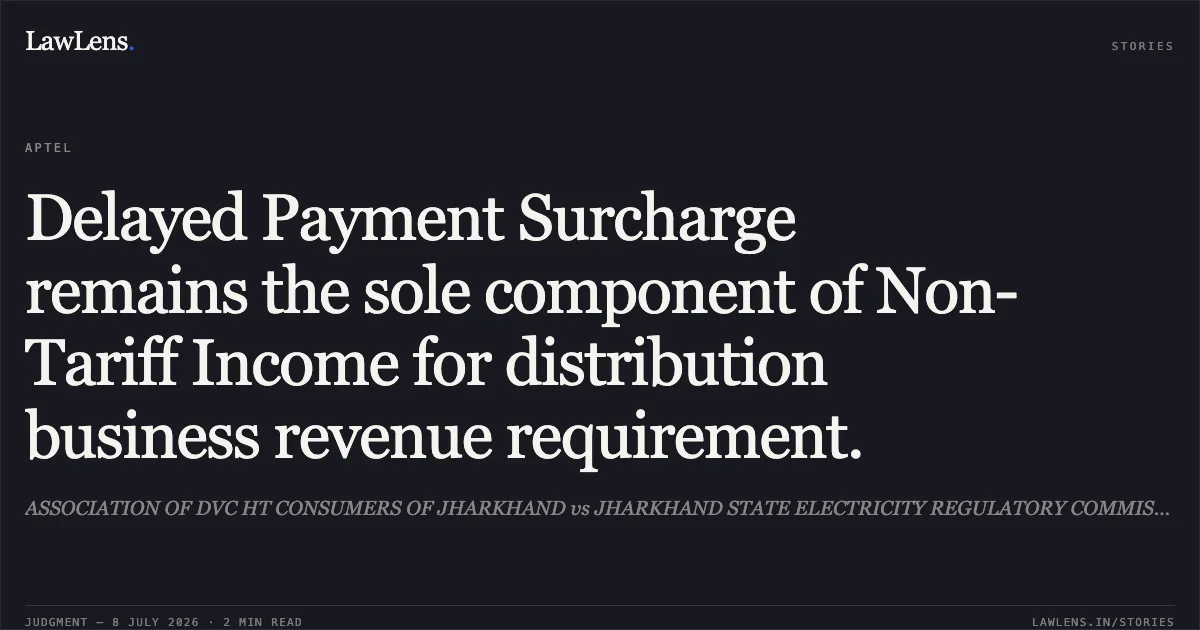
Regarding NTI, the Tribunal followed its recent specialized ruling in Appeal 227 of 2025, noting that since DVC’s network is structurally distinct (33kV and above), only DPS qualifies as NTI incidental to the distribution business; other income heads pertain to generation/transmission or non-regulated assets
Source reference: p. 12-13On the UI issue, the Tribunal found that UI is a regulatory balancing mechanism, not a "planned procurement," and is an inherent feature of grid operations
Source reference: p. 18Because the Appellant failed to prove that the UI charges allowed were "Additional UI Charges" (penalties for frequency violations), they were deemed legitimate commercial settlements under the ABT framework
Source reference: p. 22-23For the Water and Pollution Cess, the Tribunal noted these are statutory levies not recovered through CERC’s generation tariff; hence, allowing them in the distribution ARR prevents a "recovery gap" and does not constitute double recovery
Source reference: p. 25-26The Tribunal also emphasized that methodology settled in earlier MYT orders (which attained finality) cannot be altered at the True-up stage
Source reference: p. 26-27Holding
The Tribunal dismissed the appeal and upheld the JSERC’s Impugned Order dated 19.04.2017. It held that: (1) NTI for DVC's distribution business is correctly limited to DPS; (2) normal UI charges are legitimate components of power purchase costs and were not proven to be penal; and (3) Water and Pollution Cess are statutory costs recoverable in the ARR as they were not included in the generation tariff.
The appeal was found to be devoid of merit
Source reference: p. 28Acts & Sections Cited
2 provisions across 1 statute referred to in this judgment. Each provision opens on LawLens.
Electricity Act, 20032
Original Court PDF
ASSOCIATION OF DVC HT CONSUMERS OF JHARKHANDvsJHARKHAND STATE ELECTRICITY REGULATORY COMMISSION
Click to open original judgment
Original judgment, available to read, download and summarize on LawLens.in