Facts
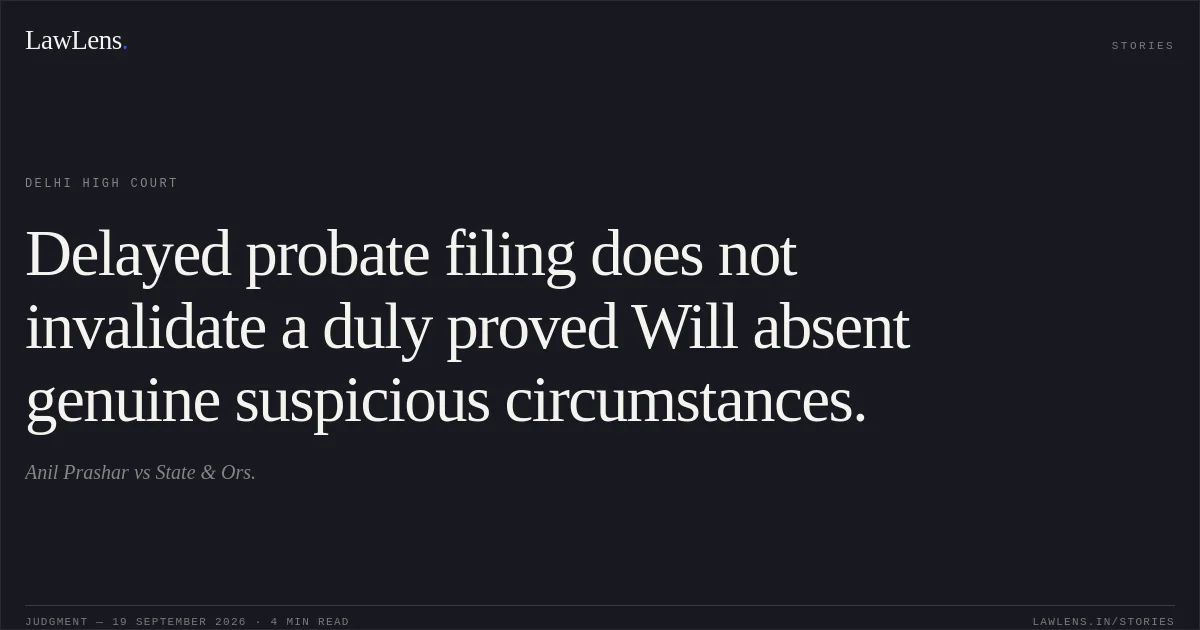
The appellant, Anil Prashar, challenged the judgment dated 02.09.2008 by which the Probate Court granted probate of a Will dated 09.11.1984 executed by Manohar Lal Sharma under Section 276 of the Indian Succession Act, 1925.
Source reference: p.1–2The testator died on 20.12.1984, leaving behind his widow, three sons—including the appellant and respondents nos. 2 and 3—and a daughter. The Will distributed different portions of the testator’s property among his three sons and appointed them executors.
Source reference: p.1–2The appellant denied the execution and genuineness of the Will, alleged forgery of the signatures, challenged the testator’s testamentary capacity, and asserted non-compliance with Section 63 of the Succession Act.
Source reference: p.2–4The respondents relied principally on the testimony of Capt. Uma Rani Kaushik, the surviving attesting witness, and on contemporaneous mutation records and a family settlement acknowledging the Will.
Source reference: p.4–5, 7–9The appellant also sought to lead additional evidence, including documents for examination by a handwriting expert, but the Probate Court rejected the application after granting several opportunities.
Source reference: p.10–12Issues
1. Whether the Will dated 09.11.1984 was duly executed and attested in compliance with Section 63 of the Indian Succession Act and proved under Section 68 of the Evidence Act.
Source reference: p.5–72. Whether the alleged suspicious circumstances—including the delay in seeking probate, the distribution of property, the testator’s health, absence of a medical fitness certificate, and disputed signatures—rendered the Will unreliable.
Source reference: p.7–103. Whether the appellant was entitled to produce additional evidence under Order XLI Rule 27 CPC, despite having failed to produce the material before the Probate Court and despite the rejection of his earlier application having attained finality.
Source reference: p.10–12Law Applied
The Court applied Section 299 of the Indian Succession Act, 1925, governing appeals from probate orders, and Sections 276 and 63(c), which concern the grant of probate and the formal requirements of execution and attestation of a Will.
Source reference: p.1, 6Under Section 63(c), each attesting witness must sign the Will in the presence of the testator, while Section 68 of the Indian Evidence Act requires examination of at least one attesting witness to prove execution where attestation is legally required.
Source reference: p.6–7The Court further applied the principle that suspicious circumstances surrounding a Will must be satisfactorily explained, but that delay in seeking probate is not by itself fatal where no statutory limitation period applies and the surrounding circumstances explain the delay.
Source reference: p.7–8It also applied Order XLI Rule 27 CPC, under which additional evidence may be admitted only where the trial court improperly refused relevant evidence, where the evidence could not despite due diligence have been produced earlier, or where the appellate court requires it to pronounce judgment or for another substantial cause.
Source reference: p.11–12The Court distinguished Renu Jain & Ors. v. Kamla Vati Jain & Ors., 2019:DHC:2574, on the basis that the attesting witness in that case had not witnessed the testator’s signature or the other attesting witness’s signature, unlike the evidence in the present case.
Source reference: p.6–7Reasoning
The Court found that PW-3 had clearly testified that the testator signed the Will in her presence, followed by the signatures of Smt. Kamla Devi and PW-3, and had identified all three signatures.
Source reference: p.5–7The fact that the advocate asked PW-3 to sign did not invalidate the attestation because the statutory requirement was satisfied by her signing in the testator’s presence.
Source reference: p.5–7The alleged suspicious circumstances were held insufficient: the delay was explained by the family’s decision not to initiate probate during the widow’s lifetime, the sons were already in possession of their respective portions, and there was no prescribed limitation period for seeking probate.
Source reference: p.7–8The appellant’s prior conduct—including acknowledging the Will in mutation proceedings and a family settlement, while later denying even his own signatures—undermined his challenge.
Source reference: p.8–9The Court also held that the testator’s asthma and physical weakness did not establish lack of testamentary capacity, and the absence of a medical fitness certificate was not decisive in light of PW-3’s positive testimony and the contemporaneous letter indicating the testator’s mental clarity.
Source reference: p.9–10Finally, the appellant had been granted repeated opportunities to produce the documents sought for handwriting comparison, failed to take the required steps, and did not satisfy the due-diligence or necessity requirements of Order XLI Rule 27 CPC.
Source reference: p.10–12Holding
The Court held that the Will dated 09.11.1984 had been duly executed and proved through the surviving attesting witness, that the alleged suspicious circumstances and objections regarding testamentary capacity and signatures were not established, and that the appellant was not entitled to lead additional evidence at the appellate stage.
The application for additional evidence was dismissed, the Probate Court’s judgment dated 02.09.2008 was upheld, and the appeal was dismissed.
Source reference: p.12Acts & Sections Cited
4 provisions across 2 statutes referred to in this judgment. Each provision opens on LawLens.
Indian Succession Act, 19253
Code of Civil Procedure, 19081
Original Court PDF
Anil PrasharvsState & Ors.
Click to open original judgment
Original judgment, available to read, download and summarize on LawLens.in