01Facts
The complainant challenged the cancellation of her appointment as Assistant Professor after she failed to obtain a caste Validity Certificate within the required time.
In the writ petition, the High Court quashed the cancellation and the University’s refusal to reinstate her, directing the University to reinstate her and extend continuity of service and other benefits, excluding arrears of salary.
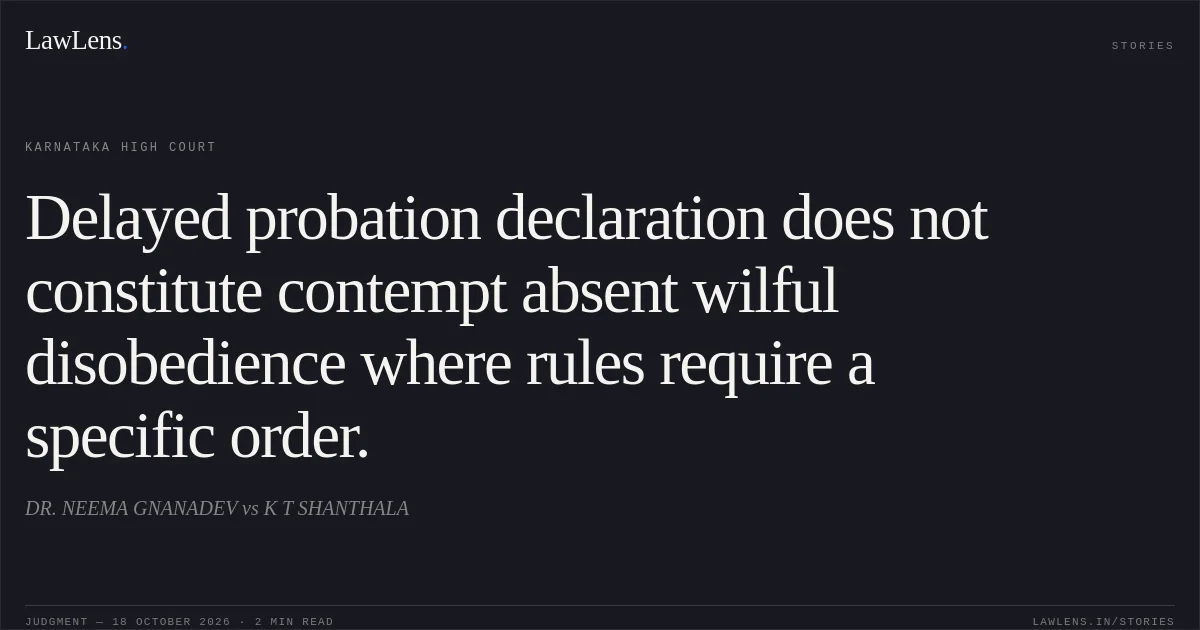
pp. 2–4The complainant later initiated contempt proceedings, alleging that the Registrar had failed to declare her probation satisfactorily completed.
pp. 4–6The University stated that a specific order was required under Rule 5 of the Karnataka Civil Services (Probation) Rules, 1977, that the complainant remained on probation, and that disciplinary charges had been approved by the Syndicate.
pp. 4–6The University had reinstated her as Associate Professor and was providing salary and other monetary and academic benefits.
p. 702Issues
i.1. Whether the Registrar’s failure to declare the complainant’s probation satisfactorily completed constituted wilful disobedience of the writ and review orders.
pp. 4–7ii.2. Whether the complainant could be treated as having satisfactorily completed probation in the absence of a specific order under Rule 5 of the Karnataka Civil Services (Probation) Rules, 1977.
pp. 5–603Law Applied
Sections 11 and 12 of the Contempt of Courts Act, 1971, under which the petition sought contempt proceedings, concern the High Court’s power to punish contempt.
p. 1Rule 5 of the Karnataka Civil Services (Probation) Rules, 1977, requires the appointing authority to assess a probationer’s suitability and issue a specific order declaring satisfactory completion; delay in issuing such an order does not deem probation satisfactorily completed.
pp. 5–6The Court applied the requirement that contempt be established by wilful disobedience of the court’s order.
p. 4, 7Provisions in the judgment · 2 · Linked ones open on LawLens
Contempt of Courts Act, 1971 Section 11Section 12
04Reasoning
The writ order directed reinstatement and specified continuity of service and other benefits, but the Court found no basis to treat it as requiring an automatic declaration of satisfactory completion of probation.
pp. 3–4, 7Rule 5 expressly required a specific order and excluded deemed completion through delay; the University’s position that the complainant remained on probation was therefore consistent with that rule.
pp. 5–6The Court also noted that she had been reinstated, was receiving salary and other benefits, and had not alleged that academic benefits due to her as a probationer were withheld.
p. 7In those circumstances, the Registrar’s conduct did not establish wilful disobedience.
p. 705Holding
The Court held that wilful disobedience of the writ or review order had not been established.
p. 7It discharged the accused and consigned the contempt petition.
p. 7Original Court PDF
DR. NEEMA GNANADEVvsK T SHANTHALA
Click to open original judgment
Original judgment, available to read, download and summarize on LawLens.in