Facts
Appellant No. 1 appeared in NEET-UG 2026 conducted by the National Testing Agency (“NTA”) on 21 June 2026.
Source reference: p.2Question No. 150 concerned the correctness of four statements regarding reabsorption in Henle’s loop. The provisional answer key treated Option 3—statements (a), (b) and (d) only—as correct, whereas Appellant No. 1 had selected Option 2—statements (a), (b) and (c) only).
Source reference: p.2The appellant challenged the answer key by relying on NCERT material, standard medical textbooks and an opinion of Dr. Yogesh Singh, Professor of Physiology, AIIMS Rishikesh.
Source reference: no citationThe NTA’s subject experts considered the objections and retained Option 3 in the final answer key.
Source reference: pp.3, 9–10Appellant No. 1 obtained 695/720 marks and All India Rank 65.
Source reference: p.3The learned Single Judge dismissed the writ petition, holding that the appellants had failed to establish a manifest error in the experts’ determination.
Source reference: p.3The present intra-court appeal challenged that decision.
Source reference: no citationIssues
1. Whether the NTA’s adoption of Option 3 as the correct answer to Question No. 150 was manifestly and palpably erroneous because Statement (c)—“Reabsorption of Na+ and water takes place in Henle’s loop”—was scientifically correct.
Source reference: pp.11–14, paras. 6–152. Whether the Court should obtain an independent expert opinion or interfere with the final answer key despite its having been reviewed by the NTA’s subject experts.
Source reference: pp.12–14, paras. 7, 11–173. Whether the learned Single Judge erred in declining to interfere with the NEET-UG 2026 result and final answer key.
Source reference: pp.14–15, paras. 17–19Law Applied
The Court applied the settled principle that an examination answer key is presumed correct and may be judicially interfered with only where the alleged error is manifest, palpable and demonstrable—so evident that no reasonable body of subject experts would regard the answer as correct.
Source reference: p.12, para. 8An answer cannot be held erroneous merely through inferential reasoning, rationalisation or competing academic interpretation.
Source reference: pp.10–12, paras. 4.5–4.6, 8The Court relied on the principles in Ran Vijay Singh v. State of U.P., AIR 2018 SC 52, and National Board of Examination v. Association of MD Physicians, 2022:DHC:2971-DB, that courts should presume the correctness of the key and, in case of doubt, extend the benefit to the examination authority.
Source reference: pp.10–12, paras. 4.5–4.6, 8It further applied the rule that, absent mala fides, academic evaluation and the determination of correct answers should ordinarily be left to subject experts.
Source reference: p.13, para. 12The constitution of an independent expert committee is discretionary and depends on the facts of each case.
Source reference: p.14, para. 16Reasoning
The Court held that the appellants had not discharged the burden of proving a manifest and palpable error.
Source reference: no citationThe opinion of Dr. Singh stated that all four statements were correct; consequently, it did not establish that Option 2 was the correct answer and instead suggested that none of the options was fully accurate.
Source reference: p.12, para. 10The appellants’ reliance on the expression “only” in Option 3 depended upon first establishing, through scientific inference and reasoning, that Statement (c) was correct.
Source reference: no citationSince that conclusion was not shown to be indisputable or demonstrable without rationalisation, the Court declined to invalidate the NTA’s answer.
Source reference: pp.13–14, paras. 14–15The objection had already been considered by a panel of subject experts, and no mala fides were alleged against them.
Source reference: p.13, para. 12The absence of a detailed expert report or scientific analysis from the NTA did not, in the Court’s view, overcome the presumption supporting the final answer key, particularly where the appellants’ case itself involved a debatable academic interpretation.
Source reference: pp.12–14, paras. 11–16Accordingly, the circumstances did not justify obtaining an independent expert opinion or substituting the Court’s view for that of the academic experts.
Source reference: p.14, para. 16Holding
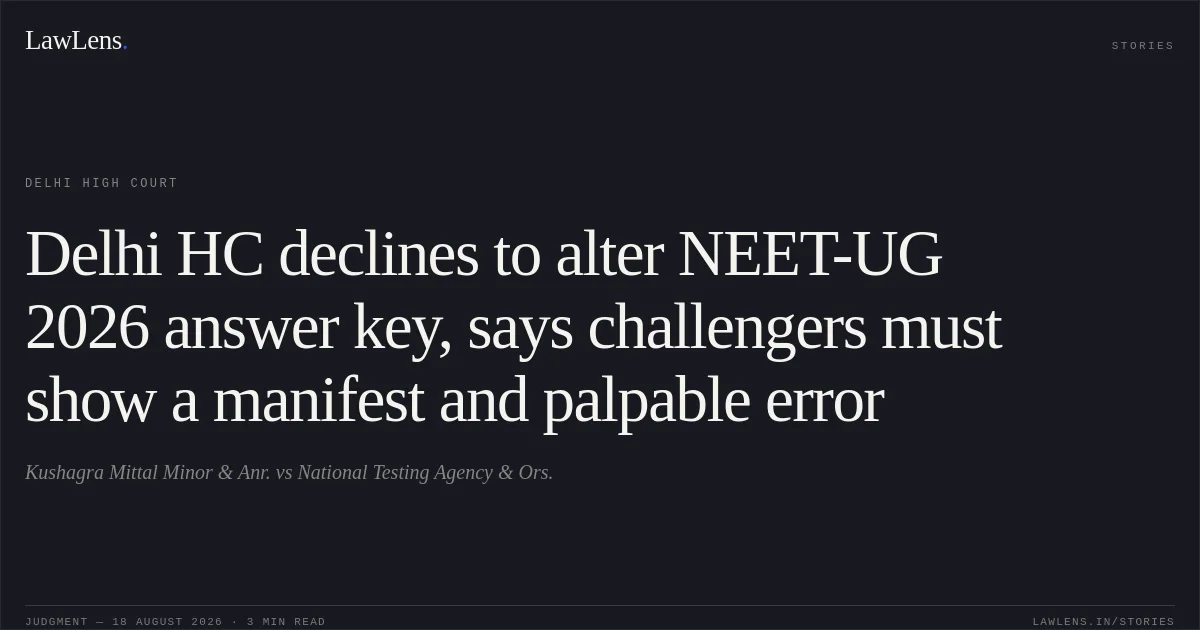
The Division Bench held that the appellants failed to establish that Option 3 in the final answer key for Question No. 150 was manifestly or palpably erroneous.
The learned Single Judge was correct in declining judicial intervention in the examination process.
Source reference: pp.14–15, paras. 17–18The appeal was dismissed, the challenge to the NEET-UG 2026 result and final answer key was rejected, and the pending applications were also disposed of without any order as to costs.
Source reference: p.15, para. 19Acts & Sections Cited
1 provisions across 1 statute referred to in this judgment. Linked provisions open on LawLens.
the Act (alias, unresolved)1
Original Court PDF
Kushagra Mittal Minor & Anr.vsNational Testing Agency & Ors.
Click to open original judgment
Original judgment, available to read, download and summarize on LawLens.in