Facts
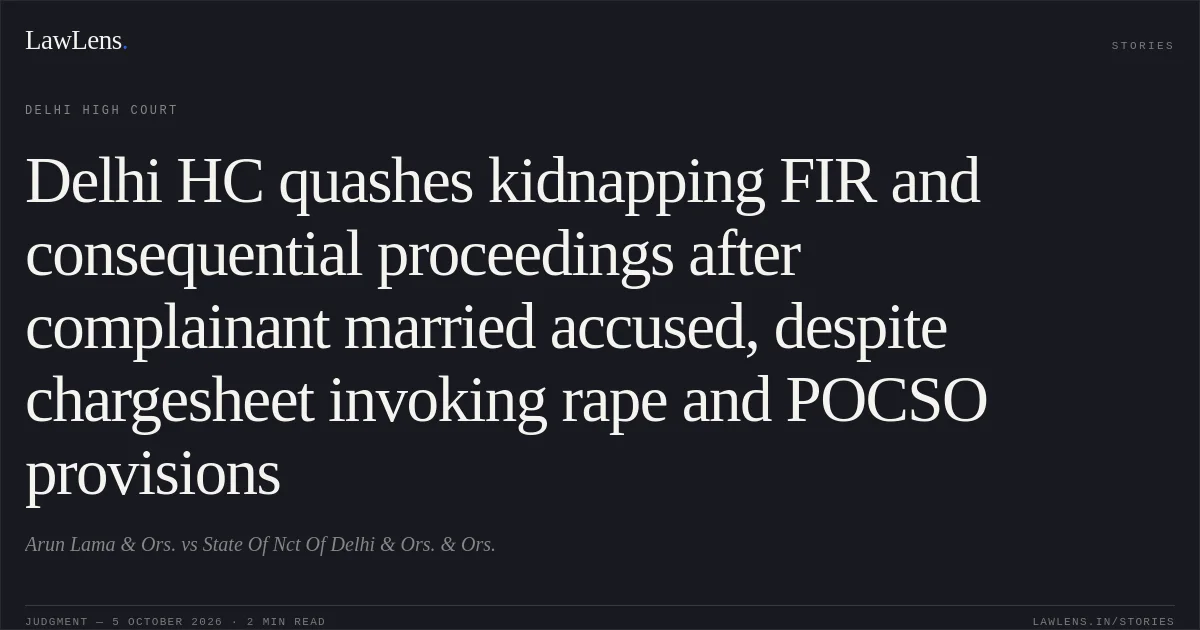
The petitioners sought quashing under Section 528 of the Bharatiya Nagarik Suraksha Sanhita, 2023 (“BNSS”), of FIR No. 250/2022, registered under Section 363 IPC, and consequential proceedings, on the basis of a settlement.
Source reference: p. 1, para. 1The FIR was lodged by respondent no. 2 after his minor daughter, respondent no. 3, left home on 29 April 2022; the investigation indicated that she had left voluntarily and was in a consensual relationship with petitioner no. 1.
Source reference: p. 2, paras. 4.2–4.3A chargesheet was filed charging petitioner no. 1 under Sections 363/376 IPC and Sections 6/21 of the POCSO Act, and petitioners nos. 2–4 under Section 21 of the POCSO Act.
Source reference: p. 2, para. 3Respondent no. 3 later married petitioner no. 1, and they had a child; the parties executed an MoU on 14 July 2026 resolving their disputes and agreeing to cooperate in closing the proceedings.
Source reference: pp. 2–3, paras. 4.4–5The parties appeared before the Court, and respondent no. 3 confirmed that she was happily married and living with petitioner no. 1.
Source reference: p. 3, paras. 6–10Issues
1. Whether the High Court should exercise its inherent jurisdiction under Section 528 BNSS to quash the FIR and consequential proceedings on the basis of settlement and subsequent marriage, despite the chargesheet alleging offences under the IPC and the POCSO Act.
Source reference: pp. 1–2, paras. 1, 3; pp. 5–6, paras. 14–172. Whether continuation of the criminal proceedings would serve the ends of justice or instead adversely affect the parties’ married life and their child’s well-being.
Source reference: p. 6, paras. 16–17Law Applied
Section 528 BNSS preserves the High Court’s inherent power to prevent abuse of process or secure the ends of justice; the power may be exercised to quash proceedings even where the alleged offence is non-compoundable, but the Court must consider the nature and gravity of the offence and the circumstances of the case (*Parbatbhai Aahir v. State of Gujarat*, (2017) 9 SCC 641).
Source reference: pp. 3–5, paras. 11–12The judgment notes that serious offences, including rape, ordinarily should not be quashed merely because the parties have settled, given their impact on society.
Source reference: p. 4, para. 12, proposition 16.6It also relies on *Ayyub Malik v. State of Uttarakhand*, 2026 SCC OnLine SC 637, which held that, in its particular circumstances, the parties’ subsequent marriage and settled life could outweigh the need to continue criminal proceedings.
Source reference: pp. 5–6, para. 14Reasoning
The Court treated the parties’ settlement, respondent no. 3’s confirmation that the relationship and marriage were voluntary, their continuing married life, and the presence of a child as the circumstances supporting quashing.
Source reference: pp. 3, paras. 5–10; p. 6, paras. 15–16Applying the ends-of-justice approach and relying on *Ayyub Malik*, it concluded that continuing the proceedings would adversely affect respondent no. 3’s married life and the child’s well-being.
Source reference: p. 6, paras. 14–17Although the chargesheet included allegations under Section 376 IPC and the POCSO Act, the Court allowed the petition and quashed the FIR and consequential proceedings.
Source reference: pp. 2, para. 3; pp. 6–7, paras. 17–19Holding
The High Court allowed the petition and quashed FIR No. 250/2022, registered at PS Inder Puri under Section 363 IPC, together with all consequential proceedings.
The parties were directed to remain bound by the terms of the MoU dated 14 July 2026, and the petition and pending applications were disposed of.
Source reference: p. 7, paras. 19–20Acts & Sections Cited
7 provisions across 4 statutes referred to in this judgment. Each provision opens on LawLens.
Bharatiya Nagarik Suraksha Sanhita, 20231
Indian Penal Code, 18602
Protection of Children from Sexual Offences Act, 20122
Code of Criminal Procedure, 19732
Original Court PDF
Arun Lama & Ors.vsState Of Nct Of Delhi & Ors. & Ors.
Click to open original judgment
Original judgment, available to read, download and summarize on LawLens.in