Facts
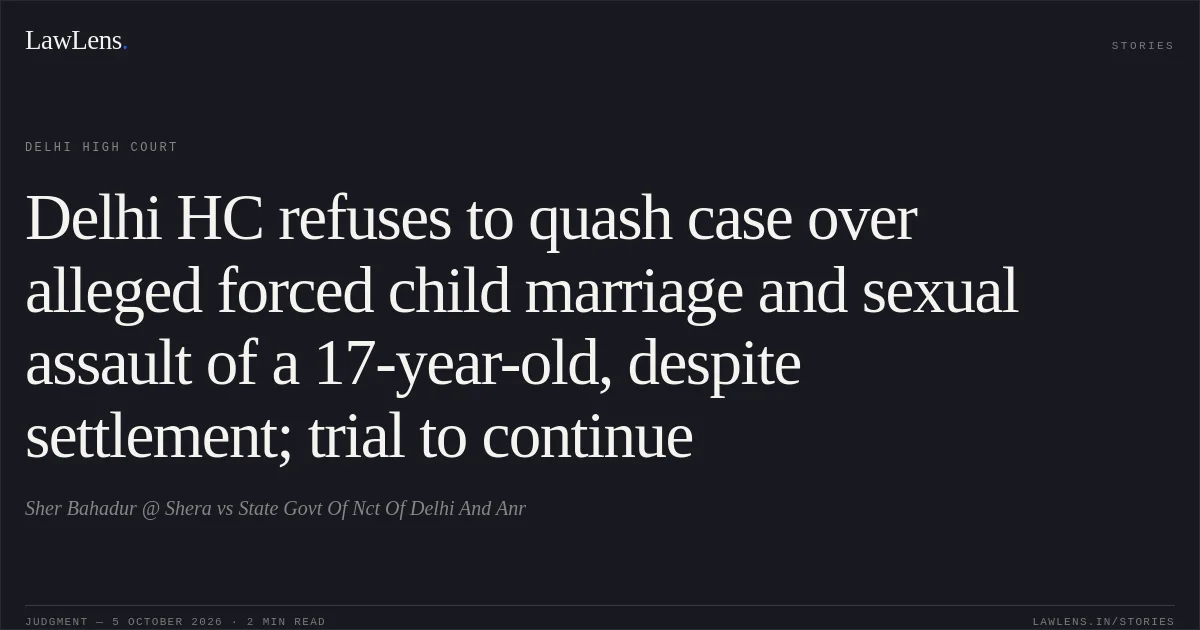
The petitioner sought to quash FIR No. 152/2019, registered under Sections 363, 366A and 376 of the IPC, Section 6 of the POCSO Act, and Sections 9 and 11 of the Prohibition of Child Marriage Act, together with the consequential proceedings, on the basis of a settlement with respondent no. 2.
Source reference: p. 1, para. 1The FIR alleged that respondent no. 2, then approximately 17 years old, married the petitioner on 8 March 2019, was taken to Ghaziabad, and was compelled to have physical relations with him; she approached the police on 12 March 2019.
Source reference: pp. 2–3, paras. 4.1–4.6A chargesheet was filed, and the petitioner was charged under the FIR provisions and Section 506 IPC. The petitioner submitted that the parties had since married and were living together; respondent no. 2 appeared before the Court.
Source reference: pp. 1–3, paras. 2, 3, 5Issues
1. Whether the FIR and consequential criminal proceedings could be quashed under Section 528 BNSS on the basis of the parties’ settlement, despite the charges involving alleged offences against a minor under the POCSO Act and the Prohibition of Child Marriage Act.
Source reference: pp. 1, 6–8, paras. 1, 9–172. Whether continuation of the prosecution was required by the gravity of the allegations and the public interest in enforcing those protective statutes.
Source reference: pp. 7–8, paras. 10–16Law Applied
Section 528 BNSS, corresponding to Section 482 CrPC, preserves the High Court’s inherent power to prevent abuse of process or secure the ends of justice, including in appropriate cases involving non-compoundable offences.
Source reference: pp. 3–7, paras. 7–9Under Gian Singh v. State of Punjab, (2012) 10 SCC 303, and Parbatbhai Aahir v. State of Gujarat, (2017) 9 SCC 641, the power to quash on settlement depends on the facts and the nature and gravity of the offence; serious and heinous offences, including rape and offences affecting society, ordinarily cannot be quashed merely because the parties have settled.
Source reference: pp. 3–7, paras. 7–9Relying on Ramji Lal Bairwa v. State of Rajasthan, (2025) 5 SCC 117, the Court stated that POCSO proceedings should not ordinarily be terminated on settlement, absent extremely compelling circumstances such as an ex facie mala fide prosecution.
Source reference: pp. 3–7, paras. 7–9The POCSO Act and the Prohibition of Child Marriage Act serve protective purposes that cannot be displaced by a private compromise.
Source reference: pp. 7–8, paras. 13–15Reasoning
The Court considered the allegations and chargesheet, including that respondent no. 2 was approximately 17 at the time of the marriage and that the petitioner was 38, creating an age gap of approximately 20 years.
Source reference: pp. 3, 7–8, paras. 6, 10–11It also noted that respondent no. 2 approached the police at the first available opportunity.
Source reference: p. 8, para. 12Given the alleged sexual exploitation of a minor and the child marriage, the Court treated the case as involving grave offences with societal consequences, rather than a private dispute.
Source reference: pp. 7–8, paras. 9–16Applying the principles in Gian Singh, Parbatbhai Aahir and Ramji Lal Bairwa, it held that the subsequent settlement and the parties’ living together did not overcome the public interest in continuing the prosecution.
Source reference: pp. 7–8, paras. 9–16Holding
The Court answered the quashing issue in the negative and dismissed the petition.
It declined to quash FIR No. 152/2019 or the consequential proceedings, holding that settlement could not justify terminating the prosecution in the circumstances alleged. The trial was directed to continue.
Source reference: p. 8, paras. 17–19Acts & Sections Cited
10 provisions across 5 statutes referred to in this judgment. Each provision opens on LawLens.
Bharatiya Nagarik Suraksha Sanhita, 20231
Code of Criminal Procedure, 19732
Indian Penal Code, 18603
Prohibition of Child Marriage Act, 20062
Original Court PDF
Sher Bahadur @ SheravsState Govt Of Nct Of Delhi And Anr
Click to open original judgment
Original judgment, available to read, download and summarize on LawLens.in