01Facts
The respondents brought a partition suit concerning a property purchased in the name of their deceased mother.
On 9 February 2011, the Trial Court passed a preliminary decree declaring seven family members entitled to equal shares and directing payment of construction expenses.
¶ 6–10, 19In May 2012, respondent no. 5 conveyed the property to the appellant, who entered appearance in the suit and was later impleaded.
¶ 21–29On 5 February 2018, the Trial Court framed an additional issue as to whether the appellant was a bona fide purchaser. After the appellant failed to appear and lead evidence, the Trial Court closed the defendants’ evidence on 27 February 2018, passed a further preliminary decree on 7 April 2018, and made the decrees final on 8 May 2018.
¶ 21–29The appellant challenged the orders and decrees, arguing that she had not received a proper opportunity to lead evidence and that her non-appearance was due to an incorrectly noted hearing date.
¶ 35–3902Issues
i.1. Whether the appellant established sufficient cause for her repeated non-appearance and for setting aside the Trial Court’s orders closing evidence and proceeding to decree the suit.
¶ 36–38, 54–57ii.2. Whether the appellant’s purchase, made after the preliminary partition decree while the suit remained pending, was subject to the decree under the doctrine of lis pendens.
¶ 40–42, 61–64iii.3. Whether the appellant could dispute the matters determined by the first preliminary decree when she had not challenged it.
¶ 42, 63–6503Law Applied
Under Section 52 of the Transfer of Property Act, 1882, a transfer of property during the pendency of litigation concerning rights in that property is subject to the rights ultimately declared in the litigation; the transferee’s bona fides do not displace the doctrine of lis pendens.
¶ 61–63 · Shingara Singh v. Daljit Singh, 2024 INSC 770Under G.P. Shrivastava v. R.K. Raizada, (2000) 3 SCC 54, a court may set aside an ex parte decree where sufficient cause for non-appearance is shown, construed liberally to advance justice, provided the absence was not mala fide or intentional.
¶ 56A preliminary decree is conclusive as to the matters it determines unless challenged through the procedures provided by law; Section 97 CPC precludes a party who did not appeal a preliminary decree from disputing its correctness in an appeal from the final decree.
¶ 65 · Venkata Reddy v. Pethi Reddy, 1962 SCC OnLine SC 320Provisions in the judgment · 5 · Linked ones open on LawLens
Code of Civil Procedure, 1908 Section 96Section 151Section 97
Transfer of Property Act, 1882 Section 41Section 52
04Reasoning
The appellant had notice of the proceedings and had been represented when the Trial Court recorded that transfer or consolidation of related suits had failed. She nevertheless did not appear on multiple subsequent dates, including when the additional issue concerning her purchase was framed and when evidence was closed; the Court found that she offered no sufficient cause for those absences.
¶ 52–57The Court also rejected reliance on pending transfer proceedings: the relevant petitions had been dismissed before the further preliminary decree, and the appellant had not taken the required steps in the remaining petition.
¶ 58–60Because the appellant purchased the property after the 2011 preliminary decree, her title remained subject to that decree under Section 52 TPA, regardless of whether she was a bona fide purchaser.
¶ 61–63She had also failed to challenge the first preliminary decree, which conclusively determined the parties’ shares.
¶ 64–6505Holding
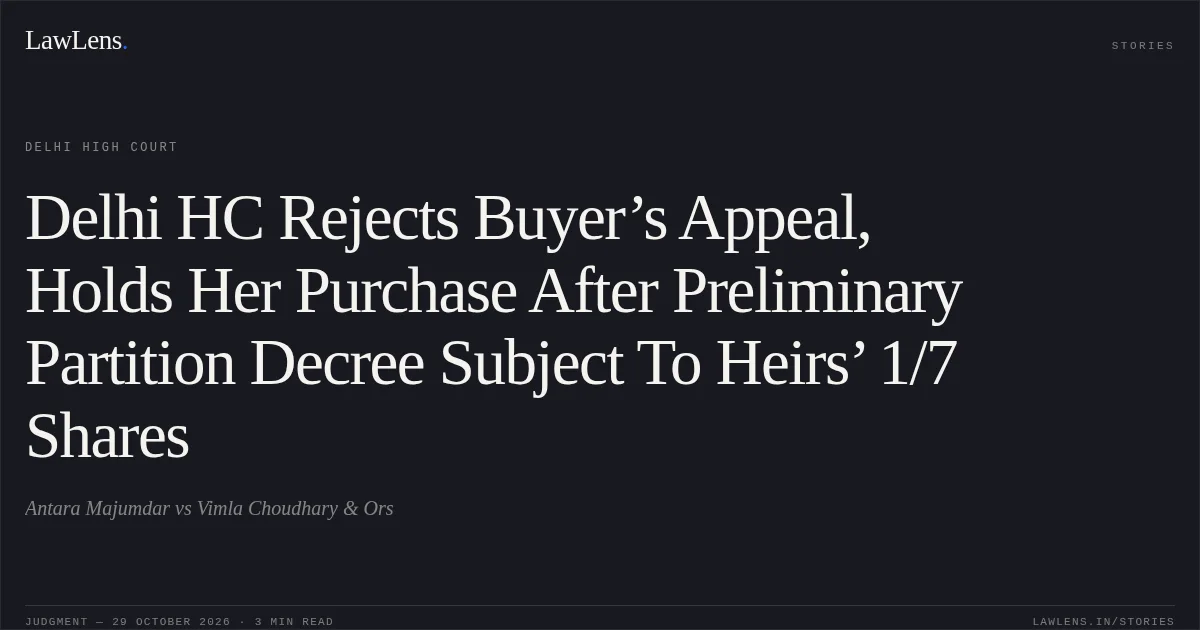
The High Court held that the appellant had shown no sufficient cause for her non-appearance, that her purchase was subject to the preliminary decree under the doctrine of lis pendens, and that she could not reopen the unchallenged determination of shares.
¶ 61–66The appeal was dismissed, and pending applications were disposed of.
¶ 67–68Original Court PDF
Antara MajumdarvsVimla Choudhary & Ors
Click to open original judgment
Original judgment, available to read, download and summarize on LawLens.in